
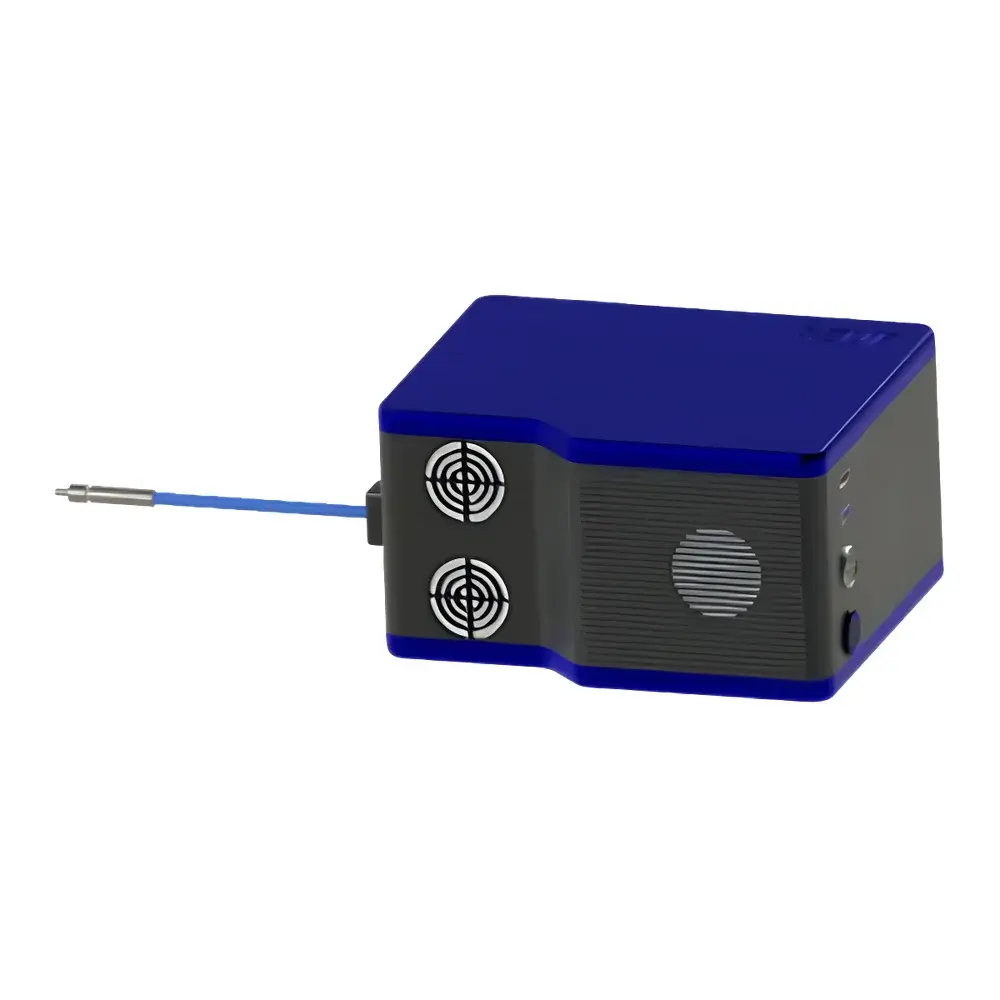
AZUP ASR1700 Field Spectroradiometer
| Brand | AZUP |
|---|---|
| Origin | Beijing, China |
| Manufacturer Type | Original Equipment Manufacturer (OEM) |
| Model | ASR1700 |
| Detector Configuration | Dual-cooled large-format InGaAs & Si CCD array |
| Spectral Range | 350–2500 nm (combined VIS-NIR-SWIR) |
| Spectral Resolution | ≤2 nm @ 700 nm, ≤7 nm @ 1500 nm |
| Pixel Count | 2048 pixels (VIS-NIR), dual-channel SWIR detection |
| Cooling | Thermoelectrically cooled detectors (NIR/SWIR channels) |
| Data Output | Radiance, Reflectance, Transmittance spectra |
| Compliance | ASTM E275, ISO 9001, NIST-traceable calibration options available |
Overview
The AZUP ASR1700 Field Spectroradiometer is a high-performance, dual-detector portable spectrometer engineered for precision ground-based spectral measurement across the ultraviolet–visible–near-infrared–shortwave infrared (UV-VIS-NIR-SWIR) spectrum (350–2500 nm). It operates on the principle of diffraction grating-based dispersion coupled with optimized optical path design and thermoelectrically stabilized detector arrays. Unlike conventional single-channel field spectrometers, the ASR1700 integrates two independently cooled, large-format detector systems: a 2048-pixel silicon CCD for the visible–near-infrared (350–1000 nm) range and dual-stage thermoelectrically cooled InGaAs arrays for extended NIR–SWIR coverage (900–2500 nm). This architecture eliminates spectral gaps, suppresses dark current noise, and ensures high signal-to-noise ratio (SNR) even under variable ambient conditions—critical for quantitative radiometric field campaigns. The instrument is calibrated traceably to NIST standards and supports absolute radiance, bidirectional reflectance distribution function (BRDF)-compatible reflectance, and transmittance measurements in accordance with ASTM E275 and ISO 9001 quality frameworks.
Key Features
- Dual-cooled detector system: Independent thermoelectric cooling for both Si CCD (VIS-NIR) and InGaAs (NIR-SWIR) channels, enabling stable dark current suppression and enhanced low-light sensitivity
- High spectral fidelity: ≤2 nm resolution at 700 nm and ≤7 nm at 1500 nm—optimized for resolving narrow absorption features in vegetation pigments, mineral hydration bands, and atmospheric gas signatures
- 2048-pixel linear array in VIS-NIR channel ensures high sampling density, supporting robust spectral derivative analysis and improved spectral unmixing accuracy
- Integrated cosine corrector, fiber-optic input port, and optional contact probe or fore-optics (e.g., 1°/5°/25° FOV lenses) for flexible deployment in lab, field, or airborne platform integration
- Ruggedized aluminum housing with IP54-rated environmental protection; operational temperature range: −10 °C to +45 °C
- Real-time onboard spectral preview and auto-exposure control to prevent saturation during dynamic illumination conditions
Sample Compatibility & Compliance
The ASR1700 is designed for non-destructive, contactless or contact-based spectral characterization of heterogeneous natural and engineered surfaces—including soils, vegetation canopies, rock outcrops, water bodies, painted materials, and industrial coatings. Its spectral response aligns with widely adopted remote sensing bandpasses (e.g., AVIRIS-NG, PRISMA, EnMAP), facilitating direct cross-platform validation. Calibration certificates include NIST-traceable irradiance and radiance standards, with optional factory re-certification every 12 months. The system complies with ISO/IEC 17025 requirements for testing laboratories and supports audit-ready metadata logging required under GLP and GMP workflows. All firmware and calibration files are digitally signed to ensure data integrity and traceability per FDA 21 CFR Part 11 guidelines.
Software & Data Management
The ASR1700 ships with SpectraView Pro v4.x—a Windows-based acquisition and processing suite supporting real-time spectral visualization, geometric correction, atmospheric correction (via MODTRAN interface), BRDF modeling, and ENVI/Python-compatible export (BIL/BIP, CSV, HDF5). Raw data includes full detector frame capture with embedded GPS time stamps, instrument temperature logs, and calibration coefficients. Software enforces role-based user access, electronic signature workflows, and immutable audit trails for all processing steps—fully compliant with 21 CFR Part 11 electronic record requirements. Batch processing modules enable automated reflectance normalization using reference panels (e.g., Spectralon® 99% white standard), and spectral library matching (USGS, ECOSTRESS, JPL) is supported via integrated spectral angle mapper (SAM) and matched filter algorithms.
Applications
- Earth observation calibration/validation: On-site vicarious calibration of airborne and satellite sensors (e.g., Landsat 9, Sentinel-2, PlanetScope)
- Mineralogical mapping: Identification of clay species, iron oxides, carbonates, and hydroxyl-bearing minerals via diagnostic absorption features at 1400, 1900, and 2200 nm
- Agricultural phenotyping: Quantification of chlorophyll-a/b, carotenoids, anthocyanins, and leaf water content using continuum-removed absorption depth metrics
- Environmental monitoring: Detection of algal blooms, suspended sediment concentration, and CDOM (colored dissolved organic matter) in coastal and inland waters
- Industrial QA/QC: Spectral verification of pigment consistency, thin-film thickness, and coating degradation in automotive, aerospace, and solar panel manufacturing
- Forensic material analysis: Discrimination of ink, paper, paint, and polymer substrates based on subtle spectral shape differences beyond RGB perception
FAQ
What spectral calibration standards are included with the ASR1700?
The instrument ships with factory-applied NIST-traceable radiance and irradiance calibration files. Optional annual recalibration services include certificate documentation aligned with ISO/IEC 17025 and traceability to NIST SRM 2035 and 2036.
Can the ASR1700 be integrated with UAV platforms?
Yes—the ASR1700 supports external triggering, TTL synchronization, and lightweight mounting configurations (≤3.2 kg with battery). Integration requires third-party gimbal stabilization and GNSS-IMU co-registration for georeferenced push-broom acquisition.
Is spectral data export compatible with ENVI and Python environments?
All acquired spectra are exportable in ENVI-compatible BIL/BIP formats and ASCII CSV with wavelength headers. Python users may leverage the open-source asr1700io package (available via PyPI) for direct binary frame parsing and metadata extraction.
How is detector linearity verified across the full dynamic range?
Linearity is validated per ASTM E275 Annex A3 using neutral density step filters and certified integrating sphere sources. Typical nonlinearity remains below ±0.5% across 0.1–100% of full-scale radiance output.
Does the ASR1700 support real-time spectral index calculation?
Yes—SpectraView Pro includes configurable index templates (e.g., NDVI, PRI, NDWI, CIred-edge) with live update during acquisition and batch computation across multi-temporal datasets.





