
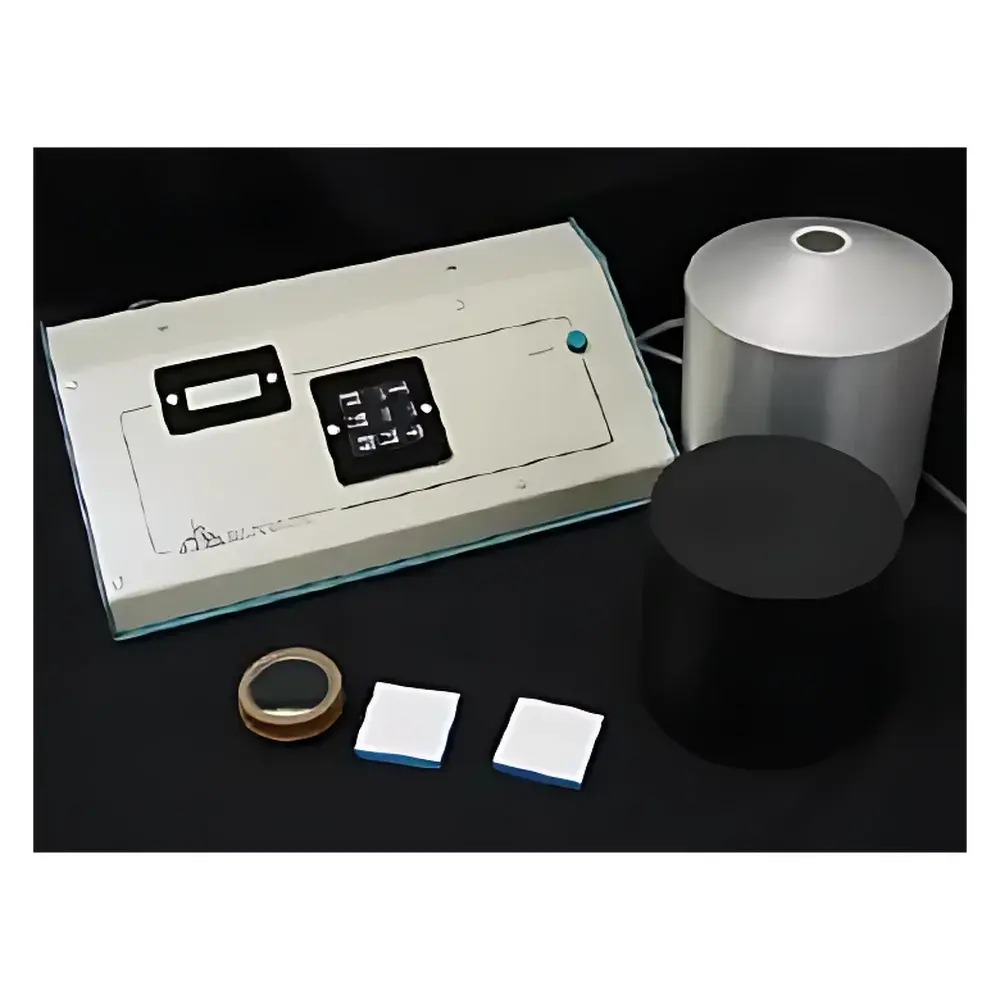
D&S SSR-ER Solar Spectral Reflectometer
| Brand | D&S |
|---|---|
| Origin | USA |
| Model | SSR-ER |
| Reflectance Repeatability | ±0.003 |
| Reflectance Accuracy | ±0.002 |
| Measurement Cycle Time | 8 s |
| Incident Angle | 20° (near-normal) |
| Detector Configuration | 6-channel filtered photodetectors (UV, Blue, Red, IR, plus dual re-sampling for low-CCT red/IR) |
| Sample Minimum Thickness | 6.4 mm |
| Calibration Standard Traceability | NIST-traceable diffuse and specular reflectance standards |
Overview
The D&S SSR-ER Solar Spectral Reflectometer is a precision optical instrument engineered for quantitative measurement of solar-weighted spectral reflectance and absorptance of opaque and semi-opaque solid materials. It operates on the principle of calibrated, multi-band photometric detection under controlled 20° near-normal incidence illumination, enabling direct determination of solar reflectance ratio (ρsolar) and solar absorptance (αsolar) in accordance with ASTM E903, ASTM C1549, and ISO 20875 standards. Unlike broadband or single-wavelength reflectometers, the SSR-ER employs six discrete, spectrally optimized photodetectors—each paired with interference filters—to emulate the solar spectral irradiance distribution (AM1.5G), covering critical bands across ultraviolet (UV), visible (blue, red), and near-infrared (NIR) regions. A tungsten-halogen lamp serves as the stable, reproducible broadband source; its spectral output is intentionally matched to low-color-temperature solar simulation requirements, with two dedicated detectors providing enhanced signal fidelity for red and IR channels under non-ideal thermal emission conditions.
Key Features
- High-fidelity solar-weighted reflectance quantification with accuracy of ±0.002 and repeatability of ±0.003 (1σ), validated against NIST-traceable diffuse and specular reference standards.
- Integrated dual-mode calibration architecture: factory-supplied, pre-characterized D&S standard reflectors (diffuse and specular) enable rapid on-site instrument validation and zero-offset correction prior to sample measurement.
- Fixed 20° incident angle geometry optimized for compliance with ASTM E903 and ISO 20875 test protocols for roofing, building envelope, and cool surface materials.
- Automated 8-second measurement cycle: 6 s lamp stabilization and dark-offset acquisition, followed by 2 s synchronized reflectance integration across all six channels—minimizing thermal drift and operator dependency.
- Onboard LCD interface with keyboard-driven selection between individual channel reflectance (%R), absorptance (%A), or calculated solar reflectance ratio (ρsolar), eliminating external software dependency for routine QA/QC use.
- Robust mechanical design supports samples ≥6.4 mm thick with flat, non-powdered surfaces; compatible with standard 100 mm × 100 mm specimen holders used in building material certification labs.
Sample Compatibility & Compliance
The SSR-ER is validated for use with rigid, planar, non-transmissive substrates including coated metals, ceramic tiles, polymer membranes, asphalt composites, and mineral-based roofing products. It does not support transparent, highly curved, or particulate samples. All measurements adhere to the geometric and spectral weighting requirements defined in ASTM E903–22 (“Standard Test Method for Solar Absorptance, Reflectance, and Transmittance of Materials Using Integrating Spheres”) and ASTM C1549–21 (“Standard Test Method for Determination of Solar Reflectance Near Ambient Temperature Using a Portable Solar Reflectometer”). Instrument calibration documentation includes full traceability to NIST Standard Reference Materials (SRMs), satisfying audit requirements under ISO/IEC 17025-accredited testing laboratories and U.S. EPA ENERGY STAR® Cool Roof Program submissions.
Software & Data Management
While the SSR-ER operates autonomously via its embedded microcontroller and front-panel interface, optional RS-232 or USB-to-serial connectivity enables data export to external PCs for long-term trending, batch reporting, and integration into LIMS environments. Exported datasets include timestamped channel-specific reflectance values, calculated ρsolar, lamp voltage history, and detector offset logs—structured in CSV format for compatibility with Excel, MATLAB, or statistical process control (SPC) platforms. No proprietary software installation is required; raw data files are human-readable and support GLP-compliant record retention. Audit trail functionality (e.g., user ID logging, parameter change history) is available through optional firmware upgrade aligned with FDA 21 CFR Part 11 readiness guidelines.
Applications
- Cool roof and cool wall material qualification per CRRC (Cool Roof Rating Council) and LEED v4.1 MR Credit: Building Product Disclosure and Optimization – Environmental Product Declarations.
- Quality assurance of reflective coatings during R&D and production line release testing in architectural coating and PV mounting system manufacturing.
- Validation of solar absorber/emitter performance in concentrated solar power (CSP) component development.
- Third-party verification testing for Department of Energy (DOE) Solar Rating & Certification Corporation (SRCC) listings.
- Academic and national lab research on spectral selectivity, aging-induced reflectance degradation, and soiling resistance of high-albedo surfaces.
FAQ
What standards does the SSR-ER comply with for solar reflectance reporting?
ASTM E903, ASTM C1549, ISO 20875, and CRRC-1 specifications for cool surface rating.
Can the SSR-ER measure both diffuse and specular reflectance simultaneously?
Yes—using the included NIST-traceable diffuse and specular calibration standards, users can configure the instrument for either mode without hardware modification.
Is spectral calibration required before each measurement session?
No—only periodic verification using the supplied standards is required; full recalibration is recommended annually or after mechanical shock or lamp replacement.
Does the instrument support thin films or transparent substrates?
No—the SSR-ER is designed exclusively for opaque or semi-opaque solids ≥6.4 mm thick; transmission-capable analysis requires complementary instrumentation such as a UV-Vis-NIR spectrophotometer with integrating sphere.
How is detector linearity maintained across intensity ranges?
Each photodetector incorporates auto-ranging amplification and real-time offset compensation during the 6-second lamp warm-up phase, ensuring linear response from 5% to 95% reflectance without manual gain adjustment.






