
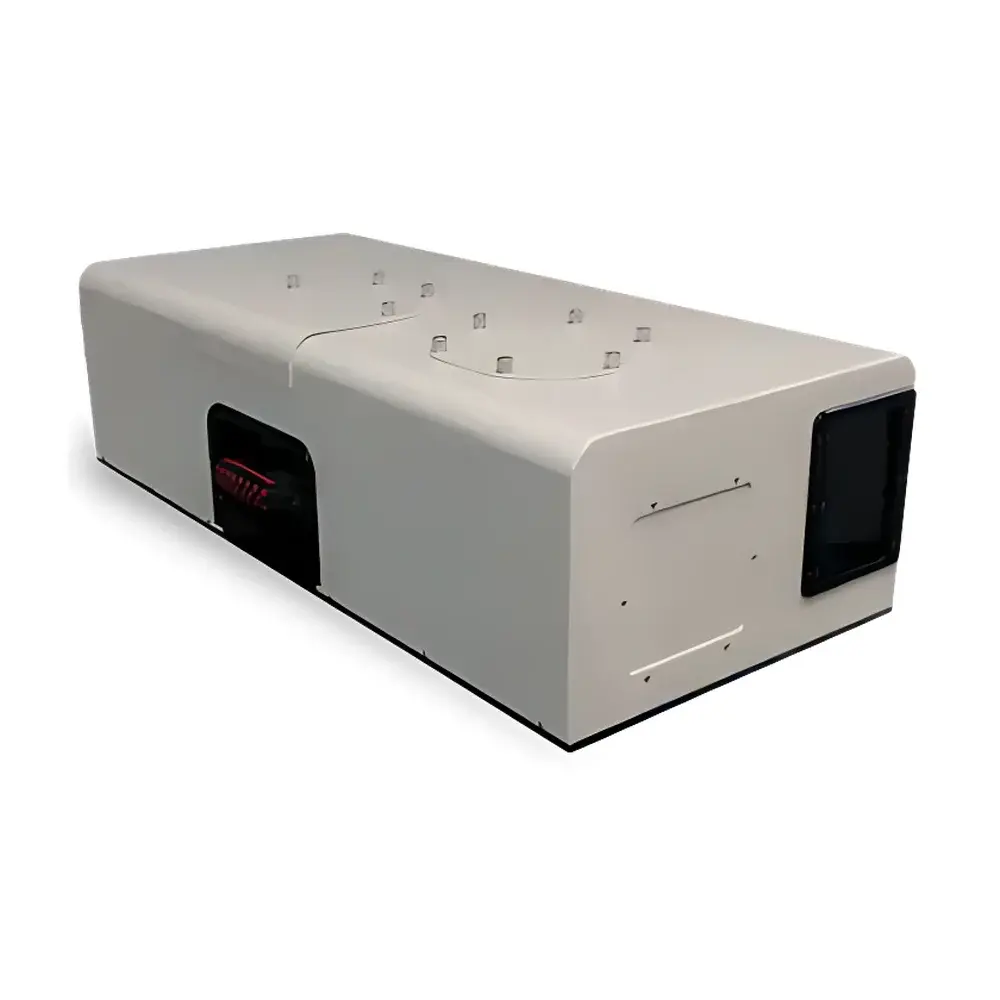
SurfaceOptics SOC760 Dual-Band Pushbroom Hyperspectral Imaging System
| Brand | SurfaceOptics |
|---|---|
| Origin | USA |
| Model | SOC760 |
| Configuration | Ground-based, Portable |
| Spectral Range | 400–1000 nm & 1000–2500 nm |
| Spectral Resolution | 2.5 nm (VIS-NIR), 5 nm (SWIR) |
| Total Spectral Bands | 650 |
| Spatial Resolution (IFOV) | 650 × 2048 pixels |
| Field of View (TFOV) | 12.5° |
| Scanning Mechanism | Oscillating mirror pushbroom |
| Detector | Uncooled CMOS (VIS-NIR), Cooled InSb FPA (SWIR) |
| Data Acquisition Platform | Integrated laptop workstation with high-end GPU, multi-core CPU, and 2 TB SSD |
| Software | Custom GUI for radiometric calibration, geometric correction, and real-time data streaming |
| Compliance | Designed for ASTM E131, ISO 18359, and USP <857> spectral data integrity requirements |
| Recommended Post-Processing | ENVI, MATLAB, Python (scikit-learn, hylite) |
Overview
The SurfaceOptics SOC760 is a dual-band, ground-deployable pushbroom hyperspectral imaging system engineered for laboratory-grade spectral fidelity and field-ready portability. It operates on the principle of spatial scanning combined with dispersive spectroscopy—using a precision oscillating mirror to sequentially project scene lines onto two parallel spectrometer channels. Light entering the fore-optics is split by a dichroic beamsplitter: visible-to-near-infrared (VIS-NIR: 400–1000 nm) radiation is reflected into one optimized grating spectrometer, while shortwave infrared (SWIR: 1000–2500 nm) radiation is transmitted into a second, thermoelectrically cooled InSb focal plane array (FPA) channel. This architecture ensures simultaneous, co-registered acquisition of 650 spectral bands across two physically decoupled optical paths—eliminating temporal misregistration and enabling pixel-level spectral unmixing. The system delivers calibrated radiance cubes with native spatial dimensions of 650 (spatial) × 2048 (scan) pixels per band, supporting quantitative reflectance modeling, material identification, and spectral library matching under controlled or outdoor terrestrial conditions.
Key Features
- Dual-band spectral coverage from 400 nm to 2500 nm in a single acquisition—no mechanical filter wheels or detector swaps required
- High spectral resolution: ≤2.5 nm FWHM in VIS-NIR and ≤5 nm FWHM in SWIR, meeting ASTM E131 resolution thresholds for chemical species discrimination
- Oscillating mirror pushbroom design ensures stable line-scan geometry, minimizing motion-induced blur during ground-based surveys
- Co-registered dual-channel optics with independent fore-optics, gratings, and detectors—enabling rigorous cross-band radiometric consistency
- Cooled InSb FPA in SWIR channel provides low-noise, high-dynamic-range detection essential for weakly reflective mineral and organic targets
- Integrated acquisition workstation with real-time onboard processing: radiometric correction (dark current, flat-field, non-uniformity), georeferencing support (via optional GNSS/IMU), and lossless data streaming to SSD
- Custom GUI software compliant with FDA 21 CFR Part 11 requirements for audit trail logging, user access control, and electronic signature support
Sample Compatibility & Compliance
The SOC760 is optimized for solid, semi-solid, and particulate samples in controlled lab environments or static outdoor setups—including geological cores, agricultural biomass, pharmaceutical tablets, forensic trace evidence, and painted cultural heritage surfaces. Its ground-based configuration eliminates atmospheric path variability inherent in airborne systems, improving signal-to-noise ratio for subtle spectral features (e.g., OH-, CO₃²⁻, and C–H vibrational overtones). The system adheres to ISO 18359:2015 for hyperspectral instrument characterization and supports GLP-compliant workflows through traceable calibration protocols (NIST-traceable lamp sources, certified reflectance standards). All raw and processed data files retain embedded metadata compliant with HDF5 and ENVI header standards, facilitating interoperability with LIMS and ELN platforms.
Software & Data Management
Data acquisition, preprocessing, and visualization are managed via SurfaceOptics’ proprietary SOC-Studio software—a Qt-based GUI running on Windows 10/11 with GPU-accelerated rendering. Key modules include: (1) real-time preview with spectral profile extraction at user-defined ROIs; (2) automated dark/white reference capture with exposure optimization; (3) geometric correction using built-in lens distortion models; (4) export to ENVI-compatible .hdr/.dat format with full wavelength and calibration metadata. The system generates FAIR-compliant datasets (Findable, Accessible, Interoperable, Reusable) with embedded provenance tags. For advanced analysis, SOC760 data integrates natively with ENVI’s spectral angle mapper (SAM), mixture-tuned matched filtering (MTMF), and PCA-based anomaly detection—validated against USP spectral similarity criteria for pharmaceutical excipient verification.
Applications
- Mineralogical mapping and alteration zone identification in core scanning and outcrop analysis
- Non-destructive quality assessment of agricultural commodities (grain moisture, protein content, fungal contamination)
- Pharmaceutical solid dosage form verification: API distribution homogeneity, coating thickness, and counterfeit detection
- Forensic document examination: ink differentiation, erased writing recovery, and substrate characterization
- Cultural heritage science: pigment identification, varnish degradation monitoring, and underdrawing visualization
- Environmental soil screening: hydrocarbon contamination, heavy metal proxies, and organic carbon estimation
FAQ
Does the SOC760 support real-time spectral library matching during acquisition?
Yes—SOC-Studio includes an optional spectral matching engine that performs on-the-fly spectral angle comparison against user-loaded libraries (e.g., USGS, ECOSTRESS, or custom collections) with configurable match thresholds.
Can the system be mounted on a tripod or translation stage for macro-scale scanning?
Absolutely—the SOC760 features standard 1/4″-20 threaded mounting points and supports programmable step-and-stare modes for high-resolution mosaic generation up to 10,000 × 10,000 pixel composites.
Is radiometric calibration traceable to NIST standards?
Yes—each system ships with factory calibration certificates referencing NIST SRM 2035 (diffuse reflectance) and 1930B (irradiance), with annual recalibration services available through SurfaceOptics’ ISO/IEC 17025-accredited facility.
What file formats are supported for export and long-term archival?
Native output is HDF5 with embedded XML metadata; ENVI (.hdr/.dat), GeoTIFF (with spectral metadata), and CSV (spectral profiles) are export options. All formats comply with NASA’s Planetary Data System (PDS4) spectral data standards.
How is data security and user accountability maintained in regulated environments?
SOC-Studio implements role-based access control, immutable audit logs (including operator ID, timestamp, parameter changes), and digital signature enforcement—all aligned with FDA 21 CFR Part 11 and EU Annex 11 requirements for analytical instrumentation.



