
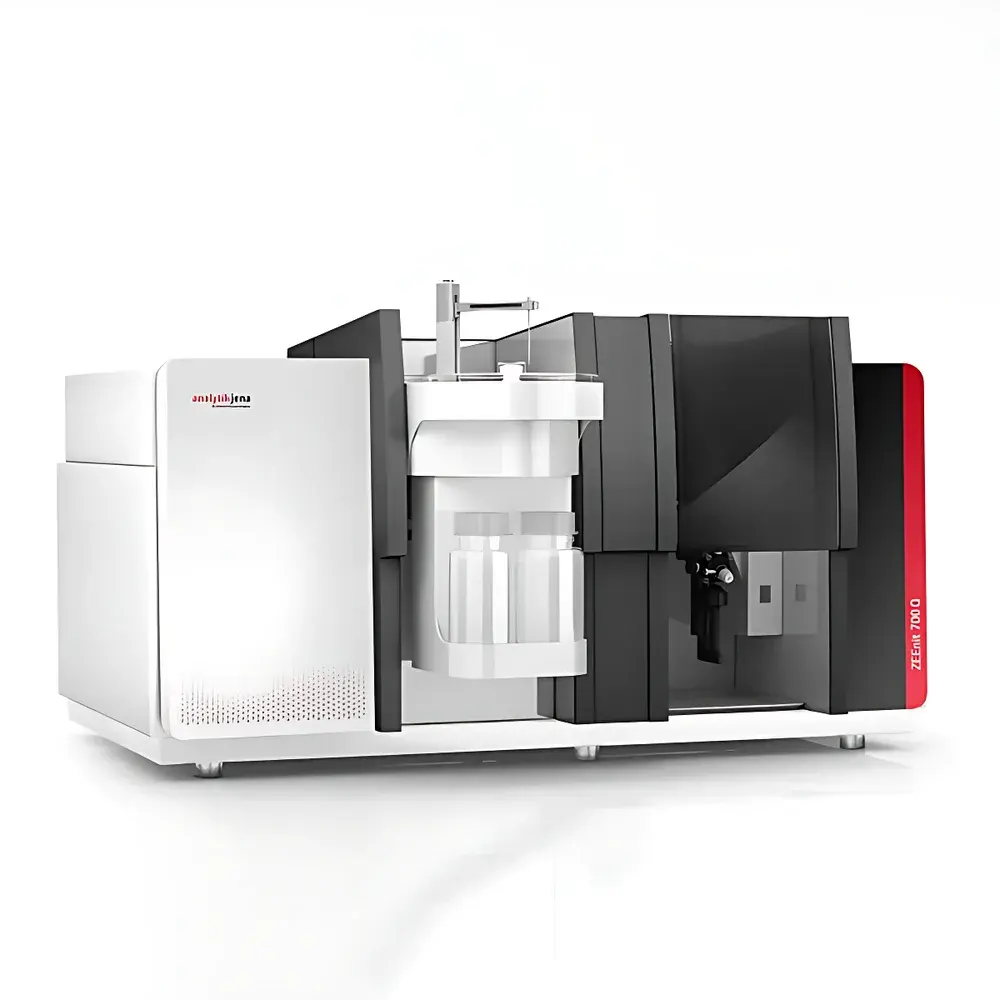
Analytik Jena ZEEnit 700Q Atomic Absorption Spectrometer
| Brand | Analytik Jena |
|---|---|
| Origin | Germany |
| Manufacturer Type | Original Equipment Manufacturer (OEM) |
| Origin Category | Imported Instrument |
| Model | ZEEnit 700Q |
| Pricing | Available upon Request |
Overview
The Analytik Jena ZEEnit 700Q is a high-performance, integrated atomic absorption spectrometer (AAS) engineered for precision elemental quantification across diverse sample matrices. It operates on the fundamental principle of atomic absorption spectroscopy—measuring the attenuation of characteristic hollow cathode lamp (HCL) or electrodeless discharge lamp (EDL) radiation as ground-state atoms in a flame or graphite furnace absorb specific wavelengths. The ZEEnit 700Q uniquely integrates flame AAS (FAAS), graphite furnace AAS (GFAAS), and hydride generation AAS (HGAAS) into a single optical platform without mechanical reconfiguration. This unified architecture eliminates manual atomizer swaps, realignment procedures, or recalibration between techniques—enabling seamless, software-driven transitions among measurement modes while maintaining long-term photometric stability via its proprietary Carl Zeiss optical train.
Key Features
- Integrated multi-atomization platform: Simultaneous hardware support for flame, electrothermal (graphite furnace), and hydride generation atomization—switched automatically via instrument control software without physical intervention.
- Carl Zeiss optical system: Precision-ground quartz and fused silica optics with thermally stable mounts ensure wavelength reproducibility ≤ ±0.05 nm and photometric drift < 0.002 A/h over 8 hours.
- Automatic optical alignment: Motorized collimation and focusing mechanisms self-adjust the optical path prior to each measurement sequence, eliminating routine manual alignment.
- Dual-mode optical configuration: Software-selectable single-beam or double-beam operation—supporting both high-sensitivity transient signal acquisition (e.g., GFAAS peak-area integration) and baseline-corrected continuous monitoring (e.g., FAAS steady-state absorbance).
- Intelligent sample introduction: Integrated autosampler with adaptive dilution logic—determines optimal dilution factor in real time based on preliminary signal intensity, targeting calibration curve mid-range without user-defined input.
- Contamination mitigation suite: Includes automated residue removal cycles post-high-concentration injection, dynamic liquid-level tracking with auto-refill (‘chase liquid’ function), and programmable rinse protocols compliant with ISO 11097 and ASTM D5684.
Sample Compatibility & Compliance
The ZEEnit 700Q accommodates aqueous solutions, acid-digested environmental solids (soils, sediments), biological digests (tissues, blood), food extracts, and industrial process streams. Its graphite furnace module supports stabilized temperature platforms up to 3,000 °C with integrated Zeeman background correction—enabling direct analysis of complex matrices with minimal matrix interference. Method libraries pre-loaded in the ASpect software conform to Chinese national standards (e.g., GB 5009.x for food, HJ 491–2019 for soil, GB/T 5750.6–2023 for drinking water), including validated sample preparation workflows, digestion protocols, and instrument parameter sets. All data acquisition, audit trails, and electronic signatures comply with FDA 21 CFR Part 11 requirements when configured with optional secure user authentication and encrypted database logging.
Software & Data Management
ASpect Q software provides a validated, role-based interface with three-tier security access (operator, supervisor, administrator). It embeds standardized method templates—including full analytical workflows from sample prep instructions to report generation—with built-in uncertainty estimation per EURACHEM/CITAC guidelines. Data files are stored in vendor-neutral .csv and .xml formats; raw spectral scans, transient signals, and calibration logs retain timestamped metadata for GLP/GMP traceability. Optional LIMS connectivity supports ASTM E1578-compliant instrument-to-system integration, enabling automatic result transfer to laboratory information management systems without manual export.
Applications
The ZEEnit 700Q delivers trace-metal quantification at sub-ppt levels in regulatory and research environments: heavy metal screening in agricultural soils (Pb, Cd, As, Hg per GB 15618–2018); nutritional mineral profiling in infant formula (Ca, Fe, Zn, Cu per GB 10765–2021); residual catalyst metals in pharmaceutical intermediates (Pd, Pt, Ni per ICH Q2(R2)); and speciation-independent total element determination in wastewater effluents (Cr, Ni, Co per HJ 700–2014). Its dual-beam capability ensures robustness in high-throughput QA/QC labs, while Zeeman-corrected furnace mode meets detection limit requirements for ultra-trace analysis in certified reference material (CRM) validation studies.
FAQ
Does the ZEEnit 700Q require manual optical alignment during routine operation?
No—motorized collimation and beam-centering routines execute automatically before each measurement sequence.
Can the instrument validate compliance with ISO/IEC 17025 documentation requirements?
Yes—when deployed with ASpect Q’s audit trail module and electronic signature functionality, it supports full traceability of method changes, calibration events, and analyst actions.
Is hydride generation supported natively without external gas modules?
Yes—the integrated hydride generation unit uses sodium borohydride and hydrochloric acid reagents delivered via the same autosampler, with reaction cell temperature and gas flow digitally controlled.
How does the intelligent dilution algorithm determine the optimal dilution factor?
It performs an initial low-volume test injection, evaluates absorbance response against stored calibration range thresholds, then calculates and executes serial dilution to target 50–70% of full-scale calibration signal.
What level of operator training is required to run standard regulatory methods?
Minimal—preconfigured method packages include step-by-step preparation guides, instrument parameter sets, and pass/fail criteria aligned to GB, HJ, and ASTM standards; no spectroscopic expertise is needed for routine execution.





