Imina miBot-01 Nano-Positioning Probe Station for SEM Integration
| Origin | Switzerland |
|---|---|
| Manufacturer Type | Authorized Distributor |
| Origin Category | Imported Instrument |
| Model | miBot-01 |
| Price Range | USD 13,500 – 40,500 (FOB) |
| Product Category | Ultra-High-Vacuum Compatible Probe Station |
| Operation Mode | Fully Automated |
| Core Function | In-Situ Nanoscale Electrical Characterization Inside SEM Chambers |
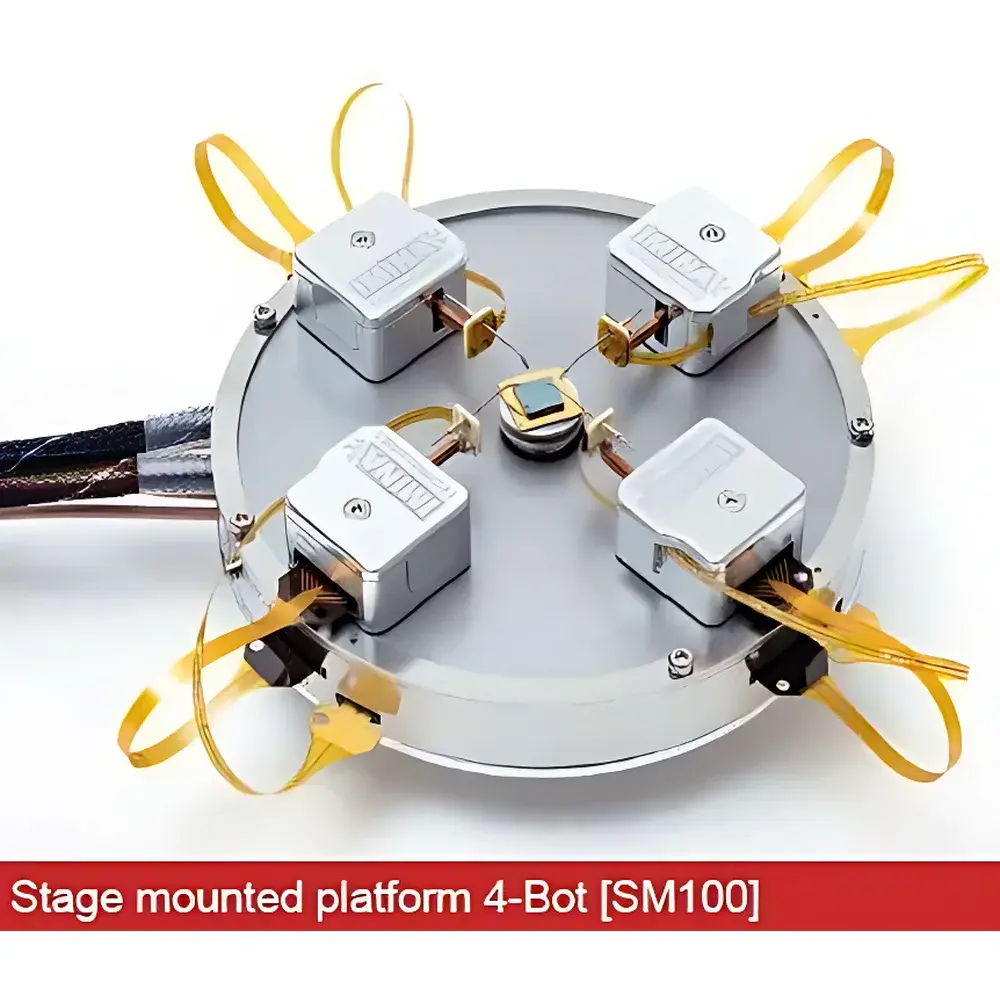
| Actuation System | Four Integrated Piezo-Driven miBot™ Micro-Robots |
| Positioning Resolution | <10 nm (Open-Loop), <2 nm (Closed-Loop with Optional Sensors) |
| Leakage Current | ≤100 fA/V at 1 V bias |
| Signal Interface | Triaxial Shielded Cabling (75 Ω/50 Ω configurable), IEEE-488 & USB 3.0 Control Bus |
| Vacuum Compatibility | 1×10⁻⁷ mbar (UHV-ready with bake-out option) |
Overview
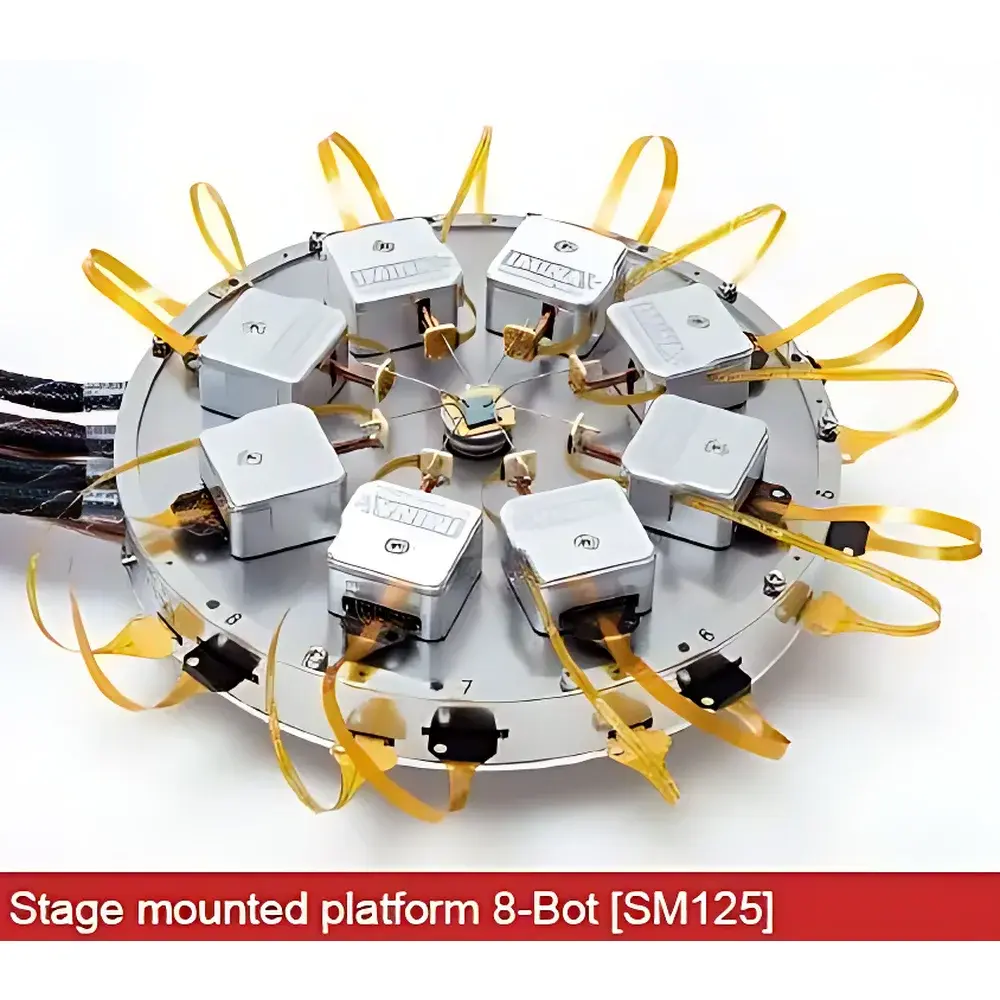
The Imina miBot-01 Nano-Positioning Probe Station is a purpose-engineered ultra-high-vacuum (UHV)-compatible platform designed for in-situ, real-time electrical characterization of nanoscale devices and materials directly inside scanning electron microscope (SEM) chambers. Unlike conventional atmospheric or low-vacuum probe stations, the miBot-01 integrates seamlessly into high-resolution SEM environments—enabling simultaneous nanoscale imaging, precise mechanical manipulation, and low-noise current–voltage (I–V), capacitance–voltage (C–V), and pulsed IV measurements. Its operational principle relies on closed-loop piezoelectric actuation combined with sub-nanometer motion control algorithms, allowing four independently programmable miBot™ micro-robots to perform coordinated tip positioning, contact formation, and dynamic probing without inducing mechanical drift or thermal noise. This architecture eliminates the need for external manipulators or post-SEM transfer, thereby preserving sample integrity and enabling true correlative microscopy—where structural morphology (imaged via SEM) and electronic transport properties (measured via synchronized instrumentation) are acquired under identical vacuum and thermal conditions.
Key Features
- Fully automated, software-synchronized operation with SEM stage coordination and beam blanking triggers
- Four integrated miBot™ piezo-driven micro-robots, each with 3-axis independent motion (X/Y/Z), 10 mm travel range, and <2 nm closed-loop repeatability
- UHV-rated construction using non-magnetic, low-outgassing stainless steel and ceramic insulators; compatible with base pressures down to 1×10⁻⁷ mbar
- Dedicated low-leakage signal path: triaxial shielded cabling with guarded inputs, optimized for sub-picoampere current measurement (≤100 fA/V leakage)
- Modular electrical interface supporting standard SMU connections (Keysight B1500A, Keithley 4200-SCS), arbitrary waveform generators, and lock-in amplifiers
- Real-time position feedback via integrated capacitive sensors (optional) and digital twin synchronization with host SEM control software
Sample Compatibility & Compliance
The miBot-01 accommodates wafers up to 200 mm diameter and discrete die mounted on standard SEM stubs or custom carriers. It supports conductive, semiconductive, and insulating substrates—including Si, SiC, GaN, 2D materials (graphene, TMDs), nanowires, and MOF-based heterostructures. All electrical components comply with IEC 61000-4-2 (ESD immunity) and IEC 61326-1 (EMC for laboratory equipment). The system meets ASTM F1718-22 requirements for nanoscale device probing and is validated for GLP-compliant workflows when paired with audit-trail-enabled data acquisition software. Vacuum flange interfaces conform to CF-63 and CF-100 ISO-K standards, ensuring compatibility with major SEM platforms (Thermo Fisher, Zeiss, JEOL, Hitachi).
Software & Data Management
Control is executed via Imina’s miControl™ Suite—a Python- and LabVIEW-compatible SDK supporting deterministic motion scripting, multi-probe synchronization, and trigger-based SEM integration (e.g., beam pause during contact establishment). Raw electrical data streams are timestamp-aligned with SEM image metadata using IEEE 1588 PTP (Precision Time Protocol). Export formats include HDF5 (with embedded calibration metadata), CSV, and MATLAB .mat—ensuring traceability per FDA 21 CFR Part 11 when used with validated electronic signature modules. Audit logs record all motion commands, voltage sweeps, and environmental parameters (vacuum pressure, chamber temperature) for full experimental reproducibility.
Applications
- In-situ failure analysis of FinFETs, GAAFETs, and CFET interconnects under electron beam irradiation
- Transport property mapping of van der Waals heterostructures and topological insulator edges
- Dynamic contact resistance monitoring during electromigration stress testing
- Low-current threshold voltage extraction in sub-5 nm gate oxide stacks
- Correlative nanomechanical–electrical testing (e.g., piezoresistive response of nanowire strain sensors)
- Quantum device characterization: Coulomb blockade spectroscopy, Andreev reflection, and single-electron transistor gating
FAQ
Is the miBot-01 compatible with field-emission SEMs operating at 1 kV or lower accelerating voltages?
Yes—the station’s compact footprint and non-magnetic construction ensure minimal interference with electron optics; it has been validated on Thermo Fisher Helios Hydra and Zeiss Sigma 300 systems at landing energies as low as 500 eV.
Can the system be retrofitted into an existing SEM chamber without chamber modification?
It requires a dedicated 6-inch CF port and 24 V DC + Ethernet feedthrough; no internal chamber machining is needed if the port is available and aligned.
Does the system support cryogenic operation?
Standard configuration operates from 20 °C to 40 °C; optional LN₂-cooled variants (down to 80 K) are available under separate configuration codes (miBot-Cryo-01).
What level of electromagnetic shielding is provided for femtoamp-level measurements?
Triaxial cabling with active guarding, mu-metal–lined probe arms, and Faraday-cage-integrated baseplate achieve >120 dB common-mode rejection at 1 kHz.
Is remote operation supported for multi-user lab environments?
Yes—via secure TLS-encrypted web interface and RESTful API; role-based access control (RBAC) enforces instrument usage policies across distributed teams.
Related Products