
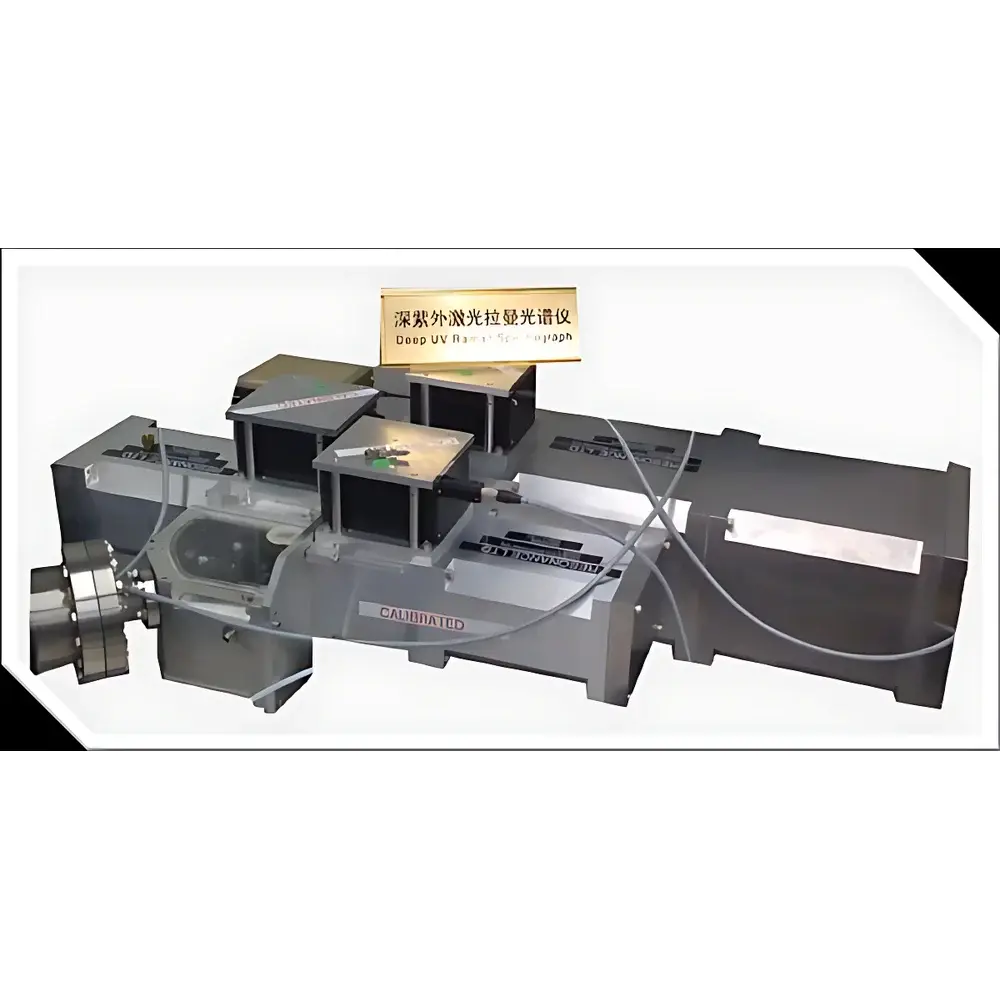
RamSPEC-VUV-0.3-0.6 Deep-Ultraviolet Raman Spectrometer
| Origin | Canada |
|---|---|
| Manufacturer Type | Authorized Distributor |
| Import Status | Imported Instrument |
| Model | RamSPEC-VUV-0.3-0.6 |
| Instrument Type | Grating-Based Raman Spectrometer |
| Spectral Range | 140–550 nm |
| Spectral Resolution | 0.1 nm |
| Spatial Resolution | 1 µm |
| Minimum Raman Shift | 0 cm⁻¹ |
| Spectral Repeatability | ≤ ±0.01 cm⁻¹ |
Overview
The RamSPEC-VUV-0.3-0.6 is a purpose-engineered deep-ultraviolet (VUV) Raman spectrometer designed for high-fidelity vibrational spectroscopy in the challenging 140–550 nm spectral window—extending into the vacuum ultraviolet (VUV) region down to 177 nm. Unlike conventional visible or near-UV Raman systems, this instrument leverages VUV excitation to access resonance-enhanced Raman scattering from electronic transitions in wide-bandgap materials, aromatic hydrocarbons, and biological chromophores with minimal fluorescence interference. Its optical architecture is fully evacuated or purged with high-purity nitrogen/argon to eliminate atmospheric absorption (e.g., O₂, H₂O), enabling stable signal acquisition below 190 nm. The system operates on standard grating-based dispersive spectroscopy principles, utilizing back-illuminated, deep-depletion CCD detection optimized for quantum efficiency above 90% in the VUV range.
Key Features
- Vacuum-compatible optical path with integrated purge interface (N₂ or Ar) for sustained operation at λ < 190 nm
- Interchangeable holographic gratings (600, 1200, 2400, 3600, and 4200 grooves/mm) for customizable dispersion–throughput trade-offs across UV–VUV bands
- High-stability kinematic mounting for grating and detector, ensuring long-term wavelength calibration integrity
- Sub-micron spatial resolution (1 µm) achieved via integrated confocal microscope coupling with motorized XYZ stage
- Calibration-traceable spectral repeatability of ≤ ±0.01 cm⁻¹ (verified using Ne/Ar emission lines and NIST-traceable Raman standards)
- Modular laser interface supporting continuous-wave VUV sources (e.g., frequency-quadrupled Nd:YAG at 266 nm, or tunable synchrotron beamlines) with adjustable polarization control
Sample Compatibility & Compliance
The RamSPEC-VUV-0.3-0.6 accommodates solid, thin-film, and gas-phase samples under ambient, low-pressure, or UHV conditions (compatible with load-lock integration). Sample chambers support electrical biasing, cryogenic cooling (down to 10 K), and in situ gas dosing for operando studies. All optical components—including mirrors, lenses, and windows—are fabricated from MgF₂, CaF₂, or synthetic fused silica to ensure broadband VUV transmission and radiation hardness. The system complies with ISO/IEC 17025 requirements for analytical instrument validation and supports audit-ready documentation per GLP and GMP frameworks. It is routinely deployed in laboratories adhering to ASTM E1840 (Standard Practice for Calibration of Spectrometers) and USP (Raman Spectroscopy).
Software & Data Management
Control and analysis are performed via SpectraSuite-VUV, a platform-certified application built on LabVIEW RT and Python-based spectral libraries. The software provides real-time spectral preview, automated grating selection logic, multi-point mapping with georeferenced metadata tagging, and batch processing with baseline correction (Asymmetric Least Squares), peak deconvolution (Voigt fitting), and library matching against the RRUFF and ICDD VUV-Raman databases. Raw data are stored in HDF5 format with embedded instrument configuration logs, enabling full traceability. The system supports 21 CFR Part 11-compliant user authentication, electronic signatures, and immutable audit trails for regulated environments.
Applications
- Resonance Raman characterization of wide-bandgap semiconductors (e.g., AlN, GaN, SiC) and 2D materials (h-BN, MoS₂) under VUV excitation
- Electronic structure probing of π-conjugated systems and polycyclic aromatic hydrocarbons (PAHs) relevant to astrochemistry and combustion diagnostics
- In situ monitoring of catalytic surface reactions under reactive gas atmospheres using time-resolved VUV-Raman
- Low-fluorescence fingerprinting of pharmaceutical polymorphs and amorphous content in APIs
- Fundamental studies of phonon–plasmon coupling in doped oxides and topological insulators
FAQ
Is the RamSPEC-VUV-0.3-0.6 compatible with synchrotron radiation sources?
Yes—the instrument features a standardized 6-inch CF flange input port and configurable entrance slit, making it suitable for beamline integration at third-generation synchrotron facilities.
What vacuum level is required for stable operation below 190 nm?
A base pressure of ≤5 × 10⁻⁶ mbar is recommended; typical operation uses dynamic N₂ purge achieving <1 ppm O₂/H₂O partial pressure.
Can the system perform quantitative analysis according to regulatory standards?
Yes—when validated per ICH Q2(R2) guidelines and operated with certified reference materials, it meets requirements for quantitative Raman assays in QC labs.
Does the system include NIST-traceable calibration services?
Factory calibration includes wavelength (using Ne/Ar lamp lines) and intensity (using calibrated photodiode) certification, with optional annual recalibration service available.
What maintenance is required for long-term VUV optical performance?
Annual inspection of MgF₂ optics for carbon contamination and re-coating of aluminum mirrors is advised; all procedures follow ISO 10110-7 surface cleanliness protocols.
Related Products






