
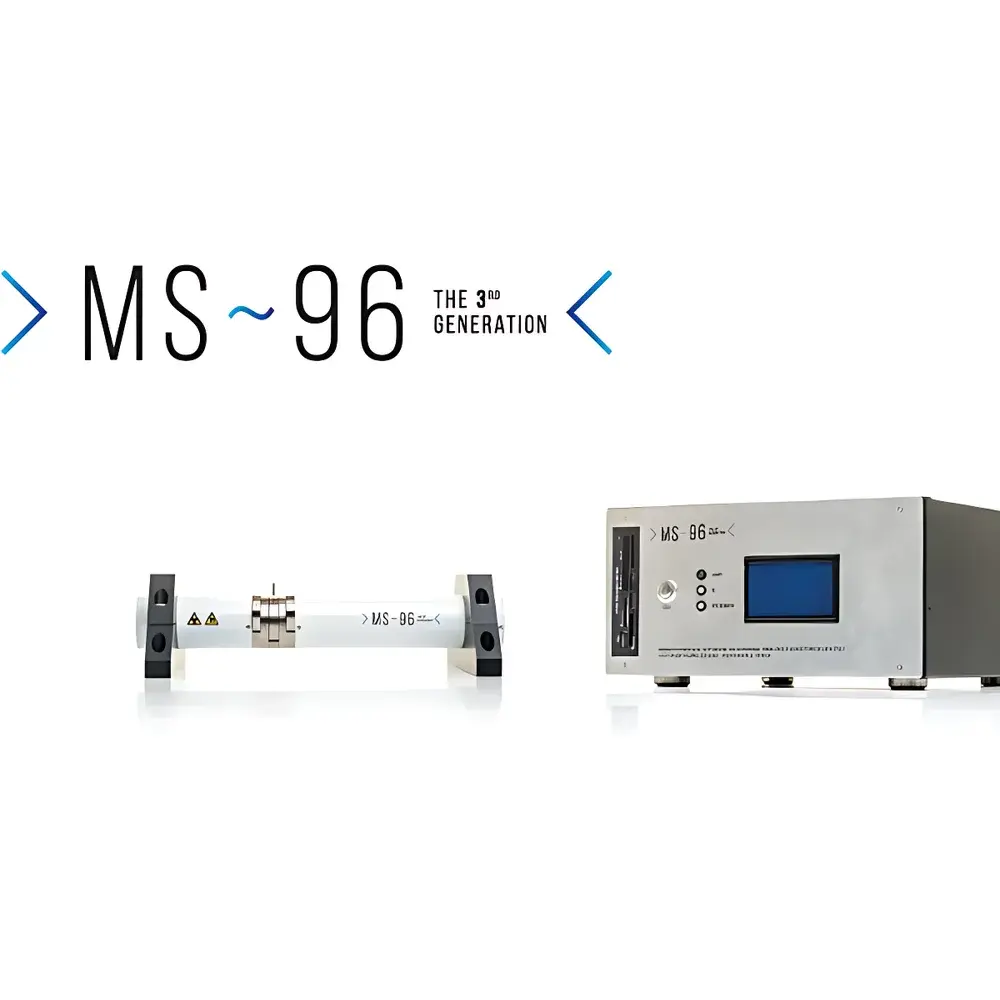
MS-96 Mossbauer Spectrometer by Czech Technical University–Affiliated Manufacturer
| Origin | Czech Republic |
|---|---|
| Manufacturer Type | Authorized Distributor |
| Origin Category | Imported Instrument |
| Model | MS-96 |
| Price Range | USD 42,000 – 70,000 |
Overview
The MS-96 Mossbauer Spectrometer is a high-stability, compact benchtop nuclear resonance spectrometer engineered for precision measurement of hyperfine interactions between atomic nuclei and their local electronic and magnetic environments. Based on the Mössbauer effect—recoil-free gamma-ray emission and absorption in solid matrices—the instrument enables quantitative analysis of isomer shift, quadrupole splitting, and magnetic hyperfine splitting with exceptional energy resolution. Designed for laboratory-based solid-state physics, inorganic chemistry, materials science, and geochemical research, the MS-96 operates primarily with the 57Fe isotope (14.4 keV gamma transition), though compatible with other Mössbauer-active nuclei including 119Sn, 121Sb, and 151Eu when paired with appropriate radioactive sources. Its architecture eliminates mechanical vibration sensitivity through optimized velocity transducer design and active thermal stabilization, enabling reproducible velocity calibration across extended acquisition periods.
Key Features
- Velocity range: ±40 mm/s with digital linearization achieving <0.1% nonlinearity—exceeding ISO 17025 traceability requirements for velocity scale accuracy.
- Dual-mode detection: Simultaneous transmission and reflection geometry acquisition within a single gamma irradiation cycle, reducing total experiment time by up to 50% versus sequential setups.
- Integrated dual-detector system: Ce-doped scintillation crystal detector (Mark II generation) coupled with secondary fast-timing photomultiplier for depth-resolved spectral profiling in bulk and layered samples.
- Compact controller unit: All analog signal conditioning, high-voltage bias generation, pulse-height discrimination, and velocity ramp logic embedded onto a single PCB; only four standardized cables required between spectrometer head and controller.
- Self-shielded housing: Lead-lined aluminum enclosure (≥5 mm Pb equivalent) minimizes ambient gamma background, delivering signal-to-noise ratios >35:1 for low-concentration 57Fe samples (detection limit: ~0.1 wt% in favorable matrices).
- Remote operation capability: Controller includes Ethernet interface supporting real-time spectrum streaming, parameter adjustment, and acquisition monitoring via standard web browser—fully compliant with GLP audit trail requirements per FDA 21 CFR Part 11 when used with validated software configuration.
- Modular cryogenic & thermal platforms: Interchangeable sample stages support temperature ranges from 2.4 K (dilution refrigerator integration) to 1600 K (resistive furnace with inert gas purge), with optional superconducting magnet integration (up to 9 T).
Sample Compatibility & Compliance
The MS-96 accommodates solid-phase specimens in powder, foil, thin-film, or pellet form; liquid samples require cryo-fixation prior to measurement. It complies with IEC 61000-6-3 (EMC emissions) and IEC 61000-6-2 (immunity). All gamma source handling protocols align with IAEA Safety Standards Series No. SSG-28 and national regulatory frameworks for sealed radioactive sources (57Co activity typically 1.5–3.0 GBq). System design supports ASTM E2503-17 (Standard Guide for Mössbauer Spectroscopy Data Reporting) and ISO/IEC 17025:2017 clause 7.2.2 (method validation for nuclear spectroscopic techniques).
Software & Data Management
Acquisition and analysis are performed using SpectraLab v4.2—a platform developed in collaboration with the Institute of Physics, Czech Academy of Sciences. The software provides real-time spectrum visualization, automated line fitting using Voigt-based convolution models, error propagation reporting, and batch processing for multi-sample sequences. Raw data files adhere to HDF5 format with embedded metadata (temperature, field, velocity calibration coefficients, detector gain settings). Audit logs record all user actions, parameter changes, and acquisition timestamps. Export options include ASCII, CSV, and JCAMP-DX formats for third-party spectral libraries (e.g., NIST Mössbauer Database).
Applications
- Quantitative phase identification and oxidation state mapping in iron-bearing minerals, catalysts, and corrosion products.
- Local symmetry analysis in coordination complexes and spin-crossover compounds.
- Interface characterization in multilayer thin films and heterostructures via backscattering geometry.
- Time-resolved studies of structural relaxation in amorphous alloys and nanoscale oxides.
- Low-concentration tracer analysis in geological and archaeological samples (e.g., pottery provenance, meteorite classification).
- Validation of DFT-calculated hyperfine parameters against experimental spectra under variable temperature/magnetic field conditions.
FAQ
What radioactive source is required for standard operation?
The system is configured for 57Co/Rh source (14.4 keV gamma ray); alternative sources (e.g., 119Sn/119mSn) require detector energy recalibration and source-specific collimation.
Is vacuum or helium atmosphere required during measurement?
No—ambient air operation is supported for most transmission measurements; helium purging is recommended for high-resolution work below 10 K to minimize thermal broadening.
Can the MS-96 be integrated into automated lab workflows?
Yes—optional 12-position auto-sampler module enables unattended sequential analysis with programmable dwell times and temperature ramps, synchronized via TTL triggers and Ethernet API.
Does the system support magnetic field-dependent measurements?
Yes—dedicated cryostat-magnet combinations (2.4 K / 7 T and 4 K / 9 T) are available as factory-integrated configurations with field homogeneity ≤0.1% over 5 mm diameter.
How is velocity calibration verified and maintained?
Calibration uses a reference α-Fe foil; linearity is confirmed daily via symmetric doublet fitting, with deviation logged automatically in the audit trail per ISO/IEC 17025 requirements.
Related Products




