
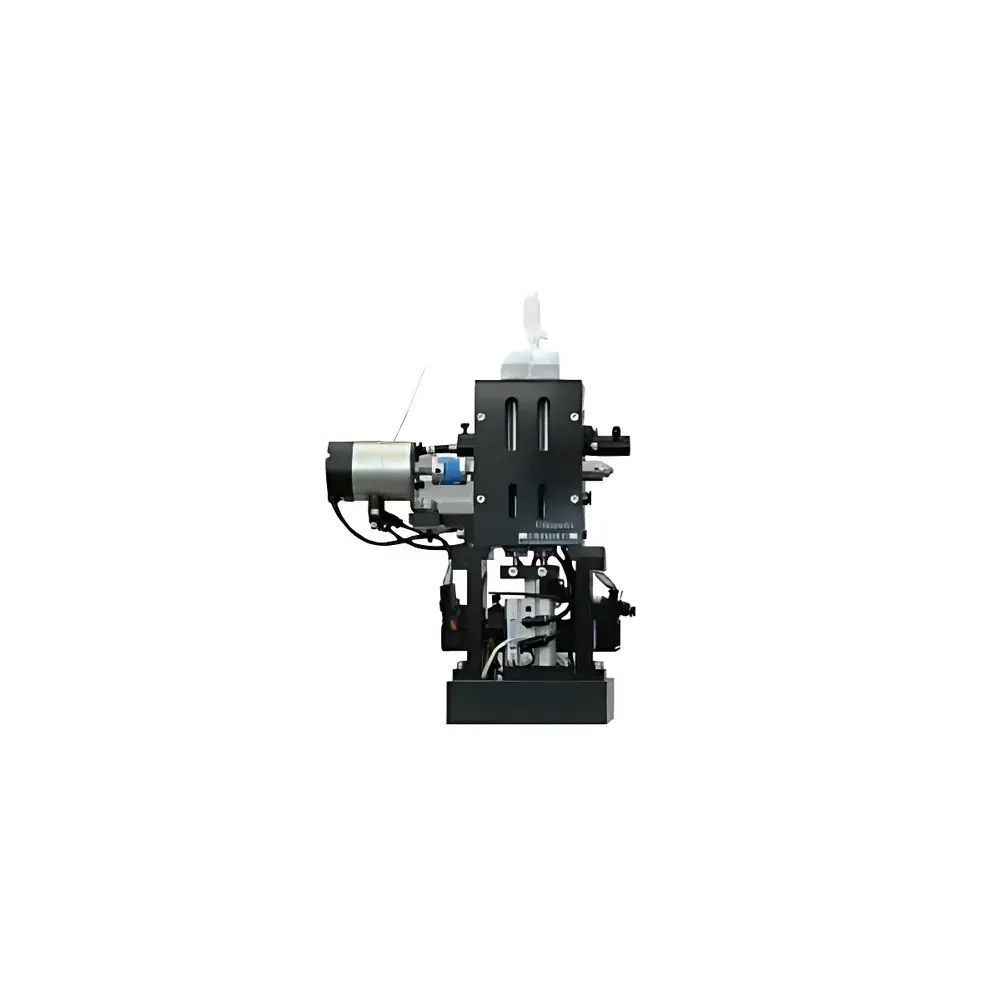
RSP-2000 Rapid Reaction Kinetics Stopped-Flow Spectrophotometer
| Origin | Japan |
|---|---|
| Supplier Type | Authorized Distributor |
| Origin Category | Imported Instrument |
| Model | RSP-2000 |
| Pricing | Upon Request |
Overview
The RSP-2000 is a high-performance stopped-flow spectrophotometer engineered for the quantitative analysis of fast chemical and biochemical reaction kinetics on the millisecond timescale. Based on the classical stopped-flow mixing principle—where two or more reactant solutions are rapidly injected into a mixing chamber, homogenized under turbulent flow conditions, and then abruptly halted to initiate time-resolved optical monitoring—the RSP-2000 delivers exceptional temporal resolution down to 1 ms per data point. It captures up to 8,000 absorbance spectra within a single kinetic trace, enabling full spectral evolution tracking (e.g., 200–800 nm) with high signal-to-noise ratio. The system employs a dual-beam optical architecture with precision-matched reference and sample paths, minimizing baseline drift during extended acquisitions. Designed for rigorous laboratory environments, the RSP-2000 conforms to ISO/IEC 17025-relevant instrumentation validation practices and supports audit-ready documentation workflows required in GLP-compliant kinetic studies.
Key Features
- Sub-millisecond dead time (<1.2 ms typical) achieved via pneumatically actuated, computer-controlled syringe drivers and low-volume mixing chambers
- Multi-channel photomultiplier tube (PMT)-based detection with selectable monochromatic or full-spectrum acquisition modes
- Integrated automatic stopcock-equipped stopped-flow mixer with optional dual-mixer configurations for sequential or parallel reaction initiation
- Temperature-controlled sample path (4–40 °C) using recirculating bath interface; compatible with cryogenic dual-mixer modules for sub-ambient kinetic studies
- Modular optical rail platform allowing rapid reconfiguration for absorbance, fluorescence, or flash-photolysis experiments
- 150 W Xe-Hg arc lamp source optimized for broad UV-Vis output (220–750 nm), with optional laser excitation coupling for time-resolved fluorescence
Sample Compatibility & Compliance
The RSP-2000 accommodates aqueous, organic, and mixed-solvent systems across a wide viscosity range (up to 20 cP). Its microcell kits support sample volumes as low as 15 µL per injection, minimizing reagent consumption for precious biomolecules (e.g., enzymes, nucleic acids, membrane proteins). All fluidic components—including syringes, tubing, and stopcocks—are chemically resistant to common solvents (acetonitrile, DMSO, ethanol, buffered saline) and autoclavable where applicable. The system meets mechanical safety requirements per IEC 61010-1 and electromagnetic compatibility standards EN 61326-1. For regulated environments, instrument control software supports 21 CFR Part 11-compliant user authentication, electronic signatures, and immutable audit trails for raw kinetic data and processing parameters.
Software & Data Management
Acquisition and analysis are managed through dedicated Windows-based software featuring real-time spectral visualization, multi-wavelength kinetic fitting (including global analysis of wavelength-dependent rate constants), and non-linear regression against mechanistic models (e.g., consecutive, parallel, or pre-equilibrium schemes). Data export formats include ASCII (.txt), CSV, and native binary (.rsp) with embedded metadata (timestamp, temperature, mixing ratio, lamp intensity). Raw spectra and time traces are stored with versioned processing history, ensuring full traceability from acquisition to publication-ready figures. Batch processing mode enables automated analysis of replicate runs, while scripting API (via COM interface) allows integration with third-party platforms such as MATLAB or Python-based kinetic modeling suites.
Applications
The RSP-2000 is routinely deployed in academic and industrial laboratories for enzyme mechanism elucidation (e.g., kcat, KM, inhibition constants), protein folding/unfolding dynamics, ligand-binding kinetics (e.g., GPCR-small molecule interactions), electron transfer reactions in photosynthetic complexes, and transient intermediate characterization in synthetic organic chemistry. Its fluorescence add-on module extends utility to tryptophan quenching assays, FRET-based conformational change detection, and excited-state lifetime analysis when paired with pulsed LED or laser sources. The system is cited in peer-reviewed literature supporting studies compliant with ASTM E2912 (Standard Guide for Kinetic Analysis of Spectroscopic Data) and IUPAC recommendations for reaction rate measurement.
FAQ
What is the minimum measurable dead time for the RSP-2000 system?
The typical dead time is 1.2 ms under standard configuration with aqueous buffers and room-temperature operation; this may vary slightly depending on viscosity, mixing geometry, and detection mode.
Can the RSP-2000 perform both absorbance and fluorescence measurements in the same experiment?
No—absorbance and fluorescence require separate optical configurations due to distinct excitation/detection pathways; however, hardware modules can be interchanged rapidly on the shared optical rail.
Is temperature control available for the observation cell?
Yes; the standard system includes a thermostatted cuvette holder (±0.1 °C stability) interfaced with an external recirculating chiller; low-temperature dual-mixer variants extend operational range to –10 °C.
Does the software support global kinetic analysis across multiple wavelengths?
Yes; the included analysis engine performs singular value decomposition (SVD) and target transformation to extract concentration profiles and rate constants from full spectral datasets.
Are service contracts and application support available outside Japan?
Yes; authorized distributors provide local technical support, preventive maintenance, and application-specific method development assistance under ISO 9001-certified service frameworks.




