A2 Photonic Sensors M2 Laser-Based Bubble Detection and Spray Monitoring System
| Brand | A2 Photonic Sensors |
|---|---|
| Origin | France |
| Manufacturer Type | Authorized Distributor |
| Product Category | Imported Industrial Instrument |
| Model | M2 for Spray |
| Pricing | Upon Request |
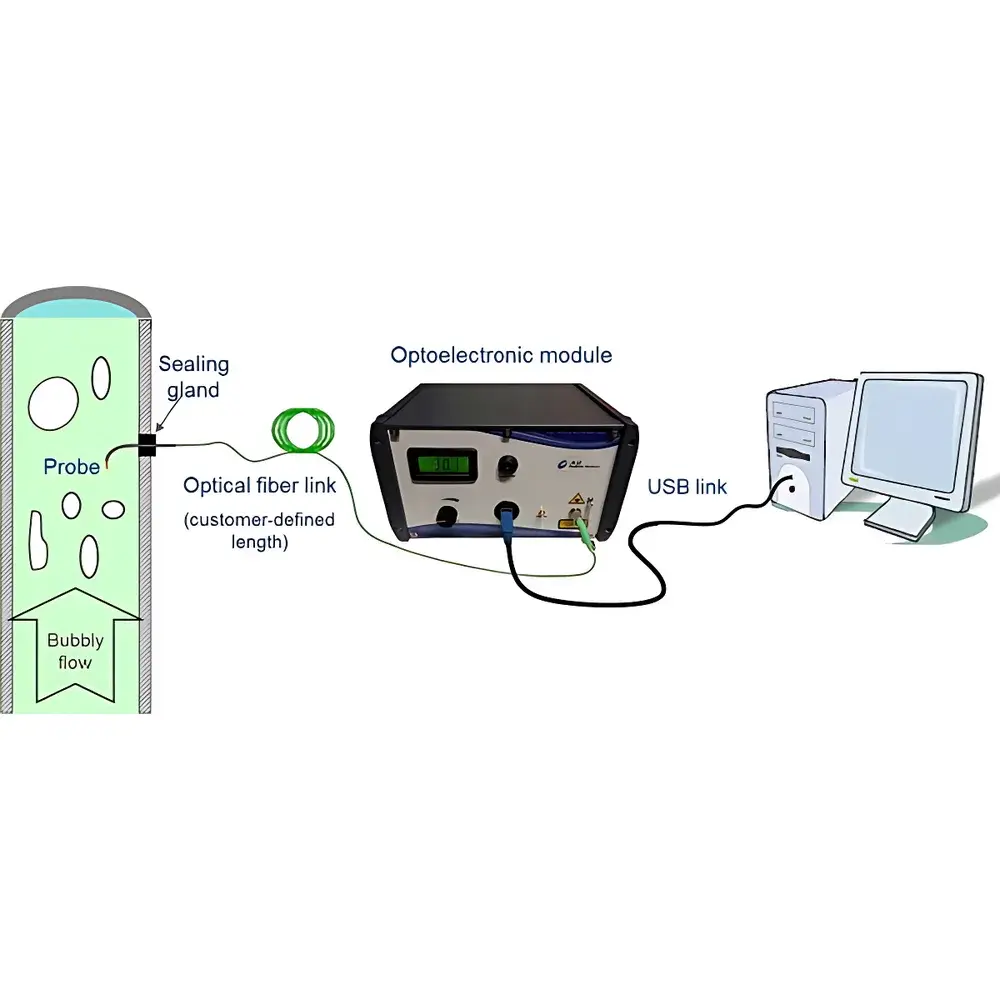
| Measurement Principle | Single-point optical fiber probe based on laser reflectometry at gas–liquid interfaces |
| Void Fraction Range | 0–100% |
| Velocity Range | 0.1–160 m/s |
| Minimum Detectable Bubble Size | >250 µm |
| Accuracy | Void Fraction ±5%, Velocity & Size ±10% |
| Operating Conditions | Up to 10 bar, up to 200 °C |
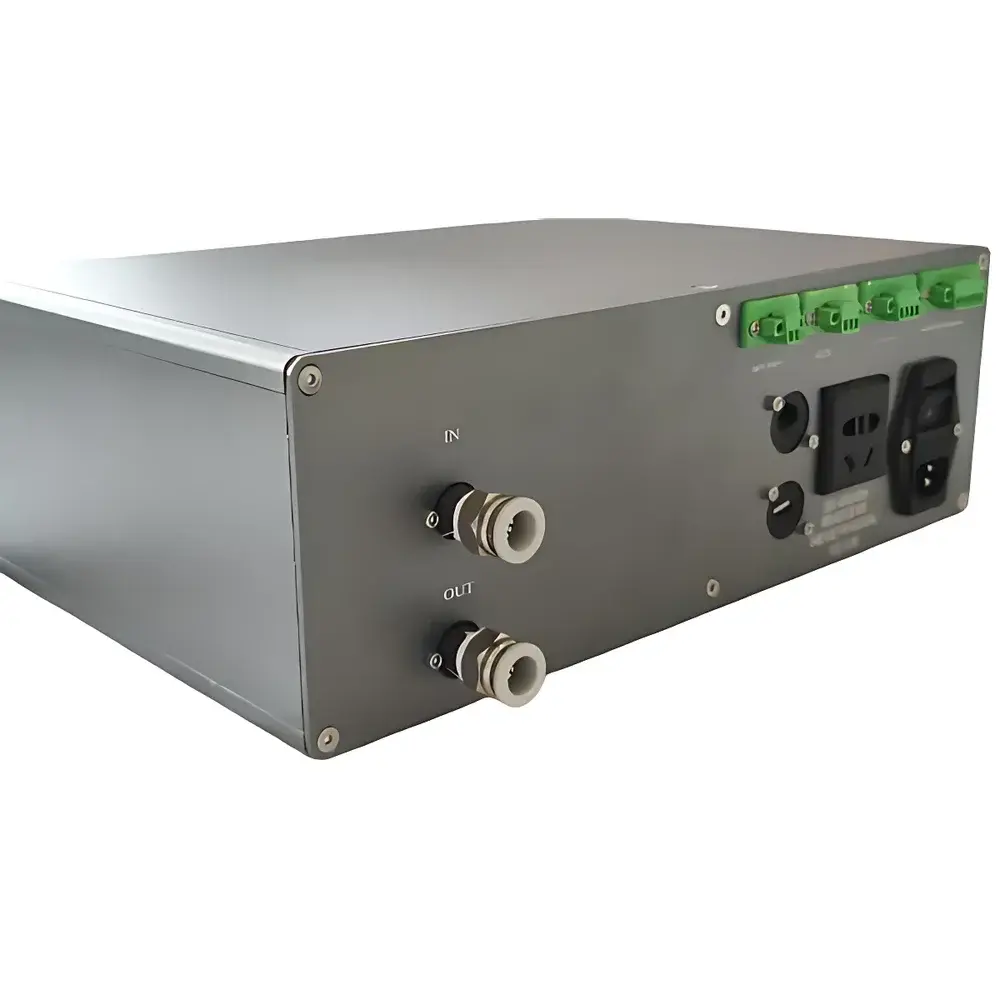
| Interface | USB, PCIe, ExpressCard |
| Software Platform | Windows-native real-time acquisition and analysis suite with raw data logging |
Overview
The A2 Photonic Sensors M2 Laser-Based Bubble Detection and Spray Monitoring System is an industrial-grade, single-point optical fiber probe engineered for real-time, in-situ characterization of gas–liquid two-phase flows in demanding process environments. Unlike imaging-based techniques (e.g., high-speed videography or PIV), the M2 operates on laser reflectometry—detecting transient changes in optical reflectivity at the probe tip as gas bubbles or droplets pass across the sensing zone. This principle enables robust operation in opaque, highly viscous, or optically heterogeneous media where conventional optical methods fail. The system delivers localized, high-temporal-resolution measurements of local void fraction (α), bubble/droplet velocity, and equivalent spherical diameter—quantities essential for spray pyrolysis optimization, spray drying nozzle calibration, atomization efficiency assessment, and reactive multiphase reactor control. Its compact, ruggedized probe design (diameter <1 mm) minimizes flow disturbance and supports integration into pressurized vessels, high-temperature ducts, and confined nozzles—making it suitable for continuous monitoring under ISO 9001-compliant manufacturing lines and GLP-aligned R&D facilities.
Key Features
- Single-fiber optical probe with sub-millimeter tip geometry for minimal intrusion and high spatial resolution
- Laser reflectometry detection insensitive to liquid opacity, turbidity, or suspended solids
- Real-time simultaneous output of local void fraction (0–100%), bubble/droplet velocity (0.1–160 m/s), and size distribution (≥250 µm)
- High-frequency signal acquisition (up to MHz sampling rate) enabling capture of transient spray dynamics and burst events
- Operational compatibility with extreme process conditions: up to 10 bar pressure and 200 °C temperature
- Robust mechanical housing rated for industrial vibration, EMI, and chemical exposure per IEC 60529 IP67 specifications
- No calibration required for baseline operation; factory-traceable performance verification available upon request
Sample Compatibility & Compliance
The M2 probe is compatible with a broad range of industrial fluids—including aqueous solutions, organic solvents, polymer melts, slurries, and molten salts—regardless of optical transparency or viscosity. It does not require refractive index matching or optical access windows, eliminating alignment drift and maintenance downtime associated with camera-based systems. The probe conforms to CE marking requirements and meets electromagnetic compatibility standards per EN 61326-1. While not intrinsically safe by default, explosion-proof variants (ATEX/IECEx certified housings) are available for Zone 1/21 hazardous area deployment. Data integrity protocols align with FDA 21 CFR Part 11 expectations when used with validated software configurations, supporting audit trails, electronic signatures, and raw data retention for regulatory submissions.
Software & Data Management
The M2 is operated via A2 Photonic Sensors’ proprietary Windows-based acquisition and analysis platform. The software provides synchronized multi-channel time-series recording, configurable trigger logic, and automated post-processing routines for void fraction histograms, velocity probability density functions, and bubble size distributions. All raw voltage-time signals are stored in open binary format (IEEE 754 double-precision), ensuring full traceability and third-party interoperability (MATLAB, Python, LabVIEW). The application supports real-time visualization, alarm thresholds, and export to CSV, HDF5, or ASCII for integration into SCADA or MES systems. Audit logs record user actions, parameter changes, and session metadata—enabling compliance with GLP/GMP documentation requirements.
Applications
- Spray pyrolysis process monitoring: quantifying droplet residence time, evaporation front progression, and precursor decomposition uniformity
- Spray drying chamber diagnostics: mapping local void fraction gradients near atomizers and cyclone inlets to optimize powder morphology
- Nozzle performance validation: characterizing spray cone angle, droplet velocity dispersion, and breakup regimes under varying feed pressures
- Chemical reactor gas-sparging control: detecting slug flow transitions, bubble coalescence frequency, and mass transfer coefficient surrogates
- Agricultural spray drift modeling: field-deployable validation of droplet size spectra under wind-tunnel or open-field conditions
- Hydraulic structure aeration studies: void fraction profiling across stepped spillways, vortex chambers, and aerated weirs
FAQ
Can the M2 probe be used in opaque or highly scattering liquids?
Yes—the system relies on localized laser reflectivity at the probe tip and does not require bulk optical transmission.
Is temperature compensation built into the sensor electronics?
The probe head is passively temperature-stabilized; active thermal drift correction is applied in software using embedded thermistor feedback.
Does the system support synchronization with external triggers (e.g., pump pulses or valve actuation)?
Yes—TTL-compatible trigger input and output ports enable hardware-level synchronization with PLCs or high-speed cameras.
What is the minimum recommended distance between multiple M2 probes in a cross-sectional array?
To avoid optical crosstalk, a center-to-center spacing ≥5 mm is recommended for standard configurations.
Is raw signal replay functionality available for method validation?
Yes—acquired waveforms are stored losslessly and can be reloaded into the software for algorithm verification, threshold tuning, or inter-laboratory comparison.
Related Products