
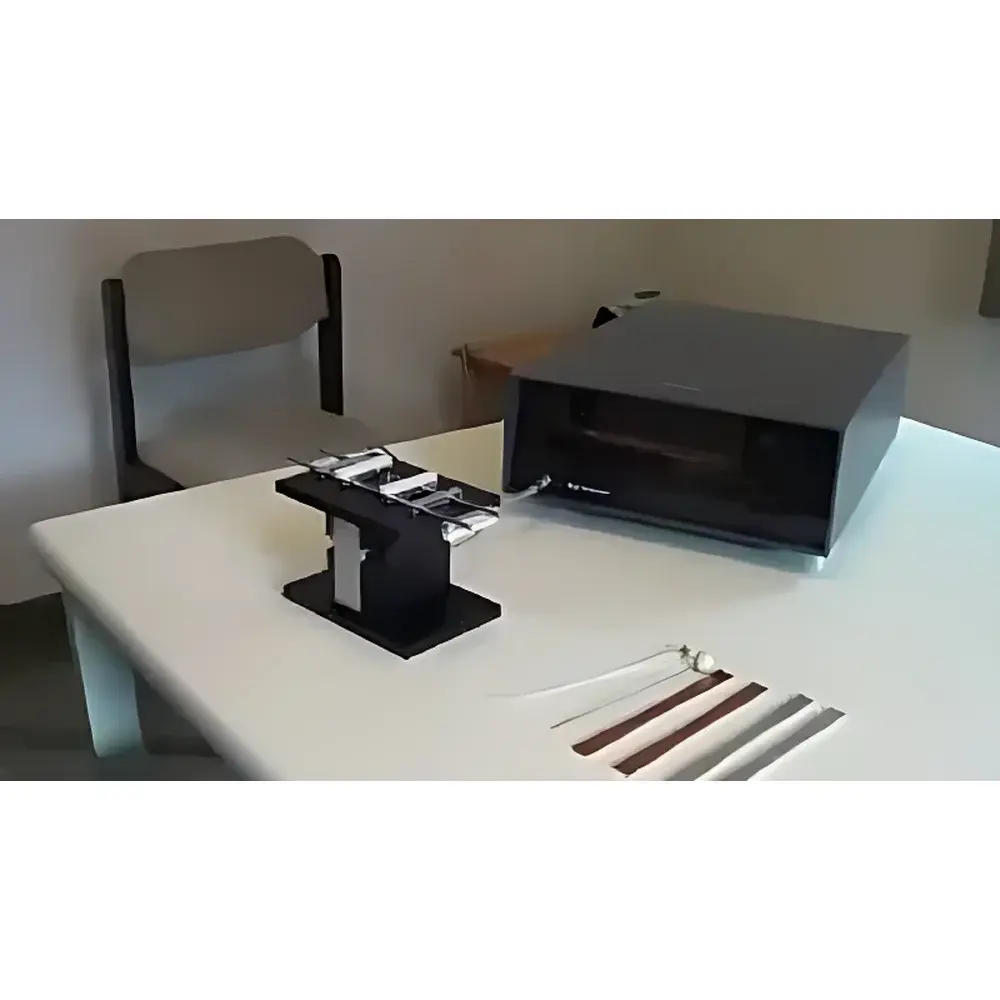
WH-Ki High-Temperature Resonance Elastic Modulus Tester
| Origin | Belgium |
|---|---|
| Manufacturer Type | Authorized Distributor |
| Origin Category | Imported |
| Model | WH-Ki |
| Pricing | Upon Request |
Overview
The WH-Ki High-Temperature Resonance Elastic Modulus Tester is a precision instrument engineered for non-destructive determination of dynamic elastic properties—including Young’s modulus, shear modulus, and Poisson’s ratio—based on the principle of free vibration resonance. It operates by exciting a freely supported sample (e.g., bar, rod, or disk) via mechanical impulse (e.g., light tap), then capturing its natural resonant frequencies using high-sensitivity vibration or acoustic transducers. These measured frequencies are directly related to the sample’s geometry, density, and elastic constants via classical beam and plate vibration theory (e.g., Euler–Bernoulli and Rayleigh–Ritz formulations). Unlike static tensile or ultrasonic pulse-echo methods, this resonance technique delivers high reproducibility with minimal operator dependency and eliminates the need for complex boundary condition control or couplant media. The system supports continuous operation from cryogenic temperatures (−180 °C) up to 1500 °C when integrated with certified high-temperature furnaces or environmental chambers—enabling real-time tracking of elastic property evolution during thermal cycling, sintering, phase transformation, or creep studies.
Key Features
- Non-destructive, contact-based resonance measurement with no sample damage or surface preparation required
- Simultaneous extraction of Young’s modulus (E), shear modulus (G), and Poisson’s ratio (ν) from a single frequency spectrum
- Extended temperature range: −180 °C to 1500 °C (furnace/chamber integration optional but required for elevated-temperature operation)
- Frequency acquisition bandwidth: 30 Hz to 100 kHz with amplitude resolution better than 0.005% of full scale
- Robust mechanical architecture designed for laboratory and industrial QC environments, including vibration-isolated base options
- Modular sensor interface supporting both piezoelectric vibration accelerometers and air-coupled acoustic emission sensors
Sample Compatibility & Compliance
The WH-Ki system accommodates diverse solid materials exhibiting linear elastic behavior within the test frequency band, including but not limited to: structural concretes and cements, technical ceramics (Al₂O₃, SiC, ZrO₂), oxide and non-oxide glasses, ferrous and non-ferrous metals/alloys (e.g., stainless steels, Ti-6Al-4V, Inconel), thermoplastics and thermosets, natural stones, timber, and fiber-reinforced composites. Sample geometries include rectangular bars (minimum L/W ≥ 3, typical 3 × 4 × 40 mm), cylindrical rods, and disks (D/t ≥ 4; optimal D/t = 10–20). Bulk components (e.g., turbine blades, refractory bricks, castings) may be tested in situ without sectioning. All measurements comply with ASTM E1876–22 (“Standard Test Method for Dynamic Young’s Modulus, Shear Modulus, and Poisson’s Ratio by Impulse Excitation of Vibration”) and ISO 12680–1:2015 (“Refractory products — Determination of dynamic Young’s modulus by impulse excitation of vibration”). Data integrity meets GLP/GMP traceability requirements when configured with audit-trail-enabled software and calibrated transducers.
Software & Data Management
The WH-Ki control and analysis suite runs on Windows-based platforms and provides real-time FFT-based spectral acquisition, automatic peak detection, and multi-mode curve fitting (flexural, torsional, longitudinal). Material density input (measured independently or imported from database) is required for modulus calculation. The software exports ASCII/CSV files compatible with MATLAB, Python (NumPy/Pandas), and statistical QC packages. Optional FDA 21 CFR Part 11 compliance modules include electronic signatures, role-based access control, and immutable audit trails for regulated environments. Calibration certificates for transducers and reference standards (e.g., NIST-traceable quartz and fused silica bars) are provided with each system shipment.
Applications
- Quality assurance of refractory linings and ceramic components in metallurgical and glass manufacturing
- In-process monitoring of concrete curing kinetics and early-age stiffness development
- Thermal stability assessment of aerospace composites under simulated re-entry conditions
- Phase transition detection in shape-memory alloys via modulus discontinuities during heating/cooling ramps
- Microstructural evolution studies in powder metallurgy sintering (e.g., pore closure onset)
- Comparative evaluation of aging effects in polymer matrix composites exposed to UV/thermal/humidity stressors
FAQ
What temperature ranges require external furnace integration?
Operation above ambient (25 °C) or below −40 °C requires externally sourced, WH-Ki–compatible environmental chambers or tube furnaces with precise PID control and thermocouple feedback (Type S, R, or B for >1000 °C).
Can the system measure anisotropic materials such as wood or fiber composites?
Yes—orthotropic elastic constants can be derived by testing specimens cut along principal material axes and applying directional vibration mode analysis.
Is sample mass or density required for modulus calculation?
Yes—density must be known or measured separately (e.g., via Archimedes’ principle or gas pycnometry); the software uses density, dimensions, and resonant frequencies to compute moduli.
How is measurement repeatability ensured across different operators?
The impulse excitation method minimizes human variability; automated signal triggering and standardized tap location protocols (per ASTM E1876) ensure inter-operator reproducibility better than ±0.3% for homogeneous samples.
Are calibration standards included with the system?
A set of certified reference bars (e.g., fused silica, stainless steel 316L) with documented density and nominal moduli is supplied for daily verification and drift correction.



