
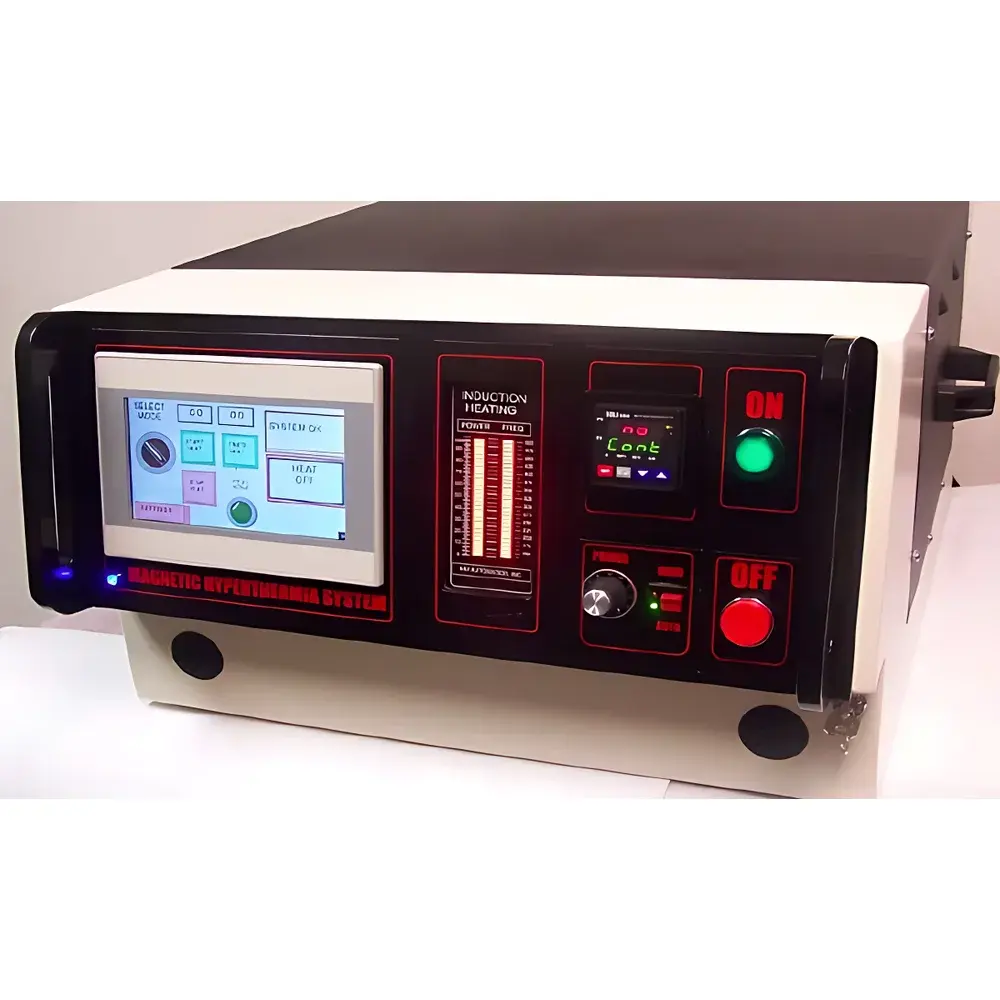
MSI Magnetic Hyperthermia System
| Origin | USA |
|---|---|
| Manufacturer Type | Authorized Distributor |
| Origin Category | Imported |
| Model | MSI |
| Pricing | Available Upon Request |
Overview
The MSI Magnetic Hyperthermia System is an advanced preclinical research platform engineered for controlled, non-invasive magnetic nanoparticle-mediated hyperthermia in oncology studies. It operates on the principle of alternating magnetic field (AMF)-induced heating of superparamagnetic iron oxide nanoparticles (SPIONs) or magnetoliposomes administered intratumorally or systemically. When exposed to a precisely tuned AMF (typically 100–500 kHz, field strength up to 20 kA/m), these nanoparticles convert electromagnetic energy into localized thermal energy via Néel and Brownian relaxation mechanisms. This enables selective elevation of tumor tissue temperature to the therapeutic window of 42–45 °C — a range sufficient to induce heat shock protein expression, disrupt membrane integrity, impair DNA repair, and sensitize malignant cells to concurrent chemotherapy or radiotherapy — without exceeding the thermal damage threshold for surrounding healthy tissue.
Key Features
- Programmable AMF generator with real-time field amplitude and frequency control (range: 100–500 kHz; max. H-field: 20 kA/m)
- Optimized solenoid coil assembly with 120 mm inner diameter — enabling uniform field distribution across larger preclinical models (e.g., rabbits, mini-pigs) beyond standard murine subjects
- Integrated fiber-optic temperature monitoring interface compatible with multiple thermometric probes (e.g., Luxtron, Neoptix) for real-time, artifact-free intratumoral thermometry
- Automated sequence programming for multi-stage protocols: preconditioning, ramp-up, plateau (42–45 °C), and controlled cooldown
- EMC-compliant architecture meeting IEC 61000-6-3/6-4 standards for laboratory electromagnetic compatibility
- Modular design supporting integration with MRI-compatible positioning stages and in vivo imaging platforms (e.g., PET/MRI co-registration workflows)
Sample Compatibility & Compliance
The MSI system is validated for use with clinically relevant magnetic nanocarriers including dextran-coated SPIONs, PEGylated magnetoliposomes, and theranostic iron oxide–drug conjugates. It supports both intratumoral injection and systemic administration routes in rodent and non-rodent models. All operational parameters comply with ISO 10993-1 (biocompatibility evaluation of medical devices) and ASTM F2129 (electrochemical corrosion testing of implantable sensors), where applicable to nanoparticle delivery validation. The system’s thermal dosimetry framework aligns with the recommendations of the International Society for Magnetic Hyperthermia (ISMH) and adheres to GLP principles for preclinical efficacy and safety studies.
Software & Data Management
The proprietary MSI Control Suite provides FDA 21 CFR Part 11–compliant software with role-based user access, electronic signatures, and full audit trail functionality. Real-time data streams — including field intensity, coil current, frequency, and synchronized temperature readings — are logged at ≥10 Hz resolution and exported in HDF5 or CSV format for downstream analysis in MATLAB, Python (NumPy/Pandas), or commercial PK/PD modeling tools (e.g., Phoenix WinNonlin). Automated report generation includes thermal dose metrics (CEM43, t43), spatial temperature variance maps, and protocol deviation alerts.
Applications
- Preclinical evaluation of magnetic nanoparticle biodistribution and thermosensitivity in orthotopic and metastatic tumor models
- Synergistic therapy development combining magnetic hyperthermia with checkpoint inhibitors, PARP inhibitors, or antibody–drug conjugates
- In vivo validation of temperature-responsive drug release kinetics from magnetoliposomes under physiological perfusion conditions
- Thermal dose optimization studies correlating CEM43 values with histopathological outcomes (e.g., TUNEL staining, HSP70 immunohistochemistry)
- Translational feasibility assessment for first-in-human (FIH) trials — supporting Investigational New Drug (IND) application documentation
FAQ
What nanoparticle types are compatible with the MSI system?
The system has been validated with iron oxide–based nanoparticles (SPIONs, magnetoliposomes, and core–shell architectures) exhibiting specific loss power (SLP) >100 W/gFe at 150 kHz / 12 kA/m.
Can the MSI system be used inside an MRI scanner?
No — the MSI generates high-power AMF and is not MRI-compatible. However, it supports sequential MRI–hyperthermia workflows using shared animal handling platforms and co-registered anatomical/thermal imaging.
Does the system include regulatory documentation for IND-enabling studies?
Yes — comprehensive Design History File (DHF), Risk Management File (ISO 14971), and verification/validation test reports are provided to support GLP-compliant toxicology and pharmacokinetic studies.
Is remote operation supported?
Yes — secure SSH and VNC interfaces enable supervised remote protocol execution and real-time data monitoring from off-site locations, subject to institutional IT security policies.
What calibration standards does the system follow?
Field strength calibration is traceable to NIST SRM 2780 (AC current reference standard); temperature measurements are certified per ASTM E2847 for fiber-optic thermometry accuracy (±0.1 °C in 37–45 °C range).





