
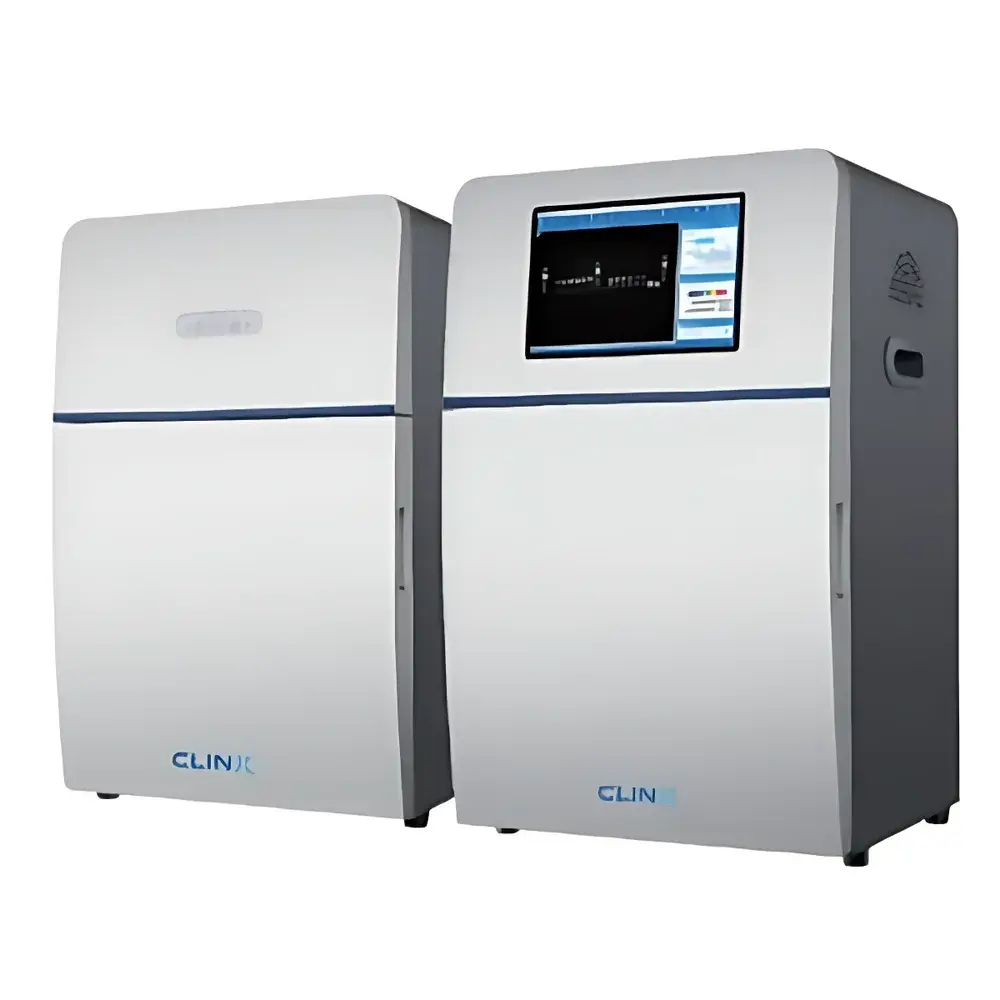
CLINX GenoSens 2250 Gel Imaging System
| Brand | CLINX |
|---|---|
| Origin | Shanghai, China |
| Model | GenoSens 2250 |
| Camera Resolution | 6.3 MP (3072 × 2048) |
| Bit Depth | 16-bit |
| Dynamic Range | 4.0 OD |
| Transmission Area | 21 cm × 26 cm |
| UV Transillumination | 302 nm / 365 nm LED |
| Blue Light Transillumination | 470 nm LED |
| White Light Transillumination | LED |
| Reflected Fluorescence Excitation | 365/470/530/630/660/730 nm LEDs |
| Emission Filters | 460/525/585/690/715/810 nm |
| Image Capture Area | 19.5 cm × 30 cm |
| Dimensions (W×D×H) | 435 mm × 395 mm × 700 mm |
Overview
The CLINX GenoSens 2250 Gel Imaging System is a high-performance, fully integrated digital imaging platform engineered for quantitative analysis of nucleic acid and protein electrophoresis gels. It employs a scientific-grade 16-bit CCD sensor with 6.3 megapixel resolution and a calibrated optical path to deliver reproducible, low-noise images across a dynamic range of 4.0 optical density (OD). Designed around a modular LED-based illumination architecture—including switchable 302 nm and 365 nm UV transilluminators, 470 nm blue-light excitation, uniform white-light transmission, and six selectable reflected fluorescence excitation wavelengths—the system supports multiplexed detection of ethidium bromide, SYBR dyes, GelSignal™ reagents, Coomassie-stained proteins, silver-stained gels, and fluorescently labeled samples. Its precision-engineered auto-focus lens and real-time image preview enable rapid optimization of exposure and focus parameters without manual calibration drift. The system complies with core laboratory imaging requirements for documentation integrity, including traceable acquisition metadata, audit-ready operation logs, and exportable raw data formats compatible with GLP- and GMP-aligned workflows.
Key Features
- Scientific-grade 16-bit CCD camera (3072 × 2048 pixels) delivering high signal-to-noise ratio and linear response across full dynamic range.
- Motorized auto-focus lens with real-time preview and pixel-precise focusing control for consistent band resolution.
- Dual-wavelength UV transillumination (302 nm / 365 nm) and dedicated 470 nm blue-light source—both rated for >30,000 hours lifetime and >90% illumination uniformity.
- White-light LED transilluminator optimized for Coomassie, silver, and label-free protein gel visualization.
- Reflected fluorescence module with six excitation wavelengths (365–730 nm) and matched emission filters (460–810 nm) for multiplexed fluorescent probe detection.
- Integrated 10.1-inch industrial touchscreen interface with optional external PC connectivity via dual USB 2.0 ports.
- Pixel binning modes (1×1 to 4×4) enabling sensitivity adjustment for low-abundance targets without hardware modification.
Sample Compatibility & Compliance
The GenoSens 2250 supports standard agarose and polyacrylamide gel formats up to 21 cm × 26 cm, accommodating common mini- and midi-gel cassettes. It is validated for use with industry-standard nucleic acid stains—including ethidium bromide, SYBR® Green I/II, SYBR® Safe, SYBR® Gold, GelSignal™ Red/Green, and GelStar®—as well as protein-compatible dyes such as Coomassie Brilliant Blue R-250, silver nitrate, SYPRO® Ruby, SYPRO® Orange, and SYPRO® Red. All illumination sources meet IEC 62471 photobiological safety classification for UV-A and visible light emissions. The system’s software enforces user-level access control and maintains immutable acquisition logs—including timestamp, exposure time, lens position, illumination mode, and gain settings—supporting compliance with FDA 21 CFR Part 11, ISO/IEC 17025, and internal QA/QC protocols requiring instrument traceability.
Software & Data Management
The GenoSens Image Acquisition and Analysis Software provides a unified interface for instrument control, image capture, and quantitative analysis. It features real-time preview with histogram overlay, automatic exposure calculation, and one-click acquisition presets. Image processing includes rotation, cropping, inversion, pseudo-color mapping, and background subtraction per lane. Quantitative analysis modules perform automated lane and band detection, calculate integrated optical density (IOD), relative mobility (Rf), molecular weight estimation (via standard curve fitting), and concentration normalization against reference bands. All results—including annotated images, measurement tables, and metadata—are exportable in TIFF, PNG, JPEG, and Excel (.xlsx) formats. The multi-tier user account system supports role-based permissions (Administrator, Operator, Viewer), with full audit trail logging of all software actions. PDF report generation includes operator ID, acquisition parameters, analysis settings, and embedded raw image thumbnails—suitable for regulatory submissions and internal documentation archives.
Applications
The GenoSens 2250 serves as a primary imaging tool in molecular biology, proteomics, and quality control laboratories. Typical applications include: verification of PCR product size and purity; quantification of DNA fragments in restriction digests or cloning workflows; comparative analysis of gene expression via RT-PCR or Northern blotting; assessment of protein expression levels and post-translational modifications using SDS-PAGE; validation of CRISPR editing efficiency through T7E1 or Surveyor assays; and routine QC of recombinant protein purification batches. Its broad spectral flexibility also enables emerging applications such as algae colony imaging under blue-light excitation and fluorescence-based viability assays in cell culture models.
FAQ
What is the maximum gel size supported by the GenoSens 2250?
The system accommodates gels up to 21 cm × 26 cm on the transilluminator stage, with an effective imaging area of 19.5 cm × 30 cm when using the extended field-of-view configuration.
Does the software support calibration with molecular weight standards?
Yes—the analysis module allows users to define custom standard curves using known molecular weight markers, enabling automatic MW estimation for unknown bands across multiple lanes.
Is the system compliant with FDA 21 CFR Part 11 requirements?
The software implements electronic signatures, user authentication, audit trails, and data integrity safeguards aligned with 21 CFR Part 11 Annex A guidance for closed systems; full validation documentation is available upon request.
Can the GenoSens 2250 be used for chemiluminescent detection?
No—the system is optimized for fluorescence, UV, and visible-light transillumination and reflection; it does not include cooled CCD or long-exposure capabilities required for chemiluminescence.
How is illumination uniformity verified during factory calibration?
Each unit undergoes flat-field correction using NIST-traceable photometric standards, and uniformity is validated at ≥90% across the active imaging area prior to shipment.




