
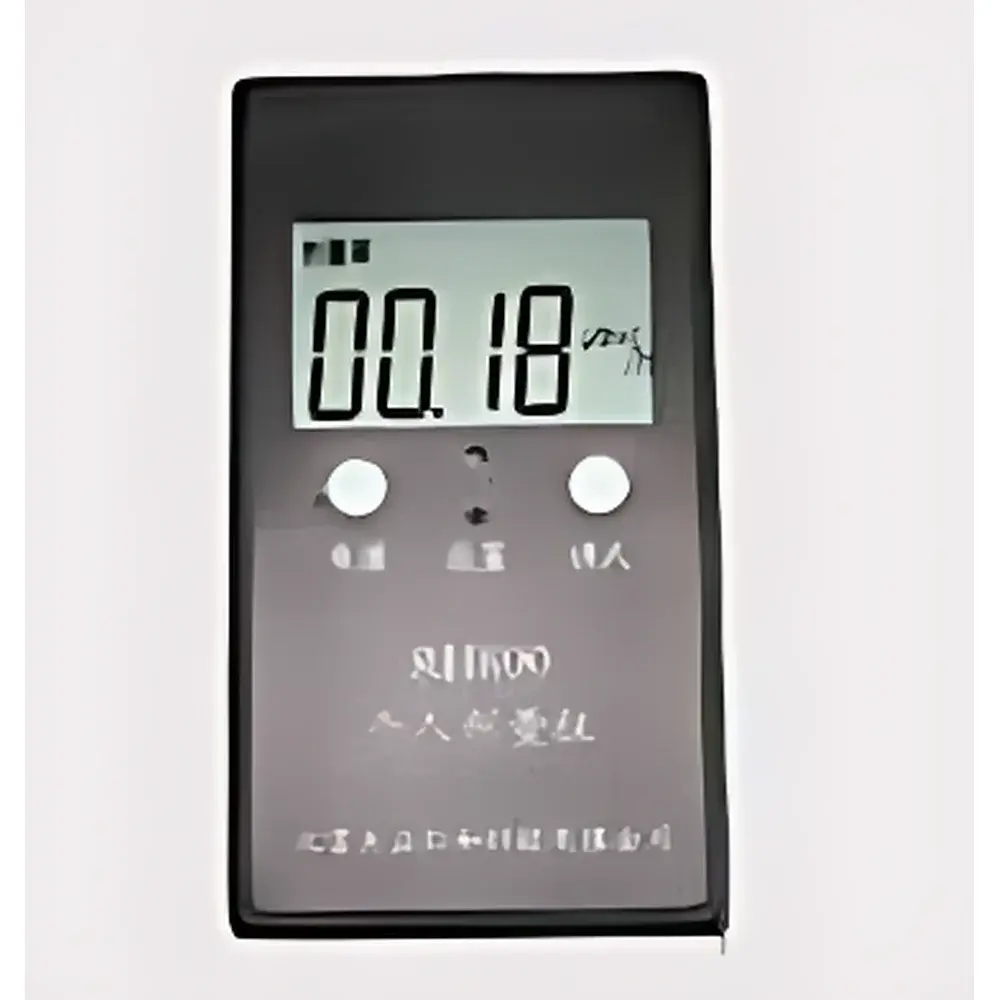
RH800 Personal Dosimeter Alarm
| Origin | Beijing, China |
|---|---|
| Manufacturer Type | Distributor |
| Origin Category | Domestic |
| Model | RH800 |
| Pricing | Upon Request |
| Detector | GM Tube |
| Energy Response | ±30% (50 keV–1.3 MeV) |
| Dose Equivalent Rate Range | 0.01 µSv/h–1.00 mSv/h |
| Cumulative Dose Equivalent Range | 0.01 µSv–99.99 mSv |
| Measurement Time | 5 s |
| Relative Error | ±20% (¹³⁷Cs) |
| Alarm Threshold | User-Configurable |
| Power Supply | Two AA batteries |
| Current Consumption | <2 mA |
| Operating Temperature | −10 °C to +40 °C |
| Temperature Drift | ±10% |
| Humidity Drift | ±15% at 95% RH (+40 °C) |
| Dimensions | 118 × 65 × 25 mm |
| Weight | <100 g |
Overview
The RH800 Personal Dosimeter Alarm is a compact, microcontroller-based radiation monitoring instrument engineered for real-time measurement of ambient dose equivalent rate (Ḣ*(10)) and cumulative dose equivalent (H*(10)) from X-ray and gamma-ray fields. It operates on the principle of gas ionization detection using a Geiger-Müller (GM) tube, providing immediate audible and visual alerts when preset dose or dose rate thresholds are exceeded. Designed in strict compliance with IEC 61526:2010 (Radiation protection instrumentation – Measurement of personal dose equivalents Hp(10) and Hp(0.07)) and GB/T 10284–2018 (Chinese national standard for portable X- and γ-ray dosimeters), the RH800 delivers reliable performance across occupational exposure scenarios where continuous, hands-free personnel monitoring is required. Its robust architecture supports stable operation under variable environmental conditions, making it suitable for deployment in high-stakes radiological environments without reliance on external infrastructure.
Key Features
- High-sensitivity GM tube detector with calibrated energy response over 50 keV–1.3 MeV (±30%), ensuring accurate readings across common diagnostic and industrial photon spectra;
- Simultaneous real-time display of both instantaneous dose equivalent rate (µSv/h) and accumulated dose equivalent (µSv/mSv) on a backlit LCD screen;
- User-configurable alarm thresholds for both dose rate and total dose, supporting site-specific safety protocols and ALARA (As Low As Reasonably Achievable) compliance;
- Ultra-low power consumption (<2 mA average current draw) enables extended field operation—typically >2,000 hours on two standard AA alkaline cells;
- Compact form factor (118 × 65 × 25 mm) and lightweight design (<100 g) facilitate unobtrusive wear on clothing or belt clips during prolonged shifts;
- Integrated battery voltage monitoring with clear low-power warning indication prior to operational failure, preventing undetected loss of monitoring capability.
Sample Compatibility & Compliance
The RH800 is optimized for direct measurement of penetrating photon radiation (X and γ) incident upon the human torso. It does not require calibration against specific radionuclides beyond the reference ¹³⁷Cs source used for factory verification (±20% relative error). The device meets essential requirements of ISO 4037-3 for radiation protection instrumentation and aligns with regulatory expectations for personal dosimetry in nuclear medicine, industrial radiography, and border security applications. While not intended as a primary legal dosimeter for regulatory recordkeeping (e.g., replacing TLD or OSL badges subject to ISO/IEC 17025-accredited calibration), it serves as a critical secondary alarm and situational awareness tool compliant with IAEA Safety Standards Series No. RS-G-1.3 and national occupational exposure limits (e.g., 20 mSv/year averaged over 5 years per ICRP recommendations).
Software & Data Management
The RH800 operates as a standalone, firmware-embedded instrument with no onboard data logging or Bluetooth/Wi-Fi connectivity. All operational parameters—including alarm thresholds, unit selection (µSv/h vs. mR/h), and display brightness—are configured via tactile push-button interface. While it lacks digital export capabilities, its deterministic 5-second measurement cycle and consistent response characteristics enable seamless integration into manual logbook workflows and periodic QA audits. For facilities requiring electronic dose tracking, the RH800 functions effectively alongside centralized radiation safety management systems (e.g., RadWorker™, DOSIsoft) by providing immediate operator feedback that informs subsequent badge issuance, zone access control, or procedural review—supporting GLP-aligned documentation practices without introducing software validation overhead.
Applications
- Radiation safety officers conducting routine surveys in nuclear power plant auxiliary buildings and spent fuel handling areas;
- Industrial NDT technicians performing gamma radiography in confined or high-background locations where rapid dose escalation must be detected;
- Customs and border protection personnel screening cargo containers with suspected radioactive materials;
- Hospital radiotherapy departments monitoring staff proximity to Co-60 teletherapy units or high-dose-rate brachytherapy suites;
- Research laboratories utilizing sealed gamma sources (e.g., ¹³⁷Cs, ⁶⁰Co) for instrument calibration or shielding validation studies;
- Emergency response teams operating in post-incident radiological environments where early warning of elevated field intensity is mission-critical.
FAQ
Does the RH800 require annual calibration?
Yes—per IEC 61526 and national regulatory guidance, field instruments used for occupational dose assessment should undergo traceable calibration at least once per year using accredited reference sources (e.g., ¹³⁷Cs or ⁶⁰Co) and documented procedures.
Can it measure beta or neutron radiation?
No—the GM tube is inherently insensitive to neutrons and exhibits minimal response to beta particles due to its metal-walled construction and lack of thin entrance window; it is certified exclusively for X/γ photons.
Is the RH800 suitable for use in high-humidity environments such as coastal nuclear facilities?
Yes—its humidity-induced drift is specified at ±15% at 95% RH and +40 °C, meeting operational requirements for tropical or marine deployments when housed within standard protective cases.
What happens when the battery voltage drops below operational threshold?
The LCD displays a dedicated low-battery icon and the instrument ceases dose accumulation and alarm generation; no silent failure mode is permitted per design safety requirements.
Does the device support multi-level alarm differentiation (e.g., caution vs. danger)?
No—it provides a single configurable threshold with unified audio-visual alert; tiered alarms require external supervisory systems or complementary instrumentation.
Related Products







