
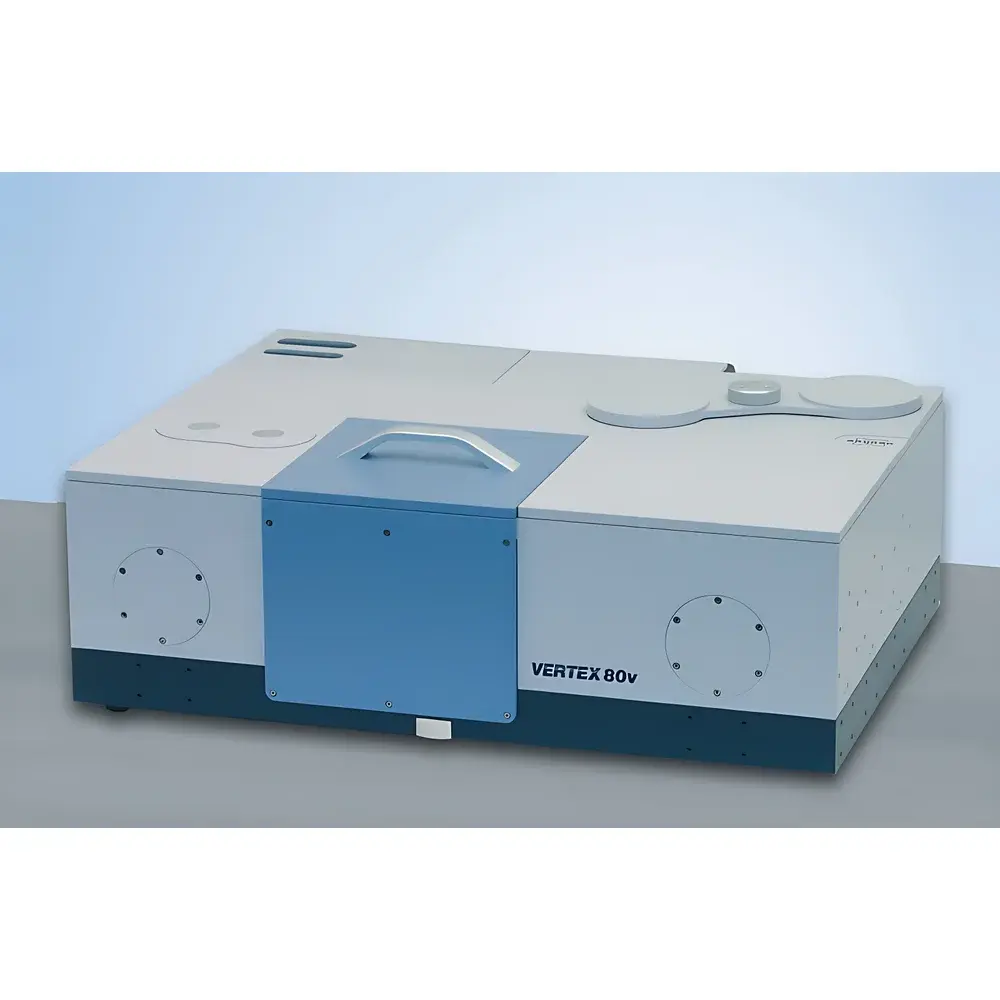
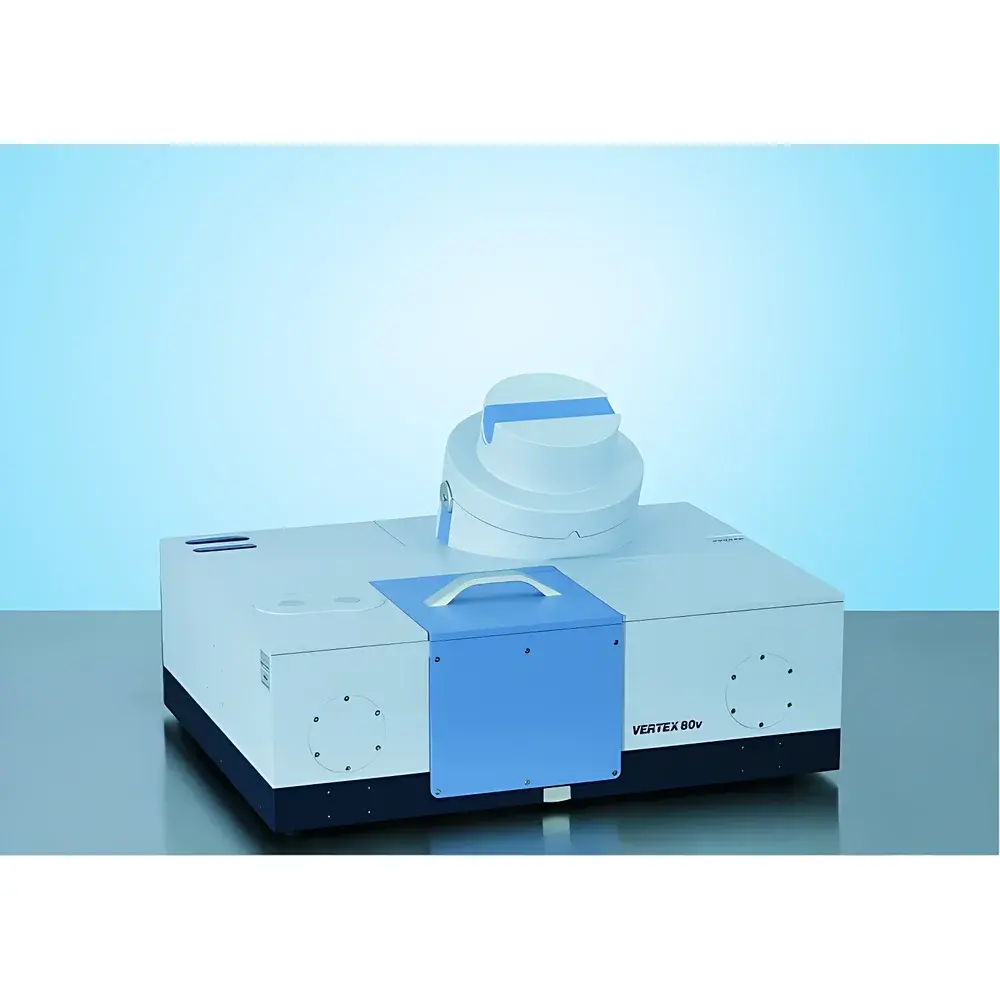
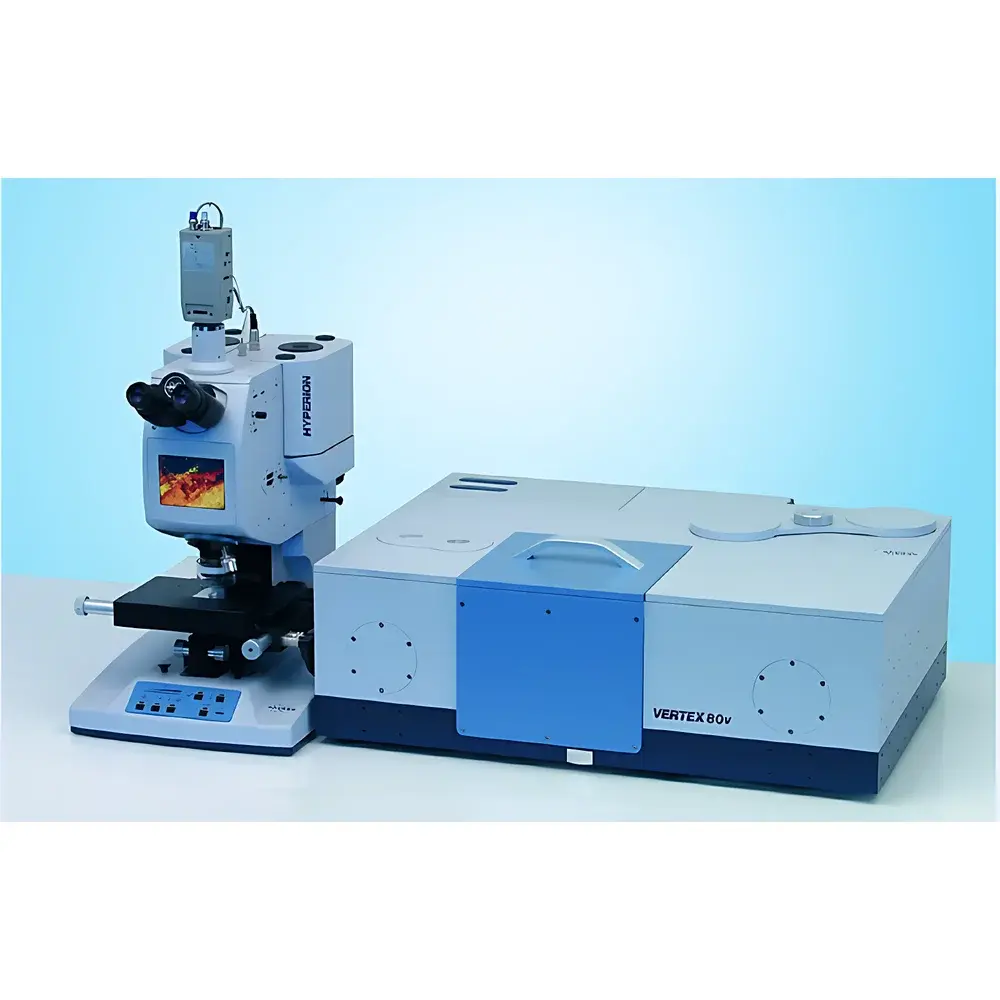
Bruker VERTEX 80 / VERTEX 80v Fourier Transform Infrared (FTIR) Spectrometer
| Brand | Bruker |
|---|---|
| Origin | Germany |
| Model | VERTEX 80 / VERTEX 80v |
| Instrument Type | Laboratory FTIR Spectrometer |
| Wavenumber Range | 50000–5 cm⁻¹ |
| Spectral Resolution | < 0.06 cm⁻¹ |
| Scan Speed | 115 scans/sec |
| Signal-to-Noise Ratio | 55,000:1 |
| Interferometer | UltraScan™ True-Alignment Patent Interferometer |
| Optical Platform | Fully Vacuum-Compatible Cast-Aluminum Base (VERTEX 80v) |
| Data Acquisition | DigiTect™ Digital Detection Technology |
| Beam Splitter Exchange | Automated, Vacuum-Compatible BMS-c |
| Detector Channels | Dual-Channel, 24-bit High-Speed ADC |
| Light Sources | Integrated Air-Cooled Source + Optional External Water-Cooled High-Power Source |
| Beam Ports | 5 Output Ports + 2 Input Ports |
Overview
The Bruker VERTEX 80 and VERTEX 80v are research-grade Fourier Transform Infrared (FTIR) spectrometers engineered for maximum spectral fidelity, long-term stability, and operational flexibility across the broadest possible infrared spectrum—from ultraviolet (UV)-extended near-IR through mid-IR, far-IR, and into the terahertz (THz) region (50,000–5 cm⁻¹). At the core of both systems lies the UltraScan™ interferometer—a patented, truly collimated design that eliminates alignment drift and ensures intrinsic optical path difference (OPD) linearity. This architecture enables sub-0.06 cm⁻¹ resolution performance without mechanical recalibration, a critical requirement for high-resolution gas-phase spectroscopy, isotopic analysis, and ultrafine vibrational band profiling. The VERTEX 80v variant integrates a fully evacuated, monolithic cast-aluminum optical bench, eliminating atmospheric water vapor absorption—particularly consequential below 600 cm⁻¹—thereby enhancing sensitivity, baseline stability, and measurement reproducibility in far-IR and THz applications. Both platforms support step-scan, rapid-scan, and time-resolved measurements, making them suitable for synchrotron IR beamline coupling, pump-probe experiments, and dynamic process monitoring under controlled environments.
Key Features
- UltraScan™ true-alignment interferometer with linear air-bearing scanner and ultra-low-expansion mirror substrates for long-term OPD stability
- DigiTect™ digital signal acquisition architecture—digitizes detector signals directly at the cold finger—eliminating analog noise and grounding loops
- Full vacuum compatibility (VERTEX 80v): hermetically sealed optical compartment with automated pressure regulation and leak-tight sealing (<1×10⁻⁷ mbar/h)
- Automated, vacuum-compatible beam splitter changer (BMS-c) enabling software-controlled, interruption-free switching among KBr, quartz, Mylar, polyethylene, and diamond-based beamsplitters
- Dual-channel, 24-bit analog-to-digital converter supporting simultaneous acquisition from multiple detectors (e.g., DTGS + MCT or bolometer + pyroelectric)
- Integrated air-cooled globar source plus optional external water-cooled high-radiance source for extended dynamic range in low-flux regions (e.g., THz)
- Five independently controllable output beam ports and two input ports for multi-accessory configurations including ATR, transmission cells, emission modules, and external interferometers
Sample Compatibility & Compliance
The VERTEX platform supports universal sample introduction via standardized optics interfaces compliant with ISO 17025 and ASTM E1421-22 for quantitative IR spectroscopy. It accommodates solid, liquid, and gaseous samples using accessories certified to IEC 61000-4 electromagnetic compatibility standards. Vacuum operation (VERTEX 80v) meets GLP/GMP environmental control requirements for trace-level moisture-sensitive analyses. All firmware and data handling modules comply with FDA 21 CFR Part 11 for electronic records and signatures—including full audit trail logging, user role-based access control, and immutable raw data archiving. Instrument qualification documentation (IQ/OQ/PQ) templates are provided per GAMP 5 guidelines.
Software & Data Management
OPUS spectroscopy software (v8.5+) provides complete instrument control, real-time spectral processing, and advanced multivariate analysis (PCA, CLS, PLS). Raw interferograms and spectra are stored in Bruker’s proprietary, metadata-rich .0 format—fully compatible with ASTM E1947-compliant spectral exchange protocols. Batch processing, script automation (via Python API), and integration with LIMS via HL7 or OPC UA ensure scalability in regulated QC laboratories. All spectral acquisitions include embedded calibration traceability to NIST-traceable reference standards (e.g., polystyrene film, water vapor lines), with automatic correction for phase error, laser wavelength drift, and detector nonlinearity.
Applications
- High-resolution rotational-vibrational spectroscopy of transient species and weakly bound complexes
- Far-IR phonon mode analysis in quantum materials, superconductors, and topological insulators
- Time-resolved FTIR for catalytic reaction kinetics and photoinduced charge transfer dynamics
- Terahertz spectroscopy of crystalline polymorphs, pharmaceutical hydrates, and amorphous content quantification
- UV-extended measurements of electronic transitions in conjugated polymers and dye-sensitized systems
- Multi-modal correlative analysis when coupled with synchrotron IR sources or external lasers
FAQ
What distinguishes the VERTEX 80v from the VERTEX 80?
The VERTEX 80v features a fully evacuated, rigid cast-aluminum optical base and vacuum-compatible internal components—including the interferometer, beam splitters, and detectors—enabling artifact-free far-IR and THz measurements.
Is the BMS-c beam splitter changer compatible with continuous vacuum operation?
Yes—the BMS-c is hermetically sealed and actuated via magnetic coupling; no vacuum break is required during spectral range switching.
Can the system be integrated into an automated laboratory workflow?
Absolutely: native support for SCADA, LabVIEW, and custom Python scripts allows seamless integration with robotic sample handlers and enterprise LIMS.
Does OPUS software meet regulatory requirements for pharmaceutical QA/QC?
Yes—OPUS includes 21 CFR Part 11-compliant electronic signatures, full audit trails, and configurable user permissions aligned with Annex 11 and ICH Q5C guidelines.
What detector options are supported for far-IR measurements?
Bolometers, silicon composite detectors, and helium-cooled composite detectors are fully supported with optimized signal conditioning and low-noise preamplifiers.




