
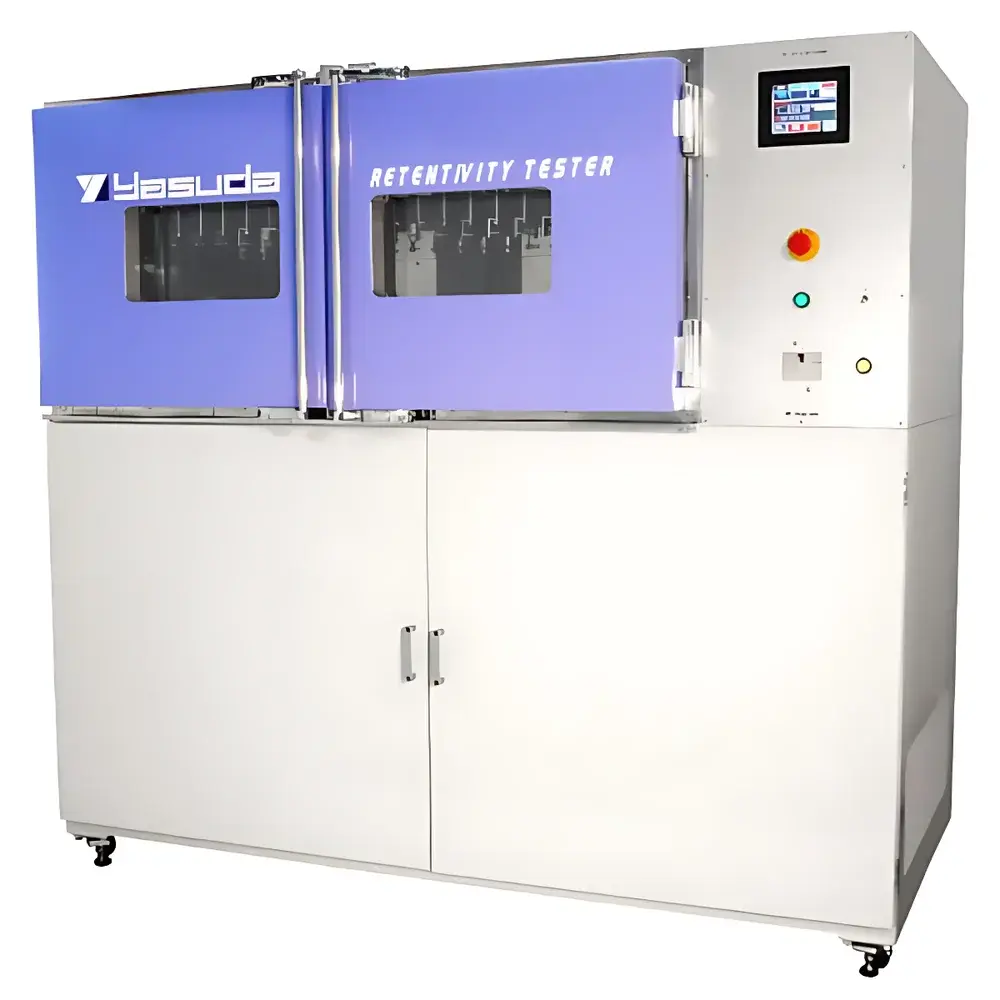
Yasuda No.145-D Stress Relaxation Tester for Adhesive Tape Holding Power Evaluation
| Brand | Yasuda |
|---|---|
| Origin | Japan |
| Model | No.145-D |
| Standard Compliance | JIS Z 0237 |
| Specimen Dimensions | 25 mm × 150 mm (or 12 ± 0.5 mm × 150 mm) |
| Test Plate | SUS304, 50 mm × 125 mm × ≥1.1 mm |
| Load Range | 200 gf to 1,000 gf (±5 g tolerance) |
| Fixture Type | Upper hook-type, Lower flat chuck (30 mm width) |
| Vertical Travel | Max. 45 mm, motorized auto-stop actuation |
| Temperature Capability | Up to 150 °C |
| Timer Functions | Preheating time setting, fall-time measurement, programmable test duration |
| Optional Accessories | Low-temperature chamber, constant temperature/humidity chamber, in-chamber lighting, 90° peel test kit |
| Power Supply & Dimensions | Configuration-dependent |
Overview
The Yasuda No.145-D Stress Relaxation Tester is a precision-engineered instrument designed specifically for quantifying the holding power (i.e., resistance to slippage or detachment under sustained load) of pressure-sensitive adhesive tapes, films, and sheets—primarily used in rubber, plastic, packaging, and automotive component manufacturing. It operates on the fundamental principle of stress relaxation under constant strain: a standardized specimen is affixed vertically to a rigid SUS304 test plate over a defined bonding area (25 mm × 25 mm), subjected to a precisely calibrated static tensile load, and monitored for either displacement over time or total time-to-failure (i.e., complete detachment). This methodology directly aligns with JIS Z 0237, the Japanese Industrial Standard governing adhesive tape performance evaluation, and serves as a critical quality control metric for product shelf-life validation, formulation optimization, and regulatory documentation in ISO 9001-certified production environments.
Key Features
- Modular multi-station configuration: Supports 3, 6, 10, or 20 parallel test positions—enabling statistically robust repeatability and high-throughput batch validation without manual repositioning.
- Traceable mechanical loading system: Applies nominal loads from 200 gf to 1,000 gf with certified tolerance of ±5 g; load verification conforms to JIS B 7738 (force calibration standards).
- Motor-driven vertical actuation: Integrated electromechanical lift mechanism provides precise, repeatable specimen positioning with automatic upper/lower limit stop functionality—eliminating operator-induced variability in initial alignment.
- Thermally stable test environment: Built-in heating capability up to 150 °C enables accelerated aging studies and high-temperature holding power assessment per JIS Z 0237 Annex B; optional integration with environmental chambers extends operational range to sub-zero or controlled RH conditions.
- Programmable digital timer: Independently configurable preheat duration, test duration, and real-time fall-time capture—supports GLP-compliant data logging when paired with validated software.
- Dual-specimen geometry support: Accommodates both 25 mm and 12 ± 0.5 mm specimen widths, ensuring compatibility with legacy test protocols and international harmonization (e.g., ASTM D3654/D3654M referencing similar dimensional constraints).
Sample Compatibility & Compliance
The No.145-D is validated for use with single-layer and laminated pressure-sensitive adhesives—including acrylic, rubber-based, silicone, and hot-melt formulations—applied to PET, PVC, paper, aluminum foil, and elastomeric substrates. Its test plate geometry (50 mm × 125 mm × ≥1.1 mm SUS304) meets surface flatness and rigidity requirements specified in JIS Z 0237 Section 5.2 and ISO 29862:2017 (adhesive tape testing general principles). The fixture design—featuring a hook-type upper clamp and 30 mm flat lower chuck—ensures uniform stress distribution across the bond line while minimizing edge peeling artifacts. All mechanical components are manufactured to JIS B 0401 Grade 7 geometric tolerancing, supporting measurement reproducibility ≤2% RSD across qualified laboratories.
Software & Data Management
While the base unit operates via standalone hardware controls, the No.145-D is compatible with Yasuda’s optional PC-based data acquisition module (Y-DAQ v3.2), which records timestamped displacement events, load application timing, and failure detection signals. Exported CSV files include metadata fields for operator ID, sample lot number, environmental chamber setpoints (if active), and calibration certificate traceability. When deployed in regulated environments (e.g., medical device adhesive qualification), the system supports audit trail generation and electronic signature workflows compliant with FDA 21 CFR Part 11—provided the host computer operates under validated GxP IT infrastructure.
Applications
- Quality assurance of masking tapes, double-coated foams, and die-cut gaskets in automotive assembly lines.
- Formulation screening for heat-activated adhesives used in flexible printed circuit board lamination.
- Stability assessment of medical-grade acrylic adhesives under accelerated thermal stress (40 °C/75% RH per ISO 11607-1).
- Supplier qualification testing against OEM-specified holding power thresholds (e.g., ≥10,000 min at 1 kgf, 40 °C).
- Root-cause analysis of adhesive delamination in outdoor signage films exposed to cyclic UV/thermal loading.
FAQ
What standards does the No.145-D directly support?
JIS Z 0237 is the primary reference standard; supplementary method alignment is documented for ASTM D3654, ISO 29862, and GB/T 4851 (China National Standard).
Can the instrument be used for creep testing?
No—it is configured exclusively for constant-load holding power evaluation per JIS Z 0237; creep modulus characterization requires a dynamic mechanical analyzer (DMA) or universal testing machine with closed-loop strain control.
Is calibration certification included with shipment?
A factory-issued calibration report (traceable to JCSS-accredited national standards) is provided; annual recalibration is recommended per ISO/IEC 17025 guidelines.
What maintenance intervals are required for the motorized lift mechanism?
Lubrication and torque verification of the lead screw assembly are advised every 500 operational hours or annually—whichever occurs first—using Yasuda-recommended synthetic grease (code Y-LUB-702).
Are replacement test plates available as consumables?
Yes: SUS304 test plates (50 × 125 × 1.5 mm) and stainless steel clamps are stocked part numbers with guaranteed surface finish Ra ≤ 0.4 µm.





