
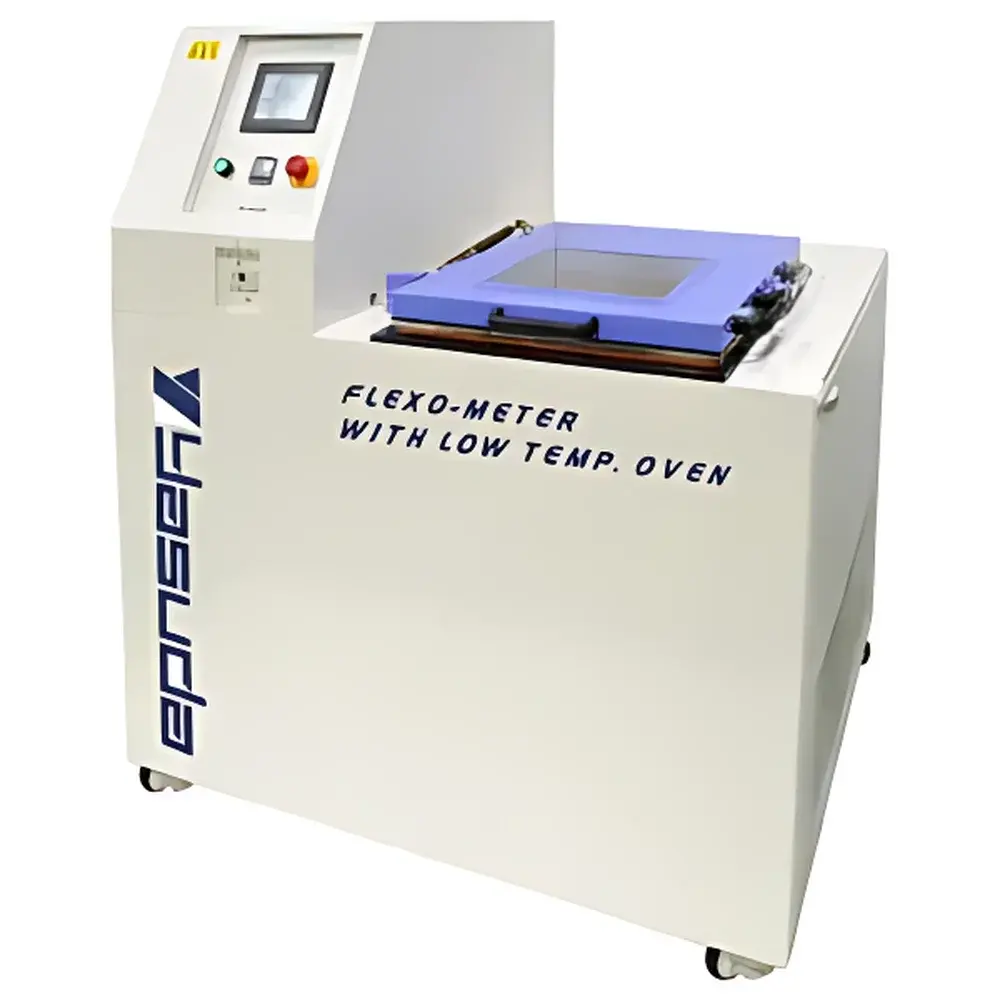
Yasuda No.197-LFR Low-Temperature Leather Flexing Tester with Integrated Cryogenic Chamber
| Brand | Yasuda |
|---|---|
| Origin | Japan |
| Model | No.197-LFR |
| Bend Angle | 22.5° |
| Bend Rate | 100 ± 5 cycles/min |
| Specimen Size | 70 × 45 mm |
| Test Stations | 12 |
| Temperature Range | −35 to +60 °C (compressor-cooled) |
| Timer | 8-digit preset timer & 9-digit total cycle counter |
| Power Supply | AC 200 V, 3-phase, 30 A, 50/60 Hz |
| Dimensions (W×D×H) | ≈1300 × 1150 × 1450 mm |
| Weight | ≈428 kg |
Overview
The Yasuda No.197-LFR Low-Temperature Leather Flexing Tester is an engineered precision instrument designed for standardized evaluation of flex resistance and fatigue behavior in leathers—particularly footwear upper materials—under controlled thermal conditions. It operates on the principle of repeated angular folding at a fixed bend radius and amplitude, simulating mechanical stress induced during real-world use such as walking or bending. The integrated cryogenic chamber enables testing across a rigorously maintained temperature range from −35 °C to +60 °C, allowing laboratories to assess low-temperature embrittlement, cold-flex retention, and thermal-dependent crack propagation in tanned hides, synthetic leathers, and coated substrates. Compliant with JIS K 6542 (flexing resistance of rubber and plastics) and JIS K 6545 (flexing resistance of coated fabrics), the system delivers repeatable, traceable results essential for QC validation, material development, and regulatory documentation in footwear, automotive interior, and luxury goods manufacturing.
Key Features
- Twelve independent test stations enabling parallel evaluation of multiple specimens under identical thermal and mechanical conditions—reducing inter-test variability and accelerating throughput.
- Compressor-based low-temperature chamber with precise digital PID control, achieving stable setpoint maintenance within ±1.5 °C across the full −35 °C to +60 °C range.
- Fixed-angle flexing mechanism calibrated to 22.5° ± 0.3° per cycle, driven by a servo-controlled cam system ensuring constant angular displacement and minimal hysteresis.
- Dual-timer architecture: an 8-digit programmable preset timer for cycle termination and a non-volatile 9-digit total cycle counter for long-term durability tracking and audit readiness.
- Robust frame construction (cast iron base, stainless steel chamber housing) and vibration-dampened mounting to minimize mechanical drift during extended test sequences (up to 100,000+ cycles).
- Fail-safe thermal interlock system that halts actuation if chamber temperature deviates beyond user-defined tolerance bands, preserving specimen integrity and operator safety.
Sample Compatibility & Compliance
The No.197-LFR accommodates standardized 70 mm × 45 mm rectangular specimens cut perpendicular to grain direction, compatible with both full-grain bovine leathers and laminated composites used in premium footwear. Its clamping geometry ensures uniform stress distribution without slippage or edge deformation during repetitive folding. The system supports ASTM D2176 (flexing resistance of paper), ISO 5422 (flexing resistance of leather), and adaptations for internal OEM specifications requiring cold-conditioned flex assessment. All operational parameters—including temperature logging, cycle count, and runtime—are recordable for GLP/GMP-aligned quality systems. Data outputs comply with FDA 21 CFR Part 11 requirements when interfaced with validated LIMS or ELN platforms via RS-232 or optional Ethernet module.
Software & Data Management
While the No.197-LFR operates as a standalone hardware platform, its digital timers and relay outputs support integration with external data acquisition systems. Optional firmware upgrades enable timestamped CSV export of cycle completion events and chamber temperature snapshots at user-defined intervals (e.g., every 1,000 cycles). Audit trails are retained in non-volatile memory for ≥12 months, including operator ID (via optional RFID badge reader), start/stop timestamps, temperature deviation alerts, and emergency stop logs. Calibration certificates reference NIST-traceable torque and thermal sensors, with annual verification protocols aligned with ISO/IEC 17025-accredited metrology labs.
Applications
- Comparative evaluation of tanning agents and fatliquors on low-temperature flex life in chrome- and vegetable-tanned leathers.
- Validation of coating adhesion and crack resistance in PU- and PVC-laminated shoe uppers exposed to sub-zero storage and transit conditions.
- Accelerated aging studies correlating flex-induced microcrack formation with tensile loss measured via ASTM D751.
- Supplier qualification testing for automotive door panel and steering wheel cover materials subjected to cyclic thermal-mechanical loading.
- Research into bio-based leather alternatives (e.g., mushroom mycelium, pineapple leaf fiber) where cold-flex performance remains a critical bottleneck.
FAQ
What standards does the No.197-LFR directly support?
It is configured and validated for JIS K 6542 and JIS K 6545; method adaptations for ISO 5422 and ASTM D2176 are documented in the operator manual.
Is the cryogenic chamber capable of maintaining −35 °C with all 12 stations active?
Yes—the compressor cooling capacity is rated for full-load operation across the entire temperature range with no derating required.
Can test parameters be modified beyond the standard 22.5° bend angle?
No—the mechanical cam is fixed at 22.5° to ensure compliance with referenced standards; custom tooling requires factory recalibration and revalidation.
What maintenance intervals are recommended for long-term reliability?
Lubrication of cam followers and chamber door seals every 6 months; annual calibration of temperature sensors and cycle counter accuracy by authorized Yasuda service engineers.
Does the system include test result interpretation guidance?
Yes—the supplied reference photo atlas includes graded images of surface cracking, grain separation, and backing delamination corresponding to JIS evaluation criteria, plus scoring worksheets compliant with internal QA checklists.



