
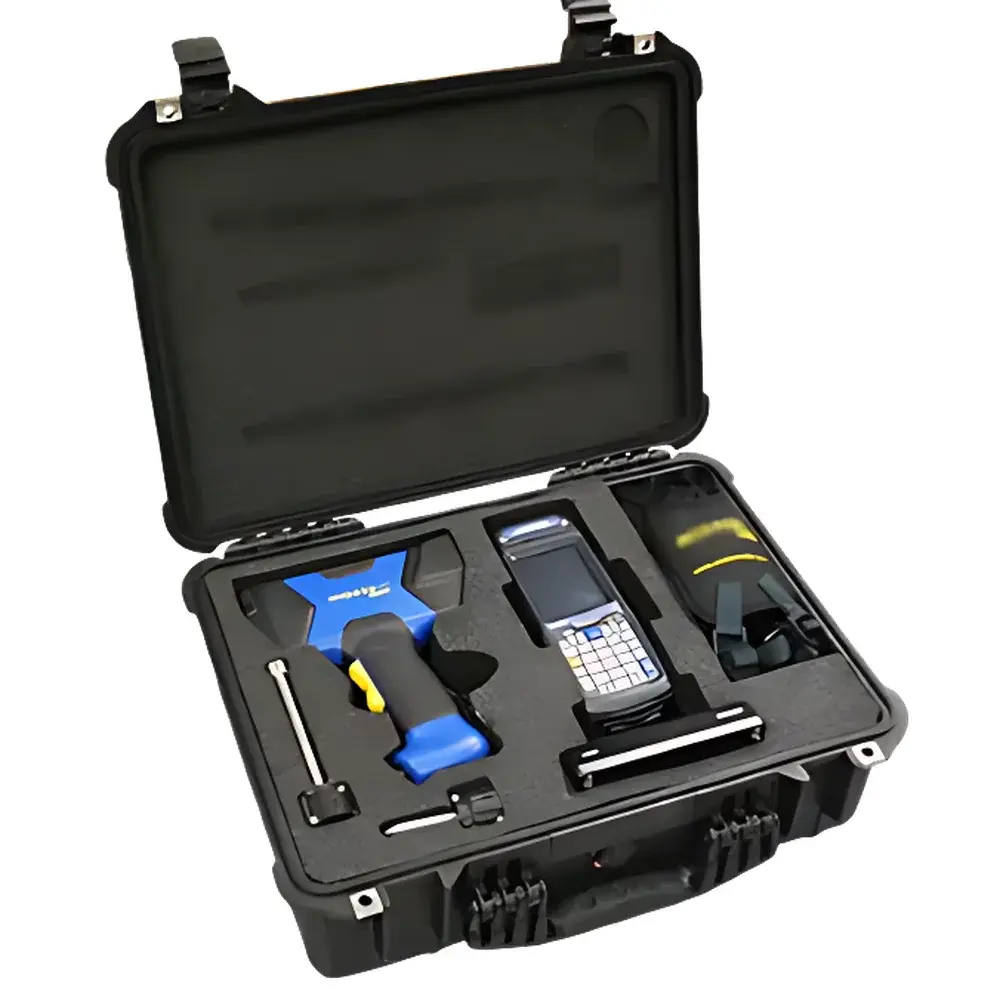
Ultrasonic Valve Leak Detection System
| Brand | — |
|---|---|
| Origin | United Kingdom |
| Manufacturer Type | Authorized Distributor |
| Origin Category | Imported |
| Model | Ultrasonic Valve Leak Detection System |
| Pricing | Available Upon Request |
Overview
The Ultrasonic Valve Leak Detection System is a non-intrusive, condition-based monitoring solution engineered for early identification and quantitative assessment of internal leakage across industrial isolation and control valves. It operates on the principle of acoustic emission (AE) sensing—detecting high-frequency ultrasonic energy (typically 20–100 kHz) generated by turbulent flow across compromised valve seats or seals. Unlike pressure-drop or thermal methods, this technique captures the intrinsic acoustic signature of fluid phase transition at the leak orifice, enabling detection even under low-differential-pressure or low-flow conditions where conventional methods fail. The system is specifically calibrated for in-service evaluation of gate, globe, ball, butterfly, and check valves operating with liquids, steam, compressed air, and hydrocarbon gases—without requiring process shutdown or instrumentation modification.
Key Features
- High-sensitivity ultrasonic transducer array with broadband frequency response (20–120 kHz), optimized to isolate leak-generated AE signals from mechanical vibration and ambient noise
- Real-time signal processing with adaptive digital filtering and spectral masking to suppress background interference (e.g., pump cavitation, pipe resonance, HVAC systems)
- Integrated handheld PDA unit featuring ruggedized IP65 enclosure, touchscreen interface, onboard data logging, and embedded analysis algorithms
- Valve-specific diagnostic library built from decades of field-acquired AE datasets—covering common valve types (ASME B16.34, API 600/602/6D), nominal sizes (DN15–DN600), and service media (water, saturated steam, natural gas, diesel, LNG)
- Quantitative leak rate estimation capability down to 0.1 L/min (±15% uncertainty at reference conditions), traceable to NIST-traceable calibration protocols
- Battery-operated design supporting >8 hours continuous operation; hot-swappable Li-ion battery modules for extended field campaigns
Sample Compatibility & Compliance
The system is compatible with all metallic and lined valve bodies installed in piping systems conforming to ASME B31.1, B31.3, and EN 13480 standards. It supports both insulated and uninsulated configurations via contact probe coupling (using silicone gel or couplant-free magnetostrictive sensors). No process penetration or electrical connection to the valve is required—ensuring compliance with IEC 61511 (functional safety) and NFPA 70E (electrical safety). Data acquisition workflows align with ISO 18436-2 (condition monitoring certification) and support integration into enterprise CMMS platforms (e.g., IBM Maximo, SAP PM) via CSV/Excel export. All firmware and reporting modules are designed to meet GLP audit requirements, including full electronic record retention, user authentication, and time-stamped event logs.
Software & Data Management
The embedded software provides guided inspection workflows, automatic threshold-based alarm classification (leak severity levels: negligible, minor, moderate, critical), and comparative trending against historical baselines. Each recorded AE trace includes metadata: date/time, operator ID, valve tag number, upstream/downstream pressure, temperature, and ambient noise floor. Reports comply with ISO 13374-1 for machinery condition monitoring documentation and can be exported in PDF or XML format for regulatory submission. Optional cloud-based dashboard (via secure TLS 1.2 connection) enables remote review, cross-site benchmarking, and predictive analytics using statistical process control (SPC) charts. Audit trails satisfy FDA 21 CFR Part 11 requirements for electronic records and signatures when configured with role-based access control and biometric login.
Applications
- Preventive maintenance prioritization in power generation (nuclear, fossil, CHP), refining, petrochemical, and pharmaceutical utilities
- Integrity verification during turnaround inspections without isolating or depressurizing critical lines
- Baseline integrity assessment prior to commissioning or after valve repair/replacement
- Supporting RBI (Risk-Based Inspection) programs per API RP 580/581 by assigning probability-of-failure scores based on AE amplitude, duration, and spectral content
- Monitoring valve performance in safety-critical applications—including emergency shutdown (ESD) and fire protection systems—where undetected leakage may compromise functional safety
- Training and competency validation for maintenance technicians through standardized pass/fail criteria and repeatability metrics
FAQ
Can this system detect leaks in cryogenic or high-pressure hydrogen service?
Yes—provided the valve body material permits ultrasonic wave transmission and surface access is available. Calibration adjustments for gas density and speed-of-sound variations are applied automatically within the software’s fluid property database.
Is third-party calibration certification available?
Yes—accredited calibration services per ISO/IEC 17025 are offered annually, including traceable sensitivity verification using reference AE sources (e.g., pencil-lead break method per ASTM E1139).
Does the system require connection to plant DCS or SCADA?
No—operation is fully standalone. Integration with DCS/SCADA is optional and achieved only via secure, one-way data export (no network ingress).
How does it differentiate between internal leakage and external packing leakage?
By combining sensor placement strategy (seat vs. stem location), time-of-flight analysis, and spectral centroid shift—internal seat leakage exhibits higher-frequency dominance (>45 kHz) and longer decay duration than stem packing noise.
What training is included with system delivery?
A 2-day certified application engineer course covering AE physics, valve mechanics, measurement uncertainty, report interpretation, and field case studies—certified under ISO 18436-2 Category II.





