
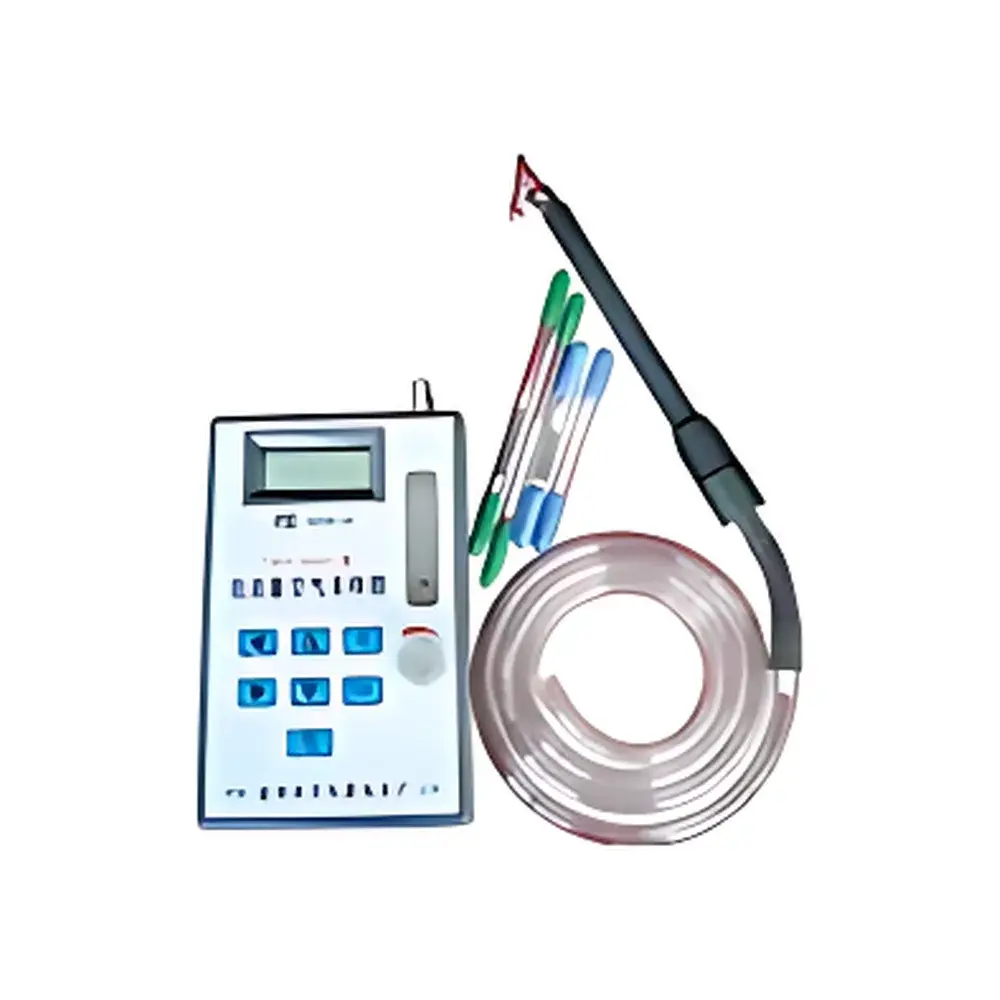
TWA-300T Low-Flow Air Sampler
| Origin | Jiangsu, China |
|---|---|
| Manufacturer Type | Distributor |
| Origin Category | Domestic (China) |
| Model | TWA-300T |
| Pricing | Upon Request |
| Max Negative Pressure | ≥2500 Pa |
| Rated Load Flow | ≥1.5 L/min @ 40 mmHg |
| Flow Range | 20–500 mL/min or 50–500 mL/min (user-selectable) |
| Flow Accuracy | Class 2.5 |
| Flow Stability | ≤±5% |
| Timer Accuracy | ≤±0.1% |
| Operating Temperature | −5 to 40 °C |
| Power Supply | 6 × AA Ni-MH rechargeable batteries |
| Dimensions | 137 × 88 × 45 mm |
| Weight | 0.5 kg (including batteries) |
Overview
The TWA-300T Low-Flow Air Sampler is a compact, portable, and microprocessor-controlled sampling instrument engineered for time-weighted average (TWA) collection of airborne contaminants in occupational hygiene, environmental health, and indoor air quality (IAQ) assessments. It operates on the principle of constant-flow volumetric aspiration, utilizing a high-efficiency diaphragm pump coupled with real-time electronic flow regulation to maintain consistent sampling rates across variable backpressures—critical for compliance with OSHA, NIOSH, and ISO 16000-18 sampling protocols. Designed for field deployment and personal monitoring applications, the TWA-300T supports both continuous and intermittent operation modes, enabling flexible integration into exposure assessment strategies such as 8-hour TWA, short-term exposure limit (STEL), or task-based sampling.
Key Features
- Stable Diaphragm Pump System: Features a corrosion-resistant elastomeric valve assembly and electronically regulated brushless motor, delivering ≥1.5 L/min at 40 mmHg load while maintaining ≤±5% flow stability—even under fluctuating battery voltage or changing filter/resistance conditions.
- Precision Timing Control: Microcontroller-based timer with ±0.1% accuracy; programmable from 1 minute to 99 hours 59 minutes; factory-preset 15-minute startup mode for rapid deployment in routine screening scenarios.
- Low-Power, High-Capacity Power Management: Powered by six AA-size nickel-metal hydride (Ni-MH) rechargeable batteries (no memory effect), providing up to 10 hours of continuous operation at 200 mL/min; built-in low-voltage warning (intermittent display flicker) and LED charging indicator.
- Modular Sampling Compatibility: Accepts standard glass impingers, silica gel tubes, activated carbon sorbent tubes (e.g., SKC 226-01, Anasorb® CSC), and stainless-steel diffusion samplers via adaptable inlet fittings and optional safety bottle integration.
- Rugged Field Design: Compact footprint (137 × 88 × 45 mm), lightweight construction (0.5 kg including batteries), IP54-rated enclosure, and ergonomic carry strap facilitate belt-mounted or tripod-mounted use in confined or mobile environments.
Sample Compatibility & Compliance
The TWA-300T is validated for use with EPA TO-17, NIOSH Methods 1501, 2525, 5515, and ISO 16017-1-compliant sorbent tubes and impinger solutions. Its flow range (20–500 mL/min or 50–500 mL/min, user-selectable) aligns with recommended sampling rates for volatile organic compounds (VOCs), aldehydes, acid gases (e.g., HCl, SO₂), metals (via filter + backup sorbent), and semi-volatile organics. The instrument meets EN 1232 (personal sampling pumps) mechanical and performance requirements and supports GLP-aligned documentation when paired with calibrated flow meters (e.g., DryCal DC-Lite) and audit-trail-enabled logbooks. While not intrinsically safe, it may be deployed in non-hazardous locations per IEC 60079-0 general requirements.
Software & Data Management
The TWA-300T operates as a standalone hardware platform without embedded Bluetooth or USB connectivity. However, its precise timer and stable flow output enable full traceability when used with external calibration logs and laboratory LIMS-integrated chain-of-custody forms. Users are advised to record start/stop times, pre- and post-calibration flow values, sampler ID, tube lot numbers, and environmental conditions (temperature, barometric pressure) in accordance with ISO/IEC 17025 documentation standards. Optional accessories—including tripod mounts, universal absorption bottle holders, and dual-tube parallel sampling adapters—facilitate structured data capture for multi-analyte studies.
Applications
- Occupational exposure monitoring for benzene, formaldehyde, hydrogen sulfide, and other workplace air toxics per OSHA 29 CFR 1910.1200 and EU Directive 2004/37/EC.
- Indoor air quality surveys in schools, offices, and residential buildings targeting VOCs, CO, NO₂, and particulate-bound PAHs.
- Baseline ambient air characterization near industrial fencelines or waste treatment facilities.
- Method validation and field verification of passive badge performance against active sampling reference methods.
- Epidemiological field studies requiring lightweight, operator-independent personal sampling over extended durations.
FAQ
What flow calibration standards are recommended for the TWA-300T?
We recommend annual calibration using a NIST-traceable primary standard (e.g., DryCal® or Bios International Series 400) at three points across the selected range (e.g., 50, 250, and 500 mL/min), conducted before and after each critical sampling campaign.
Can the TWA-300T be used for respirable dust sampling?
No—it is designed exclusively for gaseous and vapor-phase analytes. For aerosol sampling, pair with a size-selective cyclone (e.g., GK2.69) and conduct gravimetric or elemental analysis per ISO 7708 or EN 481.
Is the battery pack replaceable in the field?
Yes—six standard AA Ni-MH cells are user-replaceable; we advise using only 1.2 V, ≥2000 mAh rated cells to maintain timer accuracy and flow consistency.
Does the instrument support data logging?
No internal memory or digital output is provided. Real-time flow and timer status are displayed only on the LCD; all operational metadata must be manually documented.
What maintenance intervals are required?
Inspect inlet filters and tubing monthly; replace pump diaphragms and valves every 12 months or after 1000 operating hours—whichever occurs first—to preserve flow accuracy and vacuum integrity.
Related Products







