
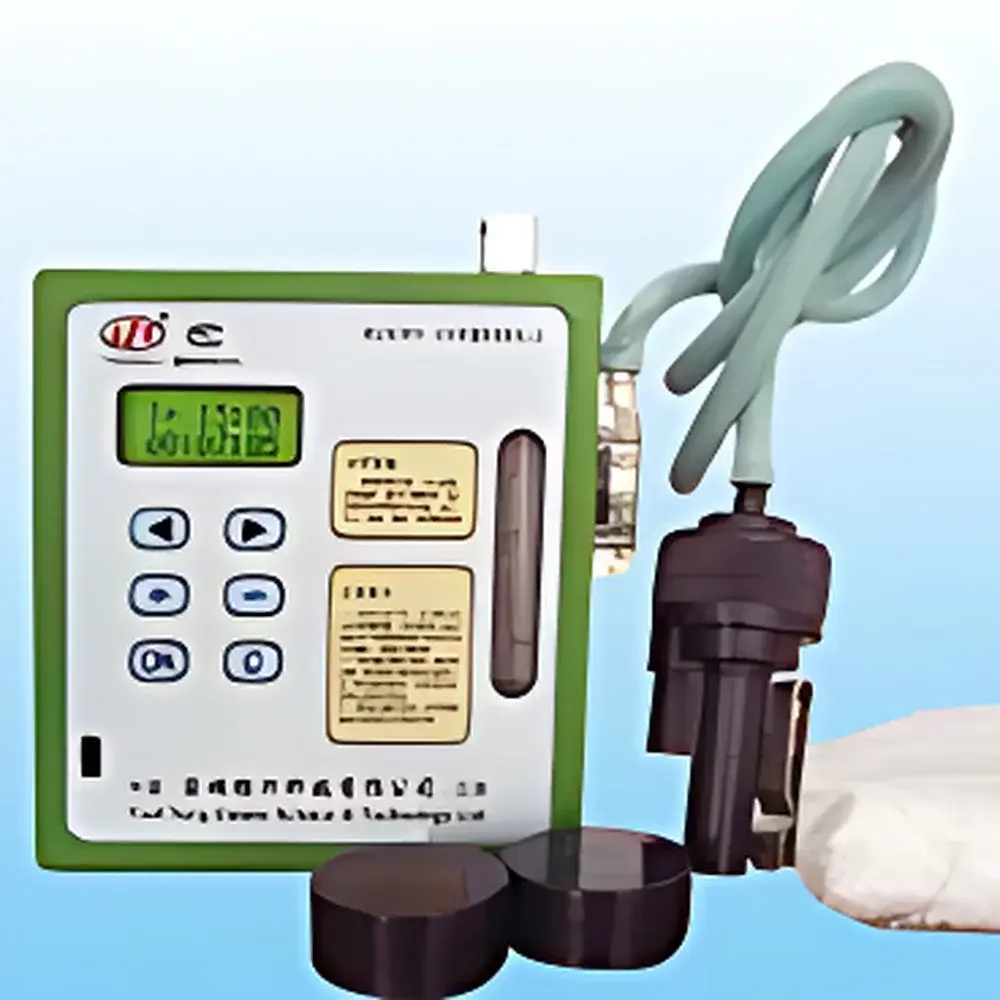
JFC-3P Programmable Personal Dust Sampler
| Origin | Jiangsu, China |
|---|---|
| Manufacturer Type | Authorized Distributor |
| Origin Category | Domestic (China) |
| Model | JFC-3P |
| Pricing | Available Upon Request |
| Pump Type | Imported Diaphragm Vacuum Pump |
| Power Supply | AC 220 V ±10 V, 50 Hz / Rechargeable Ni-MH Battery |
| Max Vacuum Pressure | >26 kPa |
| Flow Range | 0.1–3.0 L/min |
| Flow Accuracy | ±5% FS |
| Flow Stability | ≤5% over 8 h |
| Timer Range | 1 min – 99 h 59 min |
| Timer Accuracy | ≤±0.1% |
| Operating Temperature | −25 to +45 °C |
| Continuous Operation | ≥12 h on battery |
| Weight | ≤0.5 kg |
| Dimensions (L×W×H) | 100 × 50 × 110 mm |
| Ingress Protection | IP54-rated housing with anti-backflow liquid trap |
| Preseparator Compliance | BMRC (British Medical Research Council) respirable dust curve per ISO 7708:2005 and ACGIH TRK guidelines |
Overview
The JFC-3P Programmable Personal Dust Sampler is a compact, field-deployable instrument engineered for quantitative collection of airborne particulate matter in occupational and environmental settings. It operates on the principle of constant-flow aspiration through a certified preseparator—designed to physically fractionate inhalable and respirable dust fractions in accordance with the internationally recognized British Medical Research Council (BMRC) particle size-selective curve (ISO 7708:2005, Annex B). This enables compliance-driven sampling for regulatory exposure assessment under OSHA 1910.1200, NIOSH Method 0600, and EU Directive 2004/37/EC (CARC, MUTA, REPR substances). The device integrates a high-efficiency imported diaphragm vacuum pump capable of sustaining stable flow rates up to 3.0 L/min against typical filter media backpressure (>26 kPa), ensuring robust performance across variable ambient conditions from −25 °C to +45 °C.
Key Features
- Programmable time-weighted average (TWA) sampling: Supports fully autonomous 8-hour TWA or custom multi-segment timing profiles (1 min to 99 h 59 min), with timer accuracy ≤±0.1% — suitable for full-shift personal exposure monitoring without operator intervention.
- Integrated anti-backflow protection: Patented liquid and particulate backflow trap prevents condensate or aerosol ingress into the pump chamber, extending service life and maintaining calibration integrity.
- Dual-power architecture: Operates seamlessly on AC mains (220 V ±10 V, 50 Hz) or built-in high-capacity Ni-MH rechargeable battery, delivering ≥12 hours of continuous operation at 2.0 L/min — ideal for remote or mobile deployment.
- Compact ergonomic design: Weighing ≤0.5 kg and measuring only 100 × 50 × 110 mm, the unit meets ISO 13137:2013 requirements for personal sampler wearability and low-profile mounting on lapel, shoulder strap, or belt clip.
- Flow stability assurance: Maintains ≤5% flow deviation over 8-hour sampling duration at setpoint, validated per ISO 8502-1:2020 calibration traceability protocols using primary-standard dry calibrators.
Sample Compatibility & Compliance
The JFC-3P is compatible with standard 25-mm and 37-mm diameter filter cassettes (e.g., PVC, mixed cellulose ester, PTFE), as well as sorbent tubes (e.g., XAD-2, coconut charcoal) via optional adapter fittings. Its preseparator assembly is independently verified to meet BMRC respirable fraction cutoff (D50 = 4.0 µm ± 0.2 µm, σg = 1.5) per ISO/TC 146/SC 2 guidelines. Device construction conforms to IP54 environmental rating (IEC 60529), supporting use in dusty, humid, or intermittently wet industrial zones. All electronic components comply with CE EMC Directive 2014/30/EU and RoHS 2011/65/EU. Calibration documentation supports GLP-aligned audit trails per ISO/IEC 17025:2017 laboratory accreditation requirements.
Software & Data Management
While the JFC-3P operates as a standalone hardware sampler, its programmable timer module stores up to 10 independent sampling protocols internally. Field data logging includes start/stop timestamps, total elapsed time, and user-assigned batch IDs — exportable via USB-C interface to CSV-compatible spreadsheets for integration into EHS management platforms (e.g., Intelex, Sphera, ETQ Reliance). Firmware supports over-the-air updates via secure authenticated channel. Audit-ready operation logs meet FDA 21 CFR Part 11 predicate rules when used in conjunction with validated third-party data capture software and electronic signature workflows.
Applications
- Occupational hygiene surveys: Quantitative assessment of respirable crystalline silica (RCS), coal dust, wood dust, and metal fumes in mining, construction, foundries, and woodworking facilities.
- Regulatory compliance monitoring: Alignment with OSHA PELs, ACGIH TLVs®, and EU-OELVs for particulate matter classification under CLP Regulation (EC) No. 1272/2008.
- Educational laboratories: Hands-on instruction in aerosol science, industrial hygiene sampling methodology, and NIOSH/OSHA analytical protocol validation (e.g., gravimetric analysis per Method 0500).
- Environmental baseline studies: Ambient PM10/PM2.5 source apportionment in peri-industrial communities where fixed-site monitors lack spatial resolution.
- Research-grade exposure modeling: Input data generation for PBPK (physiologically based pharmacokinetic) simulations requiring time-resolved personal inhalation dose estimates.
FAQ
Does the JFC-3P meet ISO 7708:2005 respirable dust criteria?
Yes — its preseparator is geometrically and aerodynamically calibrated to replicate the BMRC curve with D50 = 4.0 µm and geometric standard deviation σg = 1.5, as verified by third-party testing per ISO/TC 146/SC 2 interlaboratory round robin protocols.
Can it be used for sorbent tube sampling (e.g., VOCs)?
Yes — with the optional universal sorbent tube adapter kit (sold separately), the unit maintains flow accuracy within ±5% FS across the 0.1–1.0 L/min range recommended for thermal desorption tubes.
Is battery runtime validated at maximum flow rate?
Battery endurance is rated ≥12 h at 2.0 L/min; at 3.0 L/min, runtime reduces to ~8.5 h due to increased power draw — both values measured at 25 °C ambient per IEC 61960 cycle-life testing.
How is flow calibration performed in the field?
Users perform daily verification using a NIST-traceable primary calibrator (e.g., DryCal DC-Lite); the device’s analog flow meter output allows real-time adjustment via front-panel potentiometer, with calibration coefficients stored in non-volatile memory.
What maintenance intervals are recommended?
Pump diaphragm replacement every 12 months or 2000 operating hours; preseparator cleaning after each 10 sampling events; battery capacity check every 6 months using built-in voltage diagnostics.
Related Products







