
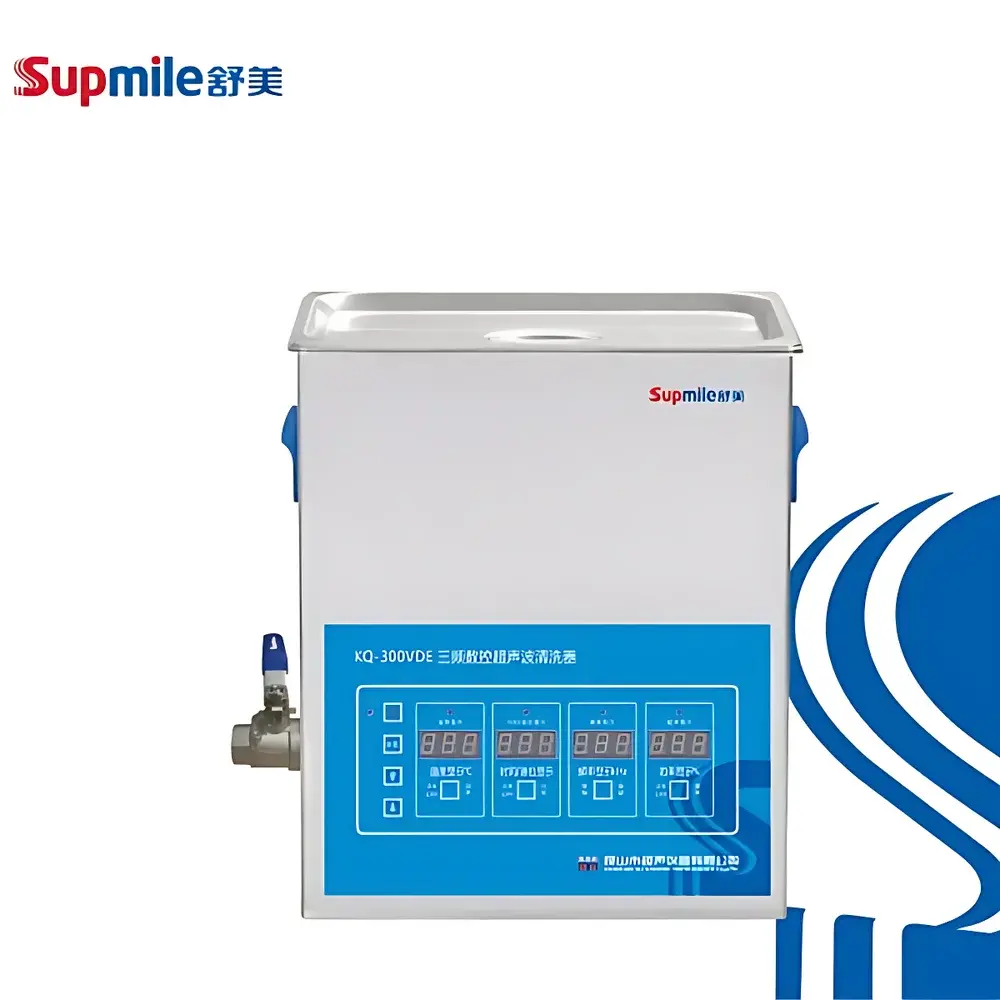
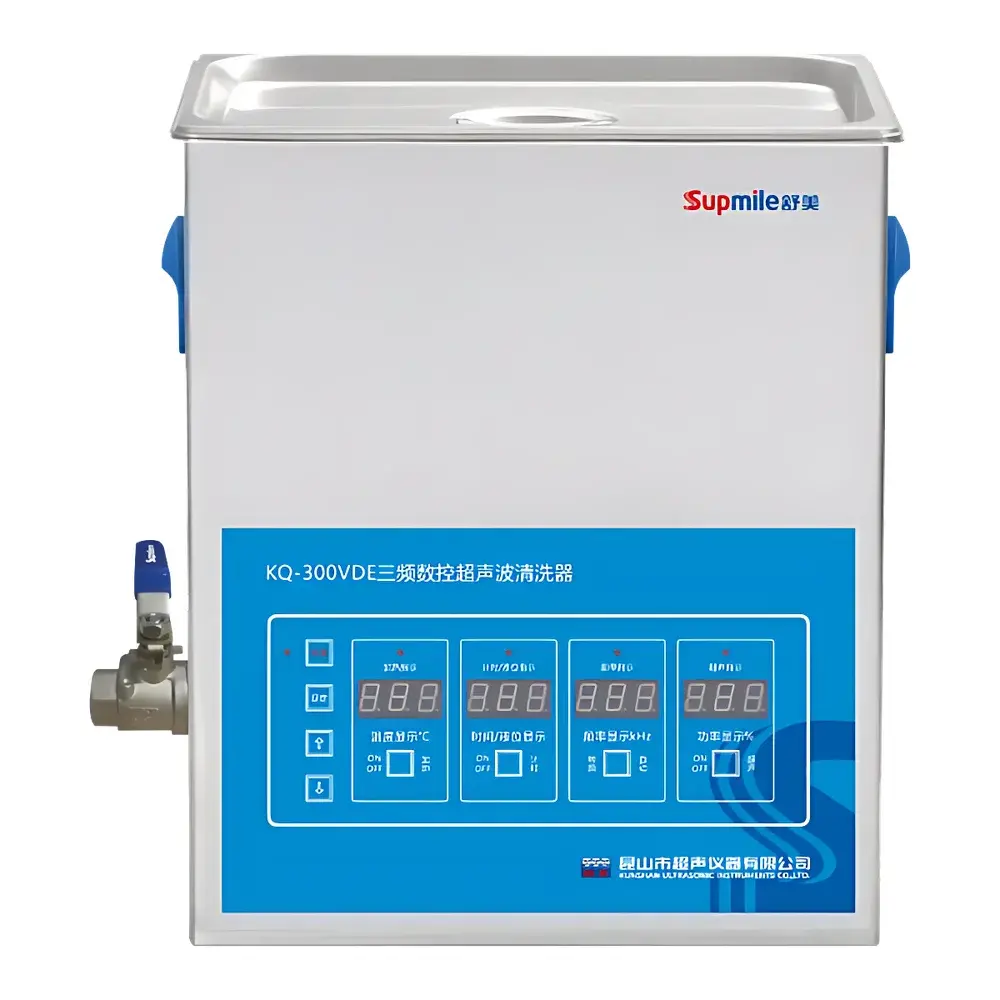
Shumei KQ-300VDE Triple-Frequency Digital Ultrasonic Cleaner
| Brand | Shumei |
|---|---|
| Origin | Jiangsu, China |
| Manufacturer Type | OEM Manufacturer |
| Equipment Type | General-Purpose Ultrasonic Cleaner |
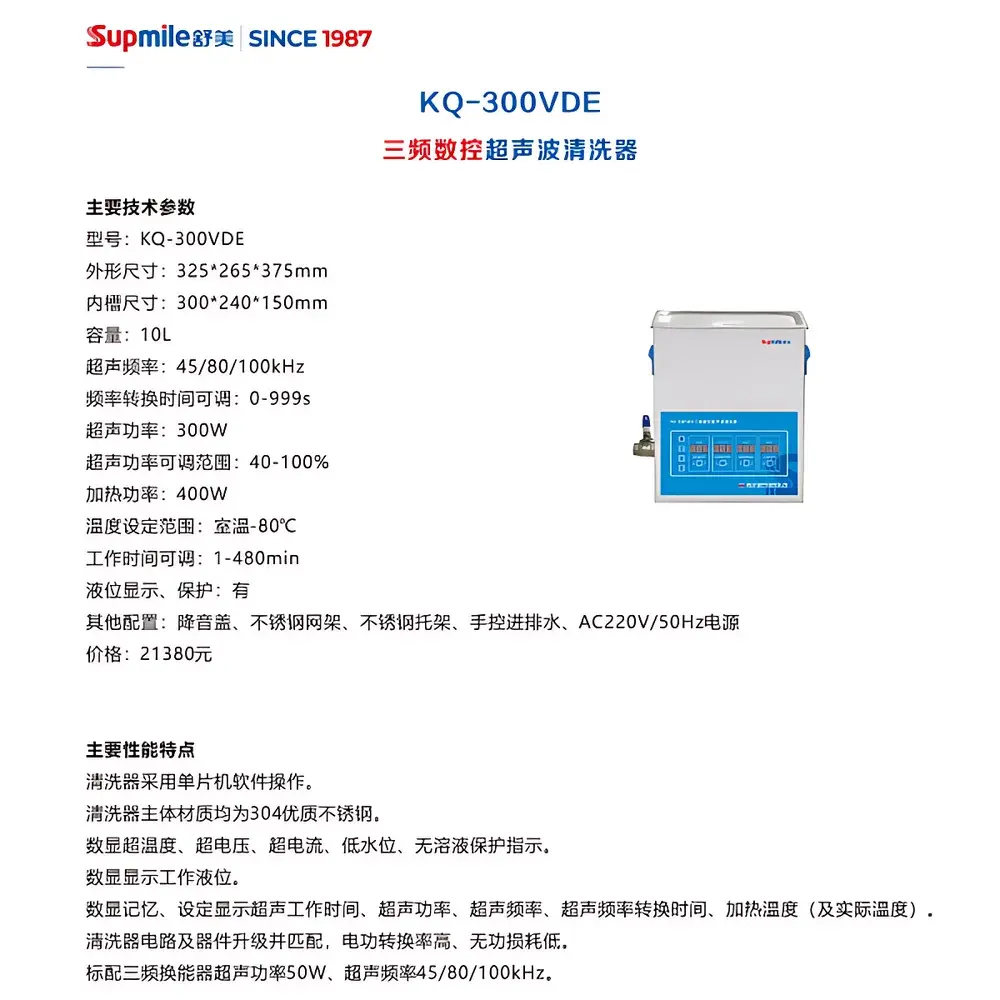
| Tank Capacity | 10 L |
| Ultrasonic Frequencies | 45 / 80 / 100 kHz |
| Ultrasonic Power Output | 300 W (adjustable from 40–100%) |
| Heating Power | 400 W |
| Temperature Range | Ambient to 80 °C (adjustable) |
| Timer Range | 1–480 min |
| Sound-Dampening Lid | Included |
| Drain/Inlet | Manual |
| Input Voltage | AC 220 V / 50 Hz |
| Tank Dimensions (L×W×H) | 300 × 240 × 150 mm |
| Overall Dimensions (L×W×H) | 325 × 265 × 375 mm |
| Construction Material | 304 Stainless Steel |
| Safety Protections | Low-level liquid detection, over-temperature, over-voltage, over-current, and dry-run prevention |
| Display | Digital LED showing real-time temperature, power level, frequency mode, timer countdown, and liquid level indicator |
| Accessories | Stainless steel mesh basket, stainless steel rack, sound-dampening lid |
Overview
The Shumei KQ-300VDE Triple-Frequency Digital Ultrasonic Cleaner is an engineered solution for precision cleaning of delicate laboratory components, optical elements, semiconductor wafers, medical instruments, and analytical sample preparation hardware. It operates on the principle of cavitation—generated by high-frequency acoustic energy transmitted through a liquid medium—to dislodge sub-micron particulate contaminants, organic residues, and loosely adhered biofilms without mechanical abrasion. Unlike single-frequency ultrasonic systems, the KQ-300VDE integrates three discrete transducer frequencies—45 kHz, 80 kHz, and 100 kHz—each optimized for distinct cleaning challenges: lower frequencies (45 kHz) deliver higher cavitation intensity suitable for robust metal parts; mid-range (80 kHz) balances penetration depth and particle removal efficiency for glassware and ceramic substrates; and higher frequency (100 kHz) enables gentler yet highly uniform energy distribution, critical for MEMS devices, microfluidic chips, and coated optics where surface integrity must be preserved.
Key Features
- Triple-frequency digital control architecture with independent selection and programmable switching intervals (0–999 s), enabling method-driven cleaning protocols across heterogeneous sample sets.
- Microprocessor-based operation with full digital interface: real-time display of setpoint vs. actual temperature, ultrasonic power output (%), selected frequency, elapsed/remaining time, and liquid level status.
- 304 stainless steel tank and chamber construction ensures long-term corrosion resistance in aqueous, mildly alkaline, or ethanol-based cleaning baths—compatible with common lab solvents including isopropanol, acetone, and low-concentration detergent solutions.
- Integrated thermal regulation system with 400 W heating element and PID-controlled temperature stability ±1.5 °C within the 20–80 °C operating range; ambient-start capability eliminates preheating delays.
- Comprehensive safety suite: automatic shutdown triggered by low liquid level, excessive current draw, voltage fluctuation, or sustained overheating—fully compliant with IEC 61010-1 requirements for laboratory electrical equipment.
- Modular accessory set includes perforated stainless steel mesh basket (for small parts), adjustable-height stainless steel rack (for vertical immersion of pipettes or cuvettes), and acoustically damped hinged lid to reduce ambient noise and solvent evaporation.
Sample Compatibility & Compliance
The KQ-300VDE supports cleaning of a broad spectrum of laboratory-grade materials—including borosilicate glass, fused silica, anodized aluminum, titanium alloys, and polymer-based substrates such as PMMA and PC—without inducing micro-scratching or interfacial delamination. Its triple-frequency flexibility allows users to align cleaning parameters with material-specific acoustic impedance thresholds and contaminant adhesion energy profiles. The unit meets CE marking requirements under the EU Machinery Directive 2006/42/EC and Electromagnetic Compatibility Directive 2014/30/EU. While not certified to ISO 13485 or FDA 21 CFR Part 11 out-of-the-box, its digital logging capability (time-stamped parameter records stored in non-volatile memory) supports GLP-compliant documentation when integrated into validated lab workflows.
Software & Data Management
The KQ-300VDE employs embedded firmware—not external PC software—for all operational logic. All user-defined parameters (frequency mode, power %, temperature setpoint, timer duration, and frequency-switching interval) are retained in EEPROM after power cycling, eliminating reconfiguration between sessions. Event logs—including activation timestamps, fault codes (e.g., E01 = low level, E03 = over-temp), and cumulative operational hours—are accessible via diagnostic menu and support traceability in regulated environments. No proprietary drivers or cloud connectivity are implemented; data export requires manual transcription from the LED display—a design choice prioritizing electromagnetic isolation and cybersecurity resilience in sensitive instrumentation labs.
Applications
- Pre-analytical sample preparation: degassing HPLC vials, cleaning LC-MS autosampler needles, and decontaminating GC inlet liners.
- Quality control workflows: residue verification on machined calibration standards, post-etch wafer cleaning in R&D cleanrooms.
- Biomedical device reprocessing: auxiliary cleaning step for reusable endoscopic components prior to steam sterilization (per AAMI ST91 guidelines).
- Materials science: removal of sputtering targets’ surface oxides, dispersion stabilization of nanomaterial suspensions prior to DLS analysis.
- Educational laboratories: reproducible demonstration of cavitation physics, frequency-dependent cleaning efficacy, and thermal kinetics in physical chemistry curricula.
FAQ
Can the KQ-300VDE operate continuously for extended durations (e.g., overnight)?
Yes—provided liquid level remains above the minimum threshold and ambient temperature does not exceed 35 °C. Duty cycle limitations are not imposed by firmware, but thermal management efficiency declines above 6 hours of uninterrupted heating + sonication; periodic cooldown intervals are recommended for optimal transducer longevity.
Is it compatible with flammable solvents such as acetone or ethanol?
It is not intrinsically safe for Class I, Division 1 hazardous locations. When using volatile solvents, the sound-dampening lid must remain closed, ventilation must meet local OSHA/ACGIH TLV requirements, and no ignition sources (e.g., open relays, unshielded switches) should be present within 0.5 m of the unit.
Does the unit support external data logging or RS-232/USB output?
No—data acquisition is confined to the onboard display and non-volatile event memory. Integration with LIMS or SCADA systems requires third-party analog signal emulation or vision-based OCR capture.
What maintenance is required for long-term reliability?
Monthly inspection of transducer mounting bolts, quarterly descaling of the heater element using 5% citric acid solution, and annual verification of temperature sensor calibration against a NIST-traceable reference thermometer.
How does the triple-frequency switching improve cleaning consistency compared to fixed-frequency units?
Sequential or alternating excitation disrupts standing wave node formation, mitigating “dead zones” in complex geometries; it also prevents resonant fatigue in fragile substrates by avoiding sustained exposure at any single mechanical eigenfrequency.



