
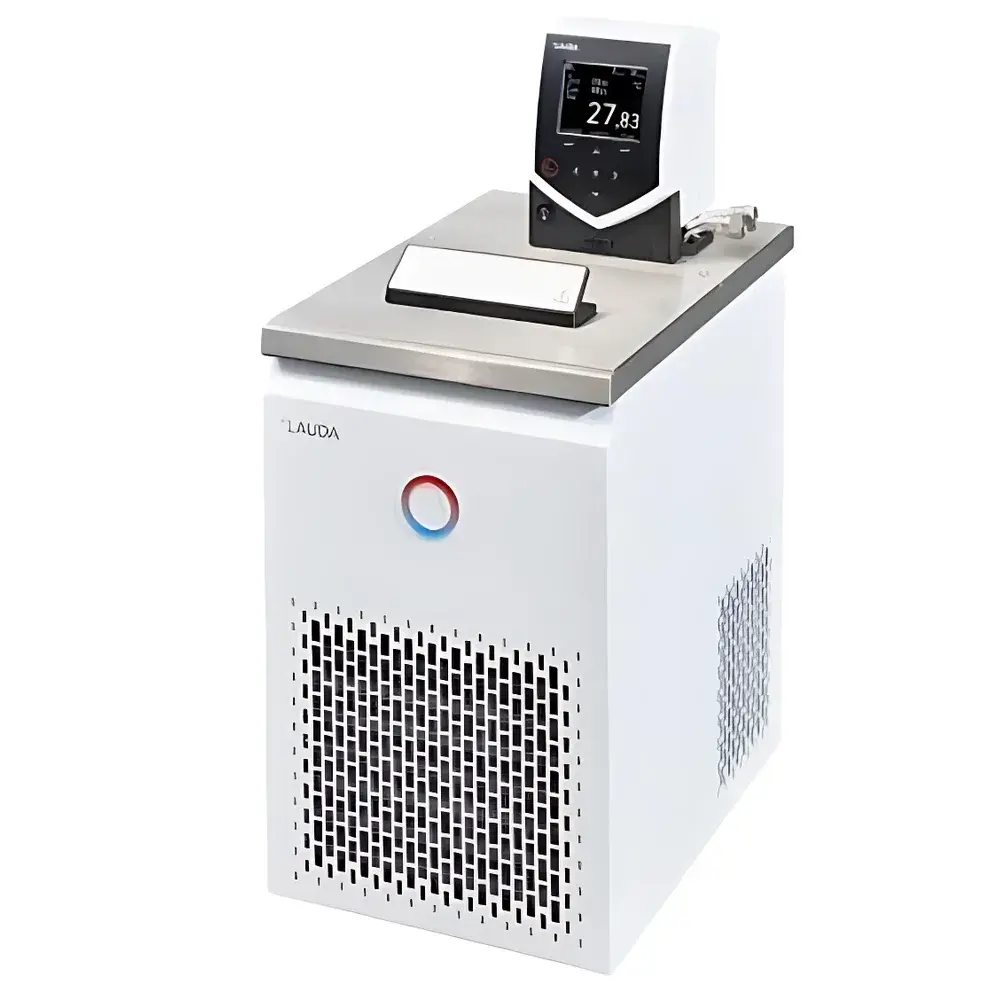
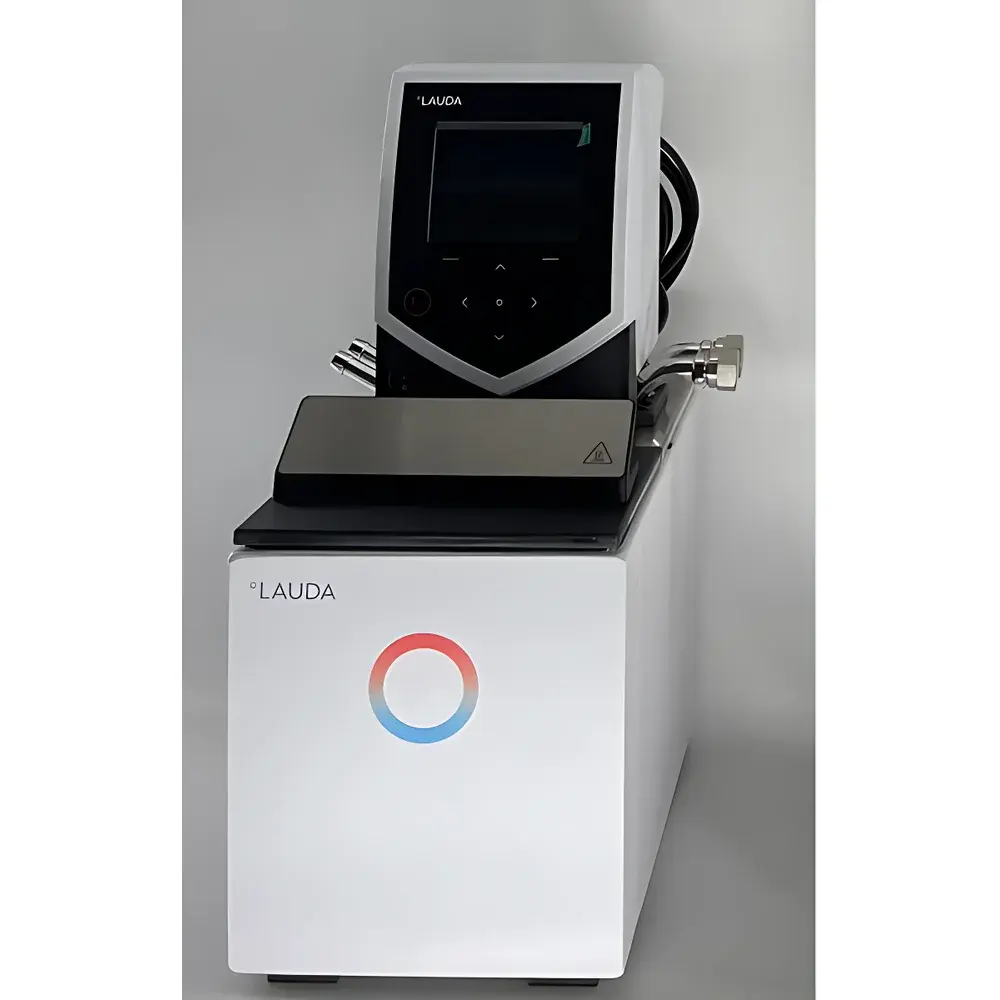
LAUDA E4G Eco Series Circulating Temperature Controller
| Brand | LAUDA |
|---|---|
| Origin | Germany |
| Model | E4G |
| Instrument Type | Bath Circulator (Water/Oil) |
| Temperature Range | 20–200 °C |
| Temperature Stability | ±0.01 K |
| Bath Volume | 3.5 L |
| Circulation Mode | Internal & External |
| Temperature Control | Heating & Cooling |
| Display | TFT Color LCD |
| Cooling System | SmartCool™ |
| Max Flow Rate | 22 L/min (adjustable) |
| Pump Pressure | 0.6 bar |
| Heating Power | 2.0–2.6 kW |
| External Dimensions (W×D×H) | 180 × 350 × 546 mm |
| Opening Dimensions / Depth | 135 × 105 / 150 mm |
Overview
The LAUDA E4G Eco Series Circulating Temperature Controller is a precision-engineered, compact bath circulator designed for laboratory applications requiring stable, programmable thermal control across a broad operational range of 20–200 °C. Built upon LAUDA’s decades-long heritage in thermal management systems, the E4G integrates advanced thermodynamic architecture with energy-efficient operation—leveraging the proprietary SmartCool™ cooling system to enable rapid, responsive temperature regulation even during high-temperature setpoint transitions. Unlike conventional single-mode heating baths, the E4G delivers true dual-function performance: simultaneous heating and active refrigeration within a single integrated unit. Its core design follows the principle of forced-convection thermal equilibration, where a high-capacity, variable-speed circulation pump (up to 22 L/min at 0.6 bar) ensures uniform heat transfer throughout both internal baths and externally connected equipment—including reactors, viscometers, spectrophotometer cells, and analytical detectors.
Key Features
- High-precision temperature stability of ±0.01 K over the full operating range, validated per DIN 12876-1 and traceable to national standards;
- TFT color LCD interface with intuitive navigation, real-time process visualization, and multi-step program capability (up to 10 segments with ramp/soak profiles);
- SmartCool™ technology enables immediate refrigeration activation—even when the bath is at elevated temperatures—eliminating pre-cooling delays and reducing cycle times;
- Energy-optimized compressor control dynamically adjusts cooling output based on thermal load, minimizing power consumption without compromising stability;
- Robust stainless-steel bath vessel (3.5 L usable volume) with chemical-resistant PTFE-coated interior; compatible with water, silicone oil, and synthetic heat-transfer fluids;
- Externally controllable via RS232 or optional Ethernet interface (Modbus TCP), supporting integration into centralized lab automation platforms;
- Compliance-ready firmware architecture with configurable audit trail logging, user access levels, and password-protected parameter editing—aligned with GLP and FDA 21 CFR Part 11 data integrity requirements.
Sample Compatibility & Compliance
The E4G supports a wide range of sample containment formats, including standard glass beakers (up to Ø135 mm × 150 mm depth), jacketed reactor vessels, and OEM-integrated flow cells. Its open-bath geometry facilitates direct immersion of probes, sensors, and reaction vessels while maintaining unobstructed visual monitoring. All wetted components conform to USP Class VI and EU Regulation (EC) No. 1935/2004 for materials in contact with laboratory reagents. The unit is CE-marked and complies with IEC 61010-1 (Safety Requirements for Electrical Equipment for Measurement, Control, and Laboratory Use) and IEC 61326-1 (EMC for Laboratory Instruments). Optional IQ/OQ documentation packages are available to support GMP-compliant installation and operational qualification protocols.
Software & Data Management
LAUDA’s PC-based software suite—Pilot ONE—enables remote configuration, real-time data logging (sample rate ≥1 Hz), and export of timestamped CSV files compliant with LIMS ingestion standards. The embedded controller maintains local storage of up to 30 days of continuous temperature and flow data (with cyclic overwrite), and supports automatic backup via USB drive. For regulated environments, Pilot ONE includes electronic signature functionality, change history tracking, and configurable alarm escalation (email/SMS via SMTP gateway). All software modules adhere to ALCOA+ principles (Attributable, Legible, Contemporaneous, Original, Accurate, Complete, Consistent, Enduring, Available) as defined in WHO TRS 996 Annex 11 and EU GMP Annex 11.
Applications
- Calibration of thermometers, RTDs, and thermocouples under ISO/IEC 17025-accredited conditions;
- Temperature-dependent kinetic studies in physical chemistry and catalysis research;
- Viscosity measurements using rotational or capillary viscometers requiring precise thermal conditioning;
- Stability testing of pharmaceutical formulations per ICH Q1A(R2) guidelines;
- Controlled heating/cooling cycles for polymer characterization (DSC sample prep, rheology master curves);
- Thermal preconditioning of optical components and sensor housings prior to metrological evaluation.
FAQ
What fluid types are compatible with the E4G bath?
Deionized water, glycol-water mixtures, silicone oils (e.g., DC200 series), and polyalphaolefin (PAO)-based heat-transfer fluids—provided viscosity remains below 50 mm²/s at operating temperature.
Can the E4G be used for external circulation with jacketed reactors?
Yes—the unit features dual NPT ½” inlet/outlet ports with integrated quick-connect fittings, rated for continuous external flow up to 22 L/min and backpressure ≤0.6 bar.
Is the temperature stability specification valid at all setpoints between 20 °C and 200 °C?
Yes—±0.01 K stability is guaranteed across the entire range when using recommended heat-transfer fluids and operating within ambient conditions of 15–30 °C.
Does the E4G support validation documentation for regulated laboratories?
Standard units include factory calibration certificates (NIST-traceable); optional IQ/OQ protocol templates and execution services are available through LAUDA’s global service network.
How is energy efficiency achieved during high-temperature operation?
The SmartCool™ system employs adaptive compressor modulation and intelligent heat recovery routing—reducing average power draw by up to 35% compared to fixed-speed refrigeration architectures under dynamic load conditions.



