
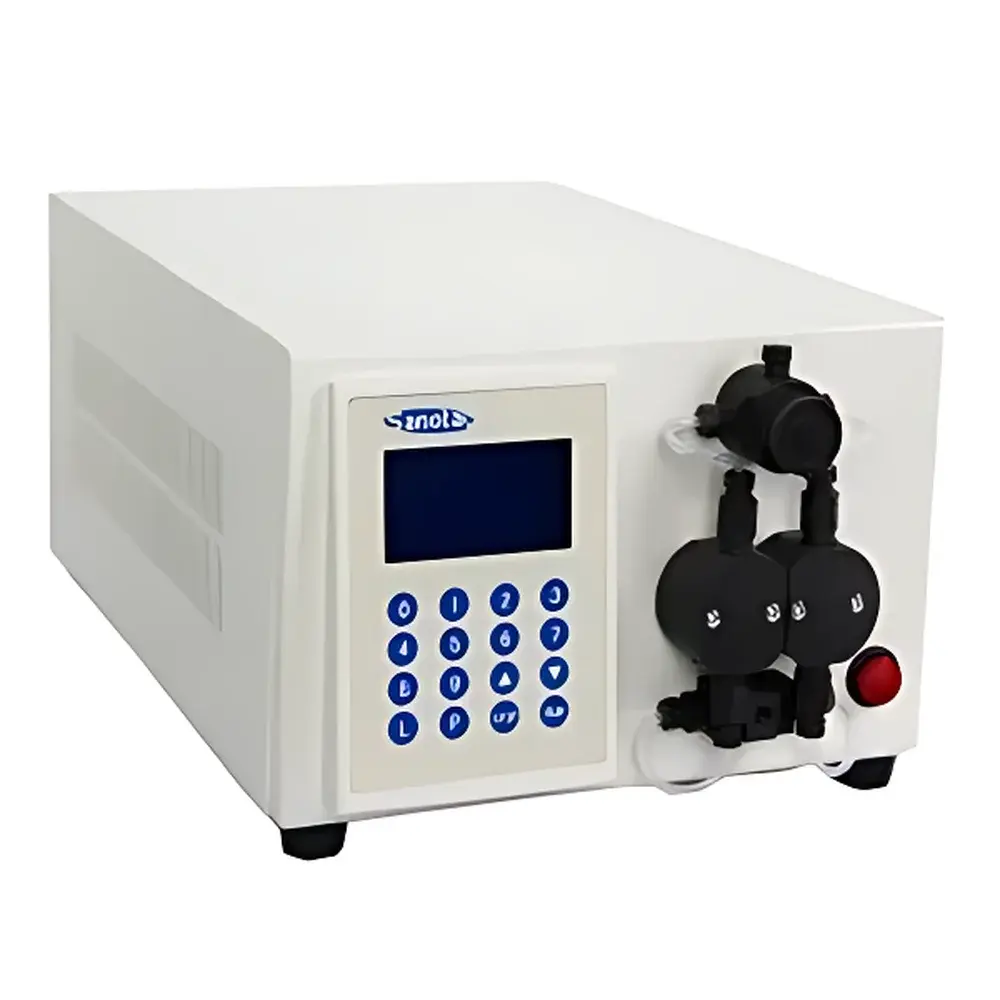
Sanotac VPF2002 PTFE-Lined High-Pressure Constant Flow Pump
| Brand | Sanotac |
|---|---|
| Origin | Shanghai, China |
| Manufacturer Type | Direct Manufacturer |
| Product Origin | Domestic (China) |
| Model | VPF2002 |
| Flow Rate | 0.1–200.0 mL/min |
| Max Pressure | 2 MPa |
| Flow Accuracy | ±1% |
| Flow Repeatability | ≤1% |
| Pressure Pulsation | ≤0.2 MPa |
| Viscosity Range | 0–30 cP |
| Wetted Materials | PTFE, Ruby, Zirconia Ceramic |
| Communication | RS232 (standard), RS485/RS422 (optional), Modbus RTU/ASCII, Sanotac Proprietary Protocol |
| Power Supply | 85–264 VAC, 50 Hz |
| Power Consumption | 75 W |
| Weight | 12 kg |
Overview
The Sanotac VPF2002 is a precision-engineered, PTFE-lined constant flow pump designed for demanding laboratory and pilot-scale applications involving chemically aggressive, moderately viscous fluids. Operating on positive displacement principle via a cam-driven diaphragm mechanism, the VPF2002 delivers stable, pulse-minimized volumetric delivery across its full flow range (0.1–200.0 mL/min) under pressures up to 2 MPa. Its all-PTFE fluid path—combined with ruby check valves and zirconia ceramic plunger components—ensures exceptional chemical resistance against strong acids, bases, halogenated solvents, and oxidizing agents commonly encountered in catalytic evaluation, microreactor feed systems, supercritical fluid processing, and heterogeneous catalysis research. Unlike conventional peristaltic or syringe pumps, the VPF2002 maintains high flow stability without tubing fatigue or seal degradation, making it suitable for continuous, unattended operation in GLP-compliant environments.
Key Features
- Chemically inert wetted path constructed entirely from PTFE, sapphire (ruby) valves, and zirconia ceramic—validated for compatibility with ASTM D543-20 and ISO 17469:2020 corrosion resistance guidelines
- Low-pressure pulsation design (<0.2 MPa) achieved through dual-stage electronic pulse suppression and optimized cam profile compensation
- Dual-mode flow control: constant-flow mode for steady-state feeding; gradient mode for programmed ramping of flow rates over time
- User-accessible calibration zone enabling in-field flow rate correction based on fluid density, temperature, and system backpressure
- Configurable pressure safety limit with real-time hardware cutoff—supports fail-safe integration into reactor interlock systems per IEC 61511 functional safety standards
- Simultaneous display of real-time pressure and flow rate curves via integrated LCD interface, supporting trend-based diagnostics and process validation
- Flexible unit selection: volumetric (mL/min) or gravimetric (g/min) output—enabling direct correlation with mass-balance calculations in reaction stoichiometry studies
Sample Compatibility & Compliance
The VPF2002 is validated for handling Newtonian and near-Newtonian liquids with viscosities up to 30 cP at ambient temperature. It is not intended for slurries, particulate-laden media, or non-Newtonian shear-thinning/thickening fluids outside its specified operating envelope. All wetted materials comply with USP Class VI biocompatibility testing and meet FDA 21 CFR 177.1550 requirements for fluoropolymer contact surfaces. The pump’s electrical architecture conforms to CE marking directives (EMC Directive 2014/30/EU and Low Voltage Directive 2014/35/EU). When integrated into automated systems, audit trails generated via Modbus RTU or ASCII protocols support ALCOA+ data integrity principles required under FDA 21 CFR Part 11 and EU Annex 11 for regulated R&D environments.
Software & Data Management
The VPF2002 supports native communication via RS232 (standard) and optional RS485/RS422 interfaces, enabling seamless integration into SCADA, DCS, and PLC-based control architectures—including Siemens S7 series, Allen-Bradley ControlLogix, and Beckhoff TwinCAT platforms. It implements both Sanotac’s proprietary ASCII command set and industry-standard Modbus RTU slave functionality (function codes 03h/06h/10h), allowing bidirectional parameter read/write and real-time status polling. LabVIEW drivers, OPC UA wrappers, and Python SDKs are available upon request for custom automation development. All communication events—including start/stop commands, pressure limit triggers, and calibration updates—are timestamped and logged internally for traceability during method validation or regulatory audits.
Applications
- Continuous reagent dosing in microfluidic and plate-type microreactors for kinetic studies and catalyst screening
- Precise co-feeding of corrosive precursors (e.g., TiCl₄, AlCl₃, HF) in fixed-bed and slurry-phase catalytic reactors
- Supercritical CO₂ co-solvent delivery in extraction and particle formation systems
- Controlled monomer injection in high-pressure polymerization and foaming extrusion setups
- Gravimetric feed calibration in thermal gravimetric analysis (TGA) and reactive gas sorption instrumentation
- Integration into automated catalytic testing platforms (e.g., AutoChem, Micromeritics AutoChem II) for ISO 10477-compliant turnover frequency (TOF) determination
FAQ
What is the maximum allowable viscosity for stable operation?
The VPF2002 is rated for Newtonian fluids up to 30 cP at 25 °C. Performance beyond this threshold requires empirical verification under system-specific backpressure and temperature conditions.
Can the pump be operated in vacuum suction mode?
No—it is designed exclusively for positive-pressure discharge applications and lacks self-priming capability under sub-atmospheric inlet conditions.
Is firmware update supported remotely?
Yes—via RS232 or USB connection using Sanotac’s certified configuration utility; updates preserve user calibration tables and communication settings.
Does the pump meet explosion-proof requirements for hazardous area installation?
The base model is rated for Zone 2 / Class I Div 2 environments; ATEX or IECEx-certified variants require factory customization and additional housing certification.
How is flow accuracy verified during qualification?
Sanotac provides NIST-traceable gravimetric calibration reports per ISO/IEC 17025; users may perform in-house verification using certified balance and timed collection methodology per ASTM D3427-21.



