
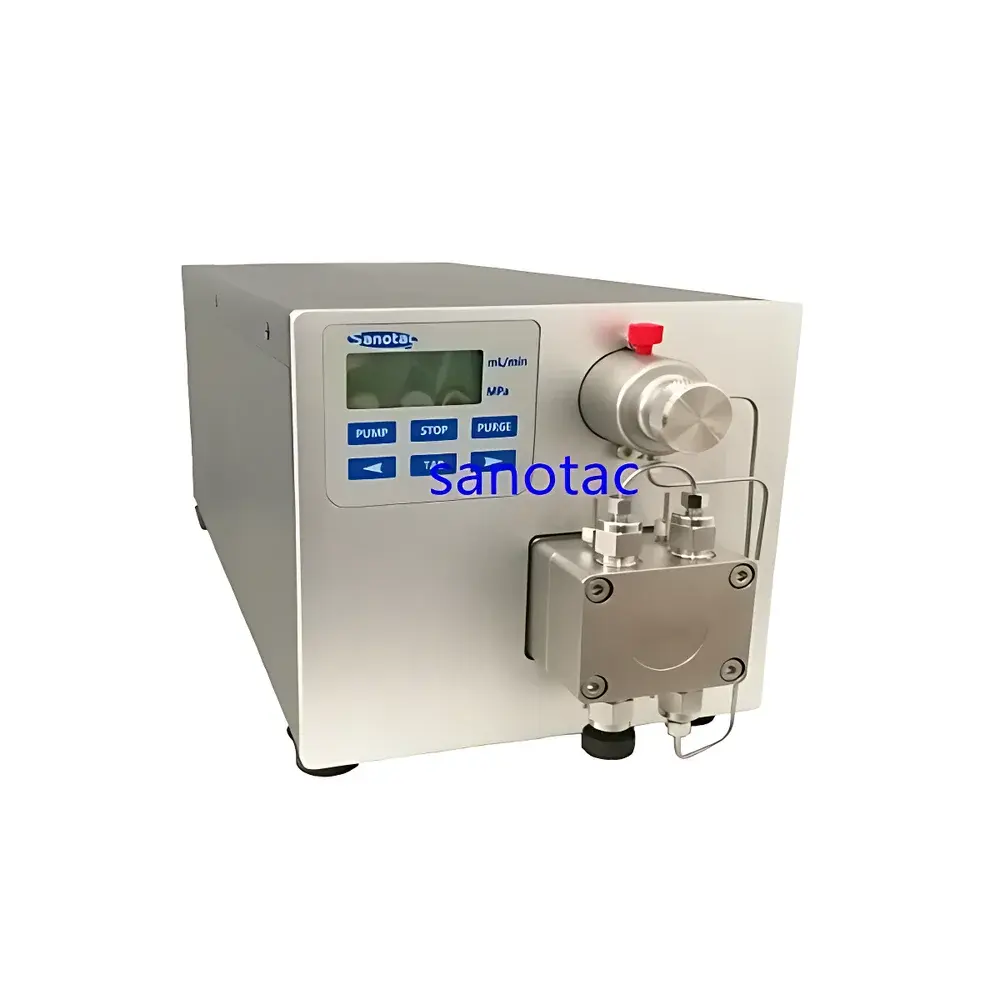
Sanotac QP1020 Micro High-Pressure Solvent Delivery Pump
| Brand | Sanotac |
|---|---|
| Origin | Shanghai, China |
| Manufacturer Type | Direct Manufacturer |
| Product Origin | Domestic (China) |
| Model | QP1020 |
| Price Range | USD 1,400 – 2,800 |
| Flow Rate Range | 0.01–100.00 mL/min |
| Flow Increment | 0.01 mL/min |
| Flow Accuracy | ±0.5% |
| Flow Precision (RSD) | ≤0.1% |
| Maximum Pressure | 20 MPa |
| Pressure Pulsation | ≤0.2 MPa |
| Fluidic Path Materials | 316L Stainless Steel, Sapphire, PTFE, Ceramic |
| Tubing Connection | 1/16″ Standard Fittings |
| Display | 256×64 Dot Matrix LCD with Backlight |
| Control Modes | Front Panel Keypad + RS232/USB Computer Remote Control (Open Protocol) |
| Power Supply | 85–264 VAC, 50 Hz |
| Dimensions (W×H×D) | 370×145×152 mm |
Overview
The Sanotac QP1020 Micro High-Pressure Solvent Delivery Pump is an engineered constant-flow precision instrument designed for laboratory-scale preparative chromatography, catalytic reaction feeding, supercritical fluid delivery, and controlled reagent dosing in R&D environments. It operates on dual parallel plunger architecture with floating plunger design—a mechanical configuration that minimizes seal wear under sustained high-pressure conditions and ensures long-term volumetric stability. The pump delivers flow rates from 0.01 to 100.00 mL/min at pressures up to 20 MPa, making it suitable for mid-pressure liquid chromatography (MPLC), continuous-flow synthesis, and electrochemical cell feed systems. Its core principle relies on microprocessor-regulated stepper motor actuation, coupled with solvent compressibility compensation algorithms and multi-point flow calibration curves, enabling consistent performance across the full dynamic range without manual recalibration.
Key Features
- Dual parallel plunger system with floating plunger mechanism—reduces radial load on seals and extends service life of sapphire/PTFE check valves and 316L stainless steel pump heads.
- Integrated pressure pulsation suppression: cam-profile optimization combined with real-time electronic flow pulse damping ensures pressure ripple ≤0.2 MPa across all operating conditions.
- High-fidelity flow control: ±0.5% accuracy and ≤0.1% RSD (n=6) validated per ISO 5725-2:2019 guidelines for repeatability under steady-state conditions.
- Open communication protocol (RS232/USB) compliant with ASTM E1382-16 for instrument interoperability—supports integration with third-party chromatography data systems (CDS), LabVIEW, Python-based automation frameworks, and custom SCADA interfaces.
- Front-panel programmable memory: stores up to 10 user-defined methods including flow rate ramps, gradient profiles (isocratic, linear, step), and hold segments—each configurable with start/stop triggers and pressure limit thresholds.
- Chemically inert fluid path: wetted components comprise 316L stainless steel housings, sapphire ball seats, PTFE gaskets, and ceramic plungers—compatible with organic solvents (e.g., THF, DCM, acetonitrile), aqueous buffers, and mildly corrosive reagents (pH 2–12).
Sample Compatibility & Compliance
The QP1020 is compatible with standard 1/16″ OD stainless steel, PEEK, or fluoropolymer tubing used in analytical and preparative LC systems. Its material construction meets USP Class VI biocompatibility requirements for non-implantable device components and complies with ISO 13485:2016 design controls for laboratory instrumentation. While not certified for GMP manufacturing environments, its traceable calibration records, audit-ready parameter logging, and firmware versioning support GLP-compliant operation in academic and industrial research labs. The pump satisfies key clauses of ASTM D3555-21 (standard practice for evaluating HPLC pump performance) and aligns with ICH Q5C stability testing guidance for consistent mobile phase delivery during forced degradation studies.
Software & Data Management
The QP1020 supports bidirectional remote control via ASCII-based command set over RS232 or USB virtual COM port. All operational parameters—including real-time flow, pressure, elapsed time, method status, and error codes—are timestamped and exportable as CSV files. Firmware includes built-in event logging (e.g., overpressure shutdown, valve switching, power cycle) with retention of last 1,000 entries. Optional Sanotac PumpLink software provides graphical method editor, gradient simulation, and compliance reporting templates aligned with FDA 21 CFR Part 11 Annex 11 expectations—enabling electronic signatures, audit trails, and role-based access control when deployed with validated IT infrastructure.
Applications
- Preparative and semi-preparative liquid chromatography (up to 20 MPa, 100 mL/min)
- Controlled addition of catalysts, initiators, or monomers in continuous-flow reactors
- Supercritical CO₂ delivery in extraction and particle formation systems
- Foam extrusion process development requiring stable low-flow (<1 mL/min) dosing
- Electrolyte feeding in fuel cell and battery R&D test benches
- High-temperature/pressure hydrothermal synthesis where precise stoichiometric reagent injection is critical
FAQ
What is the maximum allowable backpressure for continuous operation?
The QP1020 is rated for continuous operation at ≤20 MPa. Short-term excursions up to 22 MPa are permissible if duration remains under 30 seconds and frequency does not exceed once per hour.
Can the pump handle viscous solvents such as glycerol or ethylene glycol?
Yes—provided viscosity remains below 200 cP at operating temperature. For viscosities >50 cP, reduce maximum flow rate by 30% and enable solvent compressibility compensation in firmware settings.
Is the pump compatible with aggressive halogenated solvents like chloroform or carbon tetrachloride?
Chloroform is acceptable with PTFE/316L wetted parts; carbon tetrachloride is not recommended due to potential stress cracking of PTFE components and compatibility concerns with sapphire check valves.
Does the QP1020 support gradient mixing internally?
No—the QP1020 is a single-channel high-pressure pump. Gradient formation requires external low-pressure mixing modules (e.g., Sanotac GM-100 series) or dual-pump systems configured in active blending mode.
How often should the pump be calibrated?
Annual calibration is recommended for GLP environments. In routine R&D use, verification using gravimetric flow measurement per ASTM D3555-21 every 6 months ensures traceable performance.



