
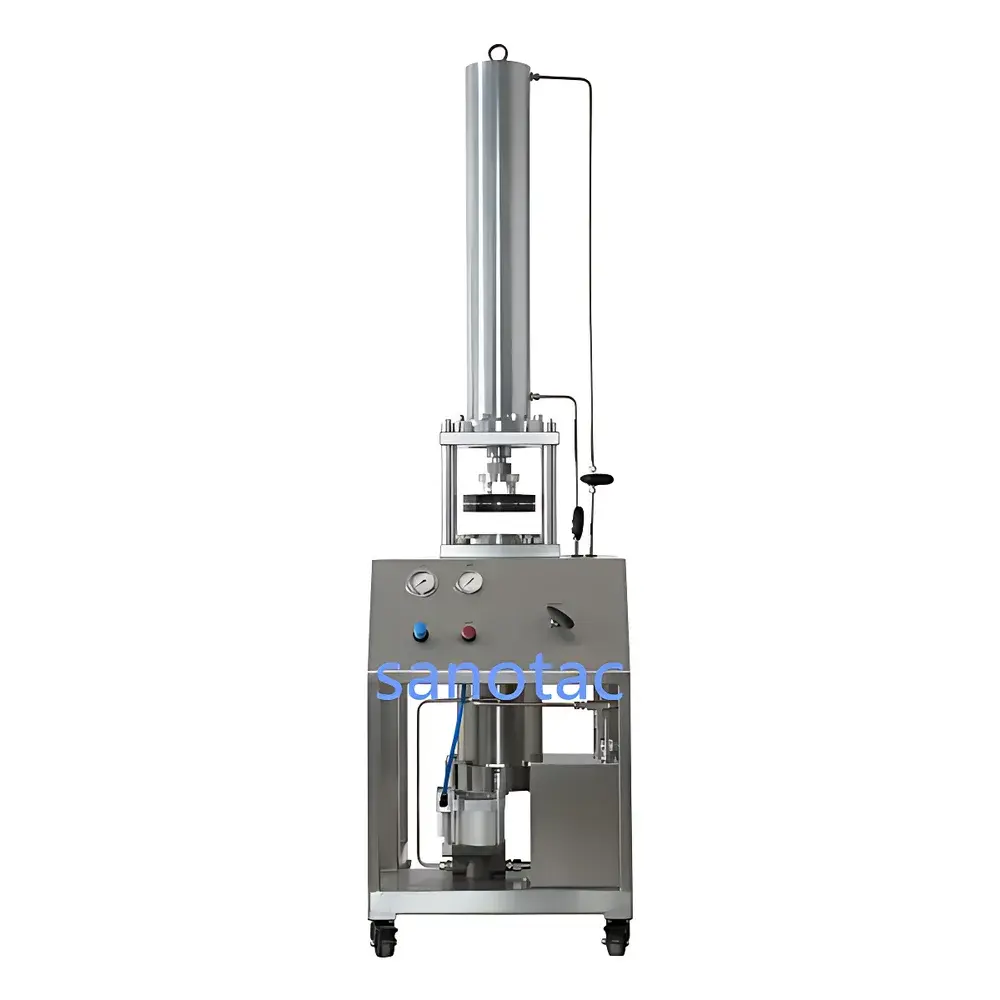
Sanotac DAC80 Dynamic Axial Compression Column System
| Brand | Sanotac |
|---|---|
| Origin | Shanghai, China |
| Manufacturer Type | Manufacturer |
| Origin Category | Domestic |
| Model | DAC80 |
| Application Level | Industrial Preparative Scale |
| Instrument Type | High-Pressure Preparative Liquid Chromatography System |
| Flow Rate Range | 0.01–1000.00 mL/min |
| Flow Accuracy | ±1% |
| Flow Precision (RSD) | ≤0.5% |
| Maximum Operating Pressure | 10 MPa |
| Wavelength Range | 190–800 nm |
| Wavelength Accuracy | ±1 nm |
| Wavelength Repeatability | 0.2 nm |
| Baseline Noise | ±0.5×10⁻⁵ AU (254 nm, TC = 1 s) |
| Data Acquisition Frequency | 10 Hz |
Overview
The Sanotac DAC80 Dynamic Axial Compression (DAC) Column System is an engineered solution for high-fidelity, scalable preparative liquid chromatography. It operates on the principle of dynamic axial compression—where a hydraulically actuated piston applies uniform, controllable pressure to a slurry-packed chromatographic bed in real time, maintaining column integrity and bed homogeneity throughout extended runs. Unlike static packing methods, DAC technology eliminates radial density gradients and channeling by continuously compensating for bed settling under flow, thereby preserving resolution, peak symmetry, and loading capacity across multi-gram to kilogram-scale purification campaigns. Designed for industrial preparative applications, the DAC80 supports robust operation at up to 10 MPa (100 bar), accommodating both high-resolution separations with sub-10 µm particles and high-throughput desalting or buffer exchange with larger media. Its architecture integrates seamlessly into GMP-aligned workflows, particularly where batch consistency, regulatory traceability, and column longevity are critical—such as in natural product isolation, synthetic API purification, and biopolymer fractionation.
Key Features
- Hydraulically driven axial piston with nitrogen-sealed interface ensures leak-free, stable pressure maintenance over extended run durations (≥12 h at 8 MPa)
- Optimized column hardware: 100 mm ID × 650 mm length stainless steel 316L tube with internal surface finish Ra ≤ 0.2 µm and 2 µm sintered 316L frits for minimal dead volume and maximal packing efficiency
- High-precision dual-pump configuration (binary or quaternary) supporting gradient elution up to 1000 mL/min with <0.5% RSD flow repeatability across full range
- Full-spectrum UV-Vis detector (190–800 nm) with dual-lamp auto-switching (D₂ + W), ±1 nm wavelength accuracy, and low-noise optical design (±0.5×10⁻⁵ AU @ 254 nm, 1 s time constant)
- Intelligent fraction collector with programmable modes: peak-triggered, time-based, volume-based, threshold-gated, and cyclic collection
- Cam-profile flow pulsation compensation and multi-point flow calibration curves ensure consistent delivery across viscosity- and backpressure-variable mobile phases
- Auto-cleaning pump heads prevent crystallization of buffer salts; modular flow cell and lamp access enable rapid maintenance without system recalibration
Sample Compatibility & Compliance
The DAC80 accommodates a broad spectrum of sample matrices—including polar alkaloids from traditional Chinese herbs, hydrophobic polyphenols, synthetic small molecules (<1 kDa), and moderately sized proteins (up to ~60 kDa) using wide-pore C4 or polymer-based resins. It supports particle sizes from 5 to 10 µm and column bed heights up to 500 mm, enabling method translation from analytical to production scale. The system conforms to ISO 9001 manufacturing standards and meets essential requirements for GLP/GMP environments: electronic audit trails, role-based user authentication, electronic signatures, and immutable method/data archiving via relational database project management. Software complies with FDA 21 CFR Part 11 and CFDA GxP guidelines for data integrity, including full traceability of parameter changes, instrument events, and operator actions.
Software & Data Management
Control and data acquisition are managed through Sanotac ChromaSuite™—a validated, Windows-based platform supporting method development, sequence scheduling, real-time chromatogram visualization, and automated report generation. All raw data (UV traces, pressure logs, fraction triggers) are stored in vendor-neutral formats (e.g., .CDF) alongside metadata-enriched project files. The database-driven architecture links instrument methods, calibration records, spectral libraries, and processed results under hierarchical project IDs. Audit trail logs record timestamps, user IDs, parameter modifications, and system alerts with tamper-proof hashing. Optional modules support integration with LIMS via ASTM E1384-compliant interfaces and export to CSV/Excel for statistical process control (SPC) analysis.
Applications
- Purification of active pharmaceutical ingredients (APIs) and intermediates under cGMP conditions
- Isolation of bioactive compounds from botanical extracts (e.g., ginsenosides, curcuminoids, flavonoid glycosides)
- Desalting and buffer exchange of monoclonal antibody fragments and recombinant enzymes
- Chiral separation of racemic synthetics using immobilized polysaccharide-based chiral stationary phases
- Scale-up of orthogonal purification strategies combining reversed-phase, ion-exchange, and size-exclusion modalities
FAQ
What column dimensions and packing materials are supported?
The DAC80 accepts columns with 100 mm internal diameter and up to 650 mm total length. Recommended packing materials include silica-based C18, phenyl-hexyl, and cyano phases (5–10 µm), as well as polymeric resins (e.g., Toyopearl®, Sepharose® CL-4B) for biomolecules.
Does the system support method transfer from analytical to preparative scale?
Yes—through retention time normalization, linear velocity scaling, and bed-height adjustment algorithms embedded in ChromaSuite™, enabling direct translation of UHPLC methods to DAC80 operating conditions.
How is pressure stability maintained during long-duration runs?
The hydraulic piston actuation system incorporates closed-loop pressure feedback and thermal drift compensation, sustaining setpoint deviation within ±0.3 MPa over 24-hour continuous operation.
Can third-party detectors be integrated?
The system provides analog (±5 V) and digital (RS-485, Ethernet) I/O ports compliant with ASTM E1384 and EUROLAB protocols, allowing seamless integration of ELSD, MS, or RI detectors.
What validation documentation is provided?
Factory acceptance testing (FAT) reports, IQ/OQ protocols, and 21 CFR Part 11 compliance documentation are supplied standard; PQ support is available upon request.





