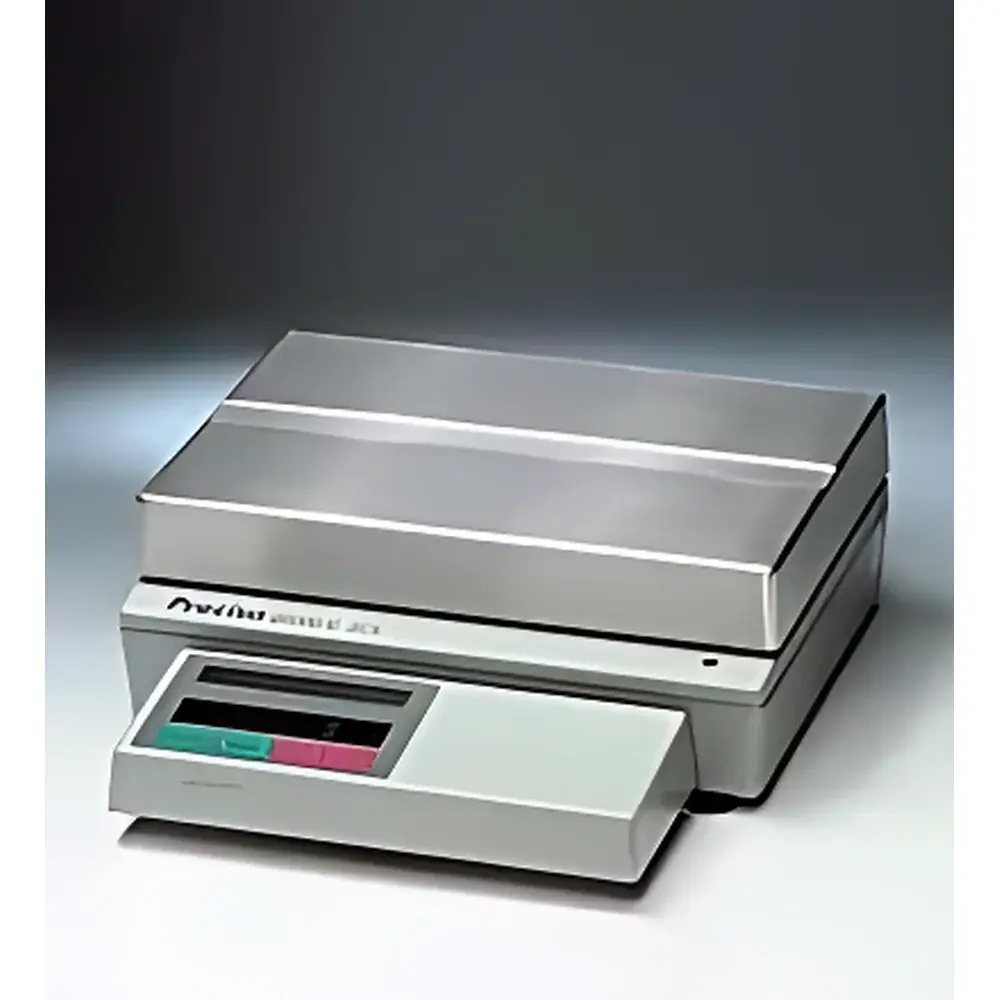
Precisa 40000G SCS High-Capacity Precision Balance
| Brand | Precisa |
|---|---|
| Capacity | 40100 g |
| Readability | 1 g |
| Display Update Rate | 0.08 / 0.16 / 0.32 sec (selectable) |
| Stability Settings | LOW / MED / HIGH (selectable) |
| Operating Temperature | 0–40 °C |
| Power Supply | AC 230 V, 50/60 Hz |
| Power Consumption | 13 VA |
| Calibration | Internal motorized weight, programmable auto-calibration every 24 h or triggered by ≥2 °C ambient temperature change |
| Dimensions (W×H×D) | 375 × 130 × 396 mm |
| Pan Size | 375 × 250 mm |
| Net Weight | 14.5 kg |
| Interface | RS-232/V.24 |
| Unit Options | g, kg, gn, dwt, ozt, oz, lb, ct, cm, pcs, tlh, tlm, tlt, % (dual-unit display supported) |
| Features | Audible key feedback (on/off), % weight indicator, bottom-loading option, optional solid/liquid density kit, dust-proof display cover, SCS Smart Calibration System, user-defined reference count memory, UMM parameter retention, password-protected operation |
Overview
The Precisa 40000G SCS is a high-capacity precision balance engineered for routine and quality-critical weighing tasks in industrial laboratories, pharmaceutical production environments, and materials testing facilities. Designed around electromagnetic force compensation (EMFC) technology, it delivers stable, drift-resistant measurement performance across its full 40,100 g capacity range with 1 g readability. Unlike analytical balances optimized for sub-milligram resolution, the 40000G SCS prioritizes robustness, repeatability, and operational flexibility at higher mass ranges—making it suitable for formulation checks, batch verification, gross weight validation, and density determination workflows where speed, environmental tolerance, and regulatory traceability are essential.
Key Features
- SCS Smart Calibration System: Fully automated internal calibration using a built-in motorized reference mass; configurable for scheduled recalibration every 24 hours or dynamic activation upon detection of ≥2 °C ambient temperature fluctuation—ensuring continuous metrological integrity without manual intervention.
- Triple-Mode Stability Control: Adjustable filtering algorithms (LOW/MED/HIGH) allow users to optimize response time versus noise rejection based on sample type, draft conditions, or vibration exposure—critical for consistent results in non-ideal lab environments.
- Dual-Unit Display & Flexible Weighing Modes: Supports simultaneous display of two user-selected units (e.g., g and %) and offers dedicated modes including piece counting (with programmable reference sample size), percentage weighing, checkweighing, and density determination (when paired with optional density kits).
- RS-232/V.24 Serial Interface: Enables direct connection to printers, LIMS, or laboratory information systems for automated data logging—supporting audit-ready documentation in GLP/GMP-compliant settings.
- User Memory & Security: UMM (User Memory Module) retains all configuration parameters—including unit preferences, stability settings, and calibration history—across power cycles. Password protection prevents unauthorized access or modification of critical settings.
- Ergonomic & Environmental Design: Integrated dust-proof display cover, audible key feedback (configurable), large 375 × 250 mm stainless steel weighing pan, and compact footprint (375 × 130 × 396 mm) facilitate integration into constrained workspaces while maintaining operational hygiene and operator comfort.
Sample Compatibility & Compliance
The 40000G SCS accommodates heterogeneous sample forms—including powders, granules, packaged goods, and irregularly shaped solids—via its wide, low-profile pan and optional bottom-loading adapter. Its operating temperature range (0–40 °C) and stable EMFC sensor architecture ensure reliable performance in manufacturing cleanrooms, warehouse QC labs, and field-deployed mobile testing stations. The balance complies with ISO 9001 quality management requirements and supports adherence to pharmacopeial standards (USP , EP 2.1.3) through documented calibration procedures, traceable internal weights, and audit-trail-capable data export. While not certified to OIML R76 or NIST Handbook 44 for legal-for-trade applications, its design aligns with ISO/IEC 17025 calibration laboratory best practices for in-house reference standards.
Software & Data Management
No proprietary software is required for basic operation; however, the RS-232 interface enables seamless integration with third-party data acquisition platforms—including LabWare LIMS, Thermo Fisher SampleManager, and custom Python- or LabVIEW-based scripts—using standard ASCII command protocols (e.g., “SI” for stable weight readout). All calibration events, timestamped weight outputs, and system diagnostics are logged via serial output and can be parsed into CSV or database formats for trend analysis, statistical process control (SPC), or electronic record retention per FDA 21 CFR Part 11 requirements when paired with validated software infrastructure.
Applications
- Pharmaceutical: Raw material receipt inspection, excipient blending verification, tablet weight uniformity sampling, and bulk intermediate packaging checks.
- Chemical & Materials: Catalyst batch reconciliation, polymer pellet lot acceptance, additive dosing validation, and metal alloy scrap sorting.
- Food & Beverage: Ingredient portioning consistency, finished product net weight auditing, and shelf-life stability study sample tracking.
- Academic & Contract Labs: Teaching labs requiring durable, multi-user instrumentation; contract testing organizations performing ASTM D198, ISO 1183, or EN 196-1 compliant density and mass fraction analyses.
FAQ
Does the 40000G SCS meet ISO/IEC 17025 calibration requirements?
Yes—when used with documented internal calibration procedures, traceable reference masses, and maintained environmental logs, it satisfies clause 6.5.2 for equipment suitability in accredited testing laboratories.
Can the balance be integrated into an automated production line?
It supports PLC-triggered weight capture via RS-232 handshake signals and is compatible with common industrial automation protocols through middleware gateways.
Is external calibration with certified weights still necessary?
Internal calibration ensures daily stability; however, periodic verification against accredited external standards (e.g., annually or after relocation) is recommended per ISO/IEC 17025 and internal QA policies.
What density measurement methods does it support?
With optional solid/liquid density kits, it performs direct buoyancy-based density calculation per ISO 1183-1 and ASTM D792, displaying g/cm³ without manual computation.
How is password protection implemented?
A four-digit numeric password restricts access to calibration, unit configuration, and system setup menus—preventing inadvertent or unauthorized changes during shared-use operations.