
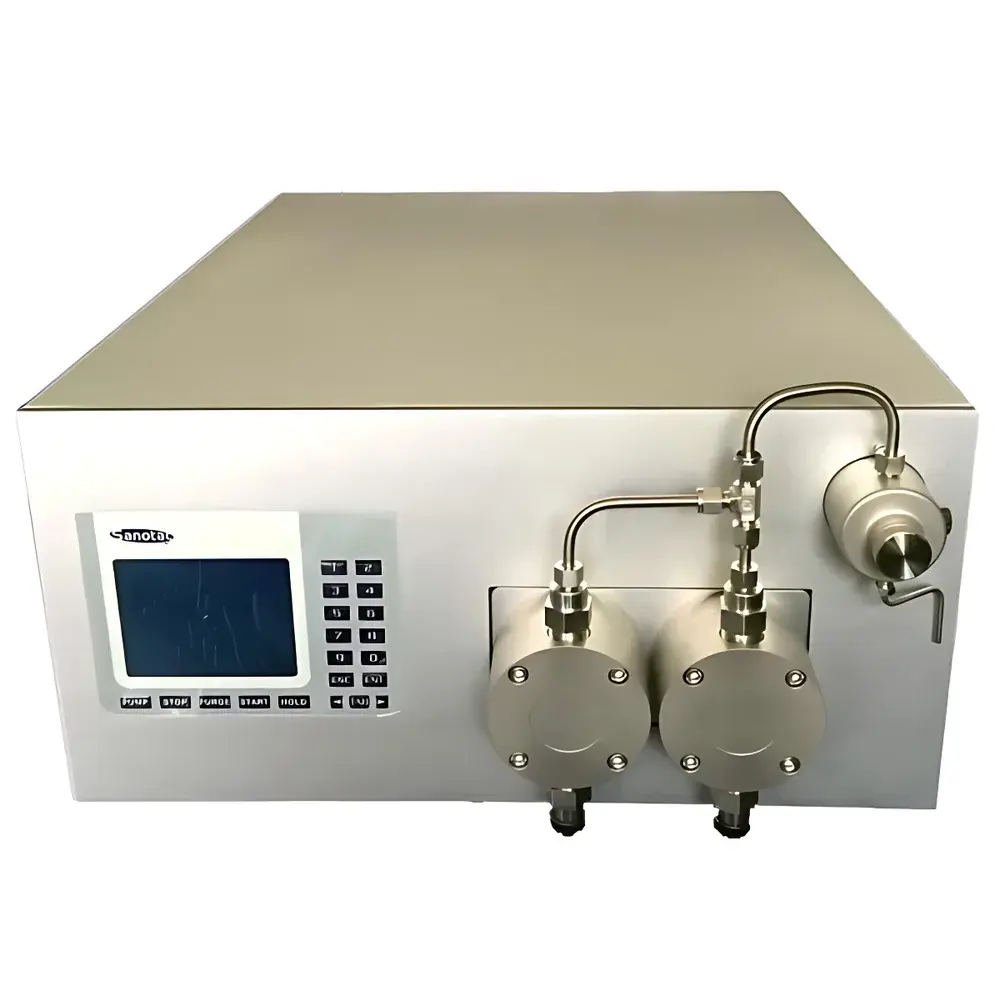
Sanotac KLP0310 High-Flow High-Pressure Dual-Piston Solvent Delivery Pump
| Brand | Sanotac |
|---|---|
| Origin | Shanghai, China |
| Manufacturer Type | Direct Manufacturer |
| Product Origin | Domestic (China) |
| Model | KLP0310 |
| Price Range | USD 2,800 – 7,000 |
| Flow Rate | 10–10,000 mL/min |
| Maximum Pressure | 10 MPa (1450 psi) |
| Pump Head Volume | 3000 mL |
| Construction Materials | Stainless Steel / Titanium / PTFE / PCTFE / Hastelloy / PEEK |
| Control Interface | Microprocessor-Based Dual-Drive System with Open Communication Protocol (RS-232/RS-485, Modbus-compatible) |
Overview
The Sanotac KLP0310 is a high-flow, high-pressure dual-piston solvent delivery pump engineered for precision fluid handling in demanding laboratory and pilot-scale process applications. Based on positive displacement piston actuation with parallel dual-head architecture, it delivers stable, pulse-dampened flow across an exceptionally wide dynamic range—from 10 mL/min up to 10,000 mL/min—while maintaining continuous operation at up to 10 MPa (1450 psi). Its design adheres to core principles of reciprocating positive displacement pumping, incorporating real-time solvent compressibility compensation and multi-point flow calibration to minimize volumetric error across varying viscosities and pressures. Unlike peristaltic or diaphragm-based systems, the KLP0310 achieves superior long-term stability and chemical compatibility through rigid metal or high-performance polymer wetted-path construction, making it suitable for integration into HPLC/UHPLC auxiliary systems, continuous flow reactors, supercritical fluid processing lines, and catalytic slurry feeding setups.
Key Features
- Dual-piston parallel drive architecture with independent cam profiling for synchronized stroke timing and minimized pressure ripple
- Microprocessor-controlled flow regulation with solvent compressibility compensation algorithms and multi-point flow curve calibration (up to 16 calibration points)
- Low-pressure-pulse design utilizing optimized cam profile geometry and real-time electronic flow pulsation suppression
- Floating piston mechanism reducing radial load on high-pressure seals, extending seal service life by up to 3× versus fixed-piston configurations
- Modular wetted-path options: 316L stainless steel, grade 5 titanium, PTFE, PCTFE, Hastelloy C-276, and PEEK—each certified for compatibility with aggressive solvents, acids, bases, and supercritical CO₂
- Open communication protocol supporting RS-232, RS-485, and Modbus RTU; fully compatible with third-party chromatography data systems (CDS), SCADA platforms, and custom LabVIEW or Python-based control interfaces
- Integrated user memory for up to 10 programmable methods—including gradient profiles combining isocratic, linear, and step segments—with local LCD interface and encoder navigation
Sample Compatibility & Compliance
The KLP0310 accommodates a broad spectrum of liquid-phase chemistries, including aqueous buffers, organic solvents (acetonitrile, THF, DMF), corrosive reagents (HF,浓H₂SO₄, fuming nitric acid), molten salts, catalyst slurries, and supercritical fluids (CO₂, ethane). All wetted materials comply with ASTM F2136 (biocompatibility of polymers), ISO 10993-5 (cytotoxicity), and USP Class VI standards where applicable. Pump assemblies are designed to meet mechanical integrity requirements under ASME B31.3 Process Piping guidelines for low-to-intermediate pressure service. While not pre-certified for GMP environments, its audit-trail-capable firmware (with optional timestamped event logging) supports GLP-compliant operation when integrated with validated workstation software meeting FDA 21 CFR Part 11 requirements.
Software & Data Management
The pump operates autonomously via its embedded controller but supports full remote orchestration through ASCII-based command sets over serial or industrial fieldbus protocols. No proprietary driver installation is required—standard terminal emulators or Python’s pySerial library suffice for scripting. For enterprise integration, Sanotac provides documented Modbus register maps enabling direct linkage to DeltaV, Siemens Desigo, or Ignition SCADA systems. Optional firmware upgrades include extended logging (SD card support), alarm relay outputs (dry contact), and time-synchronized method execution triggers—features commonly leveraged in automated reaction screening workflows and continuous manufacturing platforms compliant with ICH Q13 guidelines.
Applications
- HPLC/UHPLC system augmentation for preparative-scale separations and column cleaning protocols
- Continuous-feed reactors in heterogeneous catalysis, electrochemical synthesis, and photochemical flow chemistry
- Supercritical fluid extraction (SFE) and impregnation systems requiring precise co-solvent metering
- High-viscosity polymer solution delivery in reactive extrusion and foam expansion processes
- Electrolyte dosing in battery R&D (e.g., Li-S, solid-state cell assembly)
- High-throughput catalyst evaluation rigs with automated reagent addition sequences
- Calibration reference pumps for flowmeter validation per ISO 4064-2 and ISO 17025-accredited laboratories
FAQ
What is the maximum allowable backpressure for continuous operation at 10,000 mL/min?
At full flow rate, the KLP0310 is rated for continuous duty up to 2 MPa; pressure capability scales inversely with flow—full 10 MPa rating applies down to ~200 mL/min.
Can the pump handle abrasive slurries containing >20% solid content?
Yes—when equipped with titanium or Hastelloy wetted parts and optional ceramic-coated pistons (available as OEM upgrade), it supports slurry pumping per ISO 15136-1 Annex A guidelines.
Is gradient programming limited to binary solvent mixing?
No—the KLP0310 itself does not mix solvents; it delivers single-fluid streams with programmable flow profiles. Gradient formation requires external mixing modules or multi-pump synchronization via master-slave triggering.
Does the open communication protocol support Ethernet/IP or OPC UA?
Not natively—but Modbus TCP gateways (e.g., Moxa EDS-G205A) enable seamless translation to both protocols without firmware modification.
What maintenance intervals are recommended for high-duty-cycle operation (24/7)?
Seal replacement every 6 months under continuous 10 MPa operation; cam lubrication every 3 months; full calibration verification every 90 days per ISO/IEC 17025 Clause 7.7.



