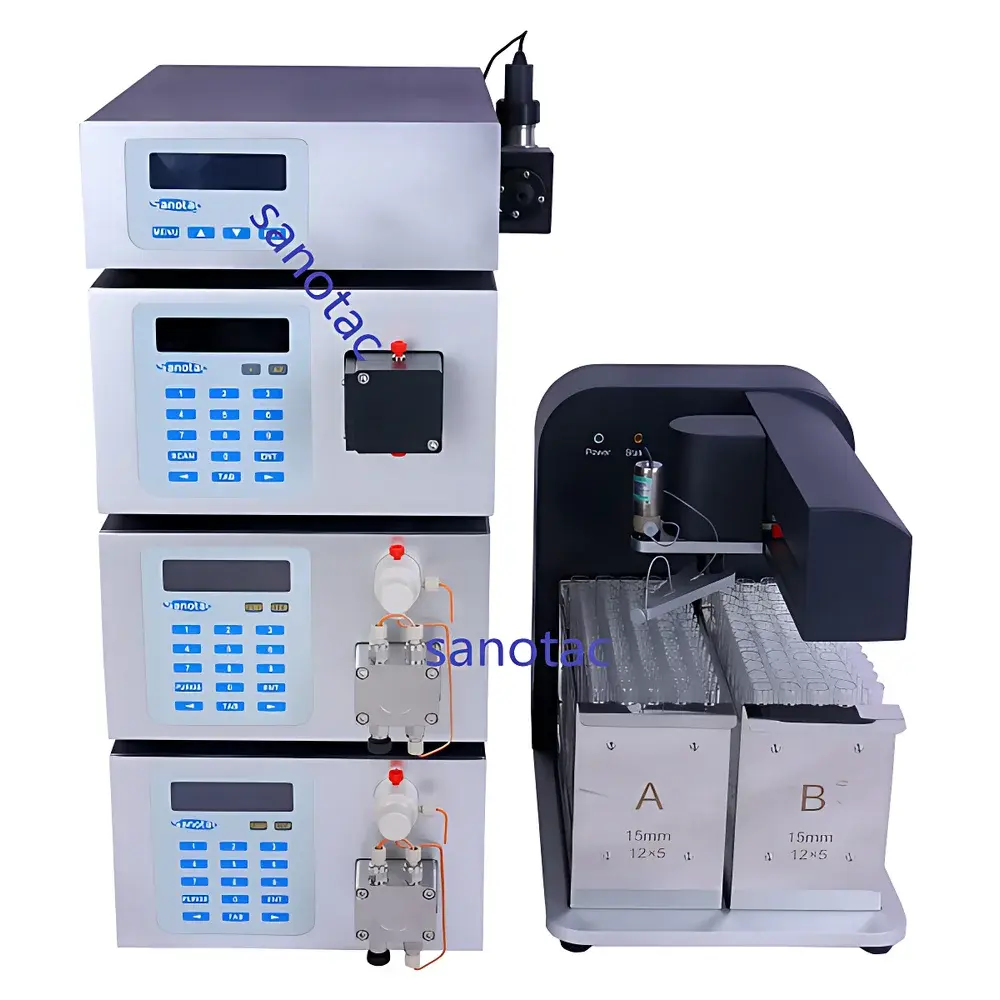
Sanotac Biolot 50 Protein Purification System with Audit Trail and User Permission Management
| Brand | Sanotac |
|---|---|
| Origin | Shanghai, China |
| Manufacturer Type | Manufacturer |
| Product Category | Domestic |
| Model | Biolot 50 |
| Purification Principle | Affinity Chromatography (AC) |
| Detector Types | UV-Vis Absorbance Detector, Conductivity Detector, Evaporative Light Scattering Detector (ELSD) |
| Detection Wavelength Range | 190–800 nm |
| Flow Rate Range | 0.01–50 mL/min |
| Pressure Range | 0–20 MPa |
| Gradient Accuracy | ±0.5% ABS (dual-pump system) |
| Conductivity Range | 0–999.9 mS/cm |
| pH Range | 0–14 |
| Fraction Collector Capacity | 2 × 60 tubes (15 mm Ø × 150 mm H) |
| Software Compliance | FDA 21 CFR Part 11, CFDA GxP |
Overview
The Sanotac Biolot 50 Protein Purification System is a modular, medium-pressure liquid chromatography platform engineered for reproducible, scalable purification of proteins, peptides, antibodies, and nucleic acids under laboratory and process development conditions. It operates on the principle of affinity chromatography—leveraging highly selective ligand–analyte interactions—and supports complementary techniques including ion exchange, size exclusion, and hydrophobic interaction chromatography. Designed for flexibility between analytical-scale characterization and gram-level preparative isolation, the system integrates high-precision PEEK-based dual syringe pumps, real-time multi-parameter detection, and a fully programmable fraction collector—all coordinated through a validated, regulatory-compliant software environment.
Key Features
- High-fidelity dual-pump gradient delivery with flow accuracy of ±0.5% and pressure capability up to 20 MPa, enabling robust method transfer from screening to process optimization.
- UV-Vis absorbance detector equipped with dual light sources (deuterium and tungsten lamps), automatically switching between spectral ranges to ensure optimal signal-to-noise across 190–800 nm; simultaneous dual-wavelength monitoring supports ratiometric analysis (e.g., A260/A280 for protein/nucleic acid purity assessment).
- Integrated conductivity and pH detection modules with calibrated analog outputs, facilitating real-time monitoring of buffer composition and elution profiles during gradient elution or stepwise washes.
- PEEK fluidic path throughout the system—including pump heads, valves, and flow cells—ensures biocompatibility, chemical resistance, and minimal metal leaching, critical for sensitive biomolecules and GMP-aligned workflows.
- Auto-cleaning pump head design reduces carryover and prevents salt crystallization in high-conductivity buffers, enhancing long-term operational stability and reducing maintenance intervals.
- Programmable fraction collector supporting sequential, looped, and trigger-based collection modes; accommodates standard 15-mm-diameter × 150-mm-tall tubes in dual 60-position racks, with optional custom rack configurations.
- Modular architecture allows seamless integration of optional detectors—including ELSD—for non-UV-absorbing analytes (e.g., carbohydrates, lipids, or certain small-molecule conjugates).
Sample Compatibility & Compliance
The Biolot 50 accommodates sample volumes ranging from microgram- to gram-scale inputs across diverse biological matrices—including clarified lysates, cell culture supernatants, plasma fractions, and synthetic oligonucleotide solutions. Its hardware and software are designed to meet international quality system requirements: the system conforms to ISO 13485 principles for medical device manufacturing environments and supports GLP/GMP documentation practices. All electronic records—including method files, raw chromatograms, audit logs, and user actions—are secured under ALCOA+ (Attributable, Legible, Contemporaneous, Original, Accurate, Complete, Consistent, Enduring, Available) data integrity standards. The embedded BioView software is validated for compliance with FDA 21 CFR Part 11 and CFDA GxP regulations, including electronic signature enforcement, role-based access control, and immutable audit trail generation with timestamped event logging.
Software & Data Management
BioView is a Windows-based workstation application providing unified control over all hardware modules, method development, sequence execution, and post-run analysis. It features hierarchical user permission management: administrators define roles (e.g., Operator, Supervisor, QA Reviewer) with granular rights over instrument control, method editing, data export, and electronic signature approval. Every action—including login attempts, parameter changes, method saves, run initiations, and report generation—is recorded in a tamper-evident audit trail with cryptographic hashing. Data files are stored in vendor-neutral formats (e.g., .CDF, .csv) compatible with third-party LIMS and ELN platforms. Built-in reporting tools support customizable templates compliant with ICH M7 and USP <1058> analytical instrument qualification guidelines.
Applications
- Purification of monoclonal antibodies (mAbs) and antibody–drug conjugates (ADCs) using Protein A, G, or L resins.
- Isolation of His-tagged recombinant proteins via immobilized metal affinity chromatography (IMAC).
- Downstream processing of viral vectors (AAV, lentivirus) requiring low-shear, low-metal-contamination workflows.
- Process development for biosimilars, including column screening, gradient optimization, and scalability studies from 1 mL to 50 mL/min flow rates.
- Quality control of therapeutic peptides and oligonucleotides where UV detection alone is insufficient—enhanced by parallel conductivity or ELSD detection.
- Academic and industrial research labs performing structural biology sample prep, where batch-to-batch consistency and traceable metadata are essential.
FAQ
Does the Biolot 50 support remote monitoring and control?
Yes—BioView includes secure TCP/IP communication protocols enabling remote operation via local network or VPN-configured environments, subject to IT security policy alignment.
Can I import existing HPLC methods into BioView?
Method templates can be imported as XML-based definitions; however, hardware-specific parameters (e.g., dwell volume, detector response time) require empirical revalidation due to architectural differences between UHPLC and medium-pressure systems.
What validation documentation is provided with the system?
Sanotac supplies a comprehensive IQ/OQ protocol package, including factory test reports, calibration certificates for detectors and pumps, and software validation summary documents aligned with ASTM E2500 and Annex 11.
Is the system compatible with third-party columns and resins?
Yes—the Biolot 50 uses standard 1/4″-28 UNF and 10-32 fittings and accepts columns with maximum dimensions of 25 mm ID × 300 mm length; compatibility with resin slurry packing and backpressure limits must be verified per manufacturer specifications.
How frequently does the audit trail require archival or backup?
Audit log files are automatically rotated every 90 days or upon reaching 500 MB; retention policies are configurable within BioView and should align with organizational SOPs and regulatory retention mandates (e.g., minimum 2 years for R&D, 15+ years for commercial product batches).