
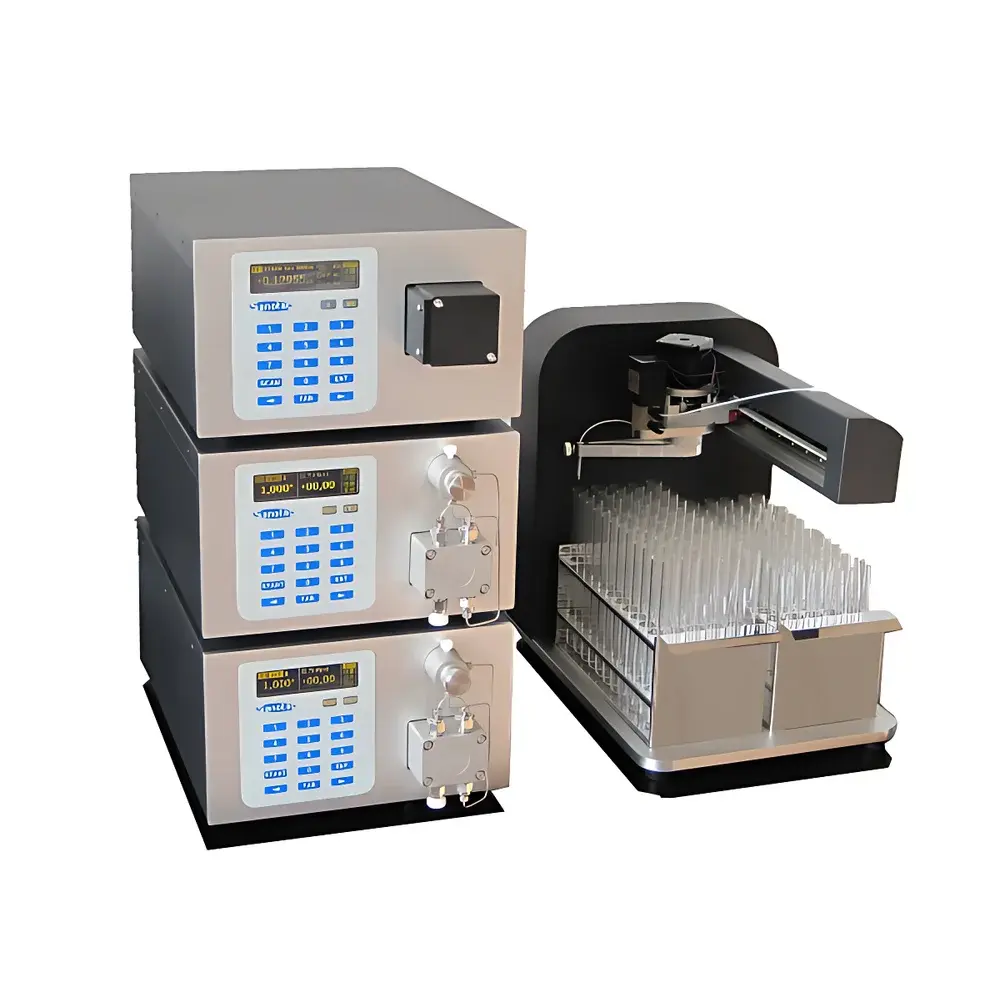
Sanotac Pilot200 Preparative Liquid Chromatography System with Audit Trail and User Permission Management
| Brand | Sanotac |
|---|---|
| Origin | Shanghai, China |
| Manufacturer Type | Direct Manufacturer |
| Origin Category | Domestic |
| Model | Pilot200 |
| Application Level | Laboratory-Scale |
| Instrument Type | High-Pressure Preparative LC |
| Flow Rate Range | 0.01–200.00 mL/min |
| Flow Accuracy | ±1% |
| Flow Precision (RSD) | ≤0.5% |
| Maximum Pressure | 10 MPa |
| Wavelength Accuracy | ±1 nm |
| Wavelength Reproducibility | 0.2 nm |
| Baseline Noise | ±0.75×10⁻⁵ AU (254 nm, TC = 1 s) |
| Data Acquisition Rate | 10 Hz |
Overview
The Sanotac Pilot200 Preparative Liquid Chromatography System is a modular, high-pressure preparative HPLC platform engineered for scalable purification of active pharmaceutical ingredients (APIs), natural products, synthetic intermediates, and biomolecules—including peptides and small proteins—across research, process development, and early-stage pilot production environments. Built upon dual-syringe pump architecture with real-time chamber pressure feedback, the system delivers precise solvent delivery under dynamic compression compensation, enabling stable flow control across the full 0.01–200.00 mL/min range. Its measurement principle adheres to UV-Vis absorbance detection via dual-wavelength photometry (190–800 nm), supporting simultaneous monitoring at two independent wavelengths with programmable time-based wavelength switching and stop-flow spectral scanning. This configuration ensures robust quantitation of major components, co-eluting impurities, and degradation products under gradient elution conditions. The system operates as an integrated unit comprising high-pressure binary gradient pumps, a dual-channel UV-Vis detector, a programmable fraction collector, and a Windows-based chromatography workstation compliant with regulatory data integrity requirements.
Key Features
- Microprocessor-controlled dual-piston pump with floating plunger design, minimizing seal wear and extending service life under sustained 10 MPa operation.
- Advanced pulse-dampening algorithm combined with cam-profile flow compensation reduces baseline noise to ±0.75×10⁻⁵ AU (254 nm, 1 s time constant) and ensures RSD ≤0.5% flow reproducibility.
- Multi-point volumetric flow calibration across the entire range guarantees ±1% accuracy without reliance on external flow meters.
- Dual-wavelength detection with automated deuterium/tungsten lamp switching, enabling uninterrupted operation and extended lamp lifetime.
- 10 user-defined method programs support complex gradient profiles—including linear, stepwise, and real-time editable gradients—with 1% minimum gradient resolution.
- Modular column interface compatible with both stainless-steel and high-pressure glass columns (up to 10 MPa), accommodating ID ranges from 10 mm to 50 mm.
- Integrated fraction collector featuring hybrid linear-rotary motion, sub-millisecond valve actuation, and dead-volume-optimized fluidics for precise peak cutting and minimal cross-contamination.
Sample Compatibility & Compliance
The Pilot200 accommodates diverse sample matrices including crude plant extracts, reaction mixtures, fermentation broths, and partially purified protein fractions. It supports solid-phase loading (via 10 mL loop valve) and direct liquid injection, with compatibility for common reversed-phase (C18, C8), normal-phase (silica), and ion-exchange media. From a regulatory standpoint, the system meets essential criteria for GLP and GMP-aligned laboratories: hardware-level audit trail logging (immutable timestamped records of all method edits, run executions, and user logins), role-based access control (administrator, operator, reviewer tiers), electronic signature support, and secure data storage with tamper-evident file integrity checks. Software architecture conforms to FDA 21 CFR Part 11 and CFDA GxP data integrity guidelines, including mandatory audit trail review functionality and password complexity enforcement.
Software & Data Management
Control and data acquisition are managed through Sanochrom™ Chromatography Workstation v3.x—a native Windows application (Windows 7/8/10 compatible) communicating via USB 2.0 and RS-232 interfaces. The software provides full instrument orchestration: synchronized pump gradient programming, detector wavelength scheduling, real-time UV signal overlay, and conditional fraction collection triggered by time, peak threshold, or derivative (slope) algorithms. All raw data files (.raw) are stored in vendor-neutral formats with embedded metadata (instrument ID, method name, operator ID, acquisition timestamp). Audit trail entries are encrypted, non-erasable, and exportable as PDF or CSV for internal QA review or regulatory inspection. Data backup policies support scheduled network drive synchronization and optional RAID-1 local redundancy.
Applications
- Purification of bioactive compounds from traditional Chinese medicine (TCM) extracts, including alkaloids, flavonoids, and terpenoids.
- Isolation of stereoisomers and regioisomers in asymmetric synthesis workflows.
- Desalting and buffer exchange of peptide fractions prior to lyophilization.
- Removal of residual catalysts and unreacted starting materials in API intermediate purification.
- Fractionation of monoclonal antibody fragments (e.g., Fab, Fc) using size-exclusion or ion-exchange preparative columns.
- Method scouting and transfer from analytical to preparative scale using retention time normalization and linear velocity scaling.
FAQ
Does the Pilot200 support 21 CFR Part 11 compliance out-of-the-box?
Yes—the Sanochrom™ workstation includes preconfigured electronic signature workflows, audit trail archiving, and user permission hierarchy management aligned with Part 11 Annex A requirements.
Can I use PEEK pump heads instead of stainless steel?
Optional PEEK pump heads are available for enhanced chemical resistance with aggressive solvents such as THF, DCM, or high-pH mobile phases.
What is the maximum column inner diameter supported at full pressure?
The system maintains rated 10 MPa performance with columns up to 50 mm ID when operated within validated flow and backpressure limits.
Is remote monitoring or control possible?
Local network access is supported via TCP/IP-enabled instrument modules; however, cloud-based remote operation is not implemented for security and data integrity reasons.
How is delay volume compensated during fraction collection?
The software allows manual input of system dwell volume and detector-to-collector tubing length, enabling precise retention-time offset correction for accurate peak slicing.





