
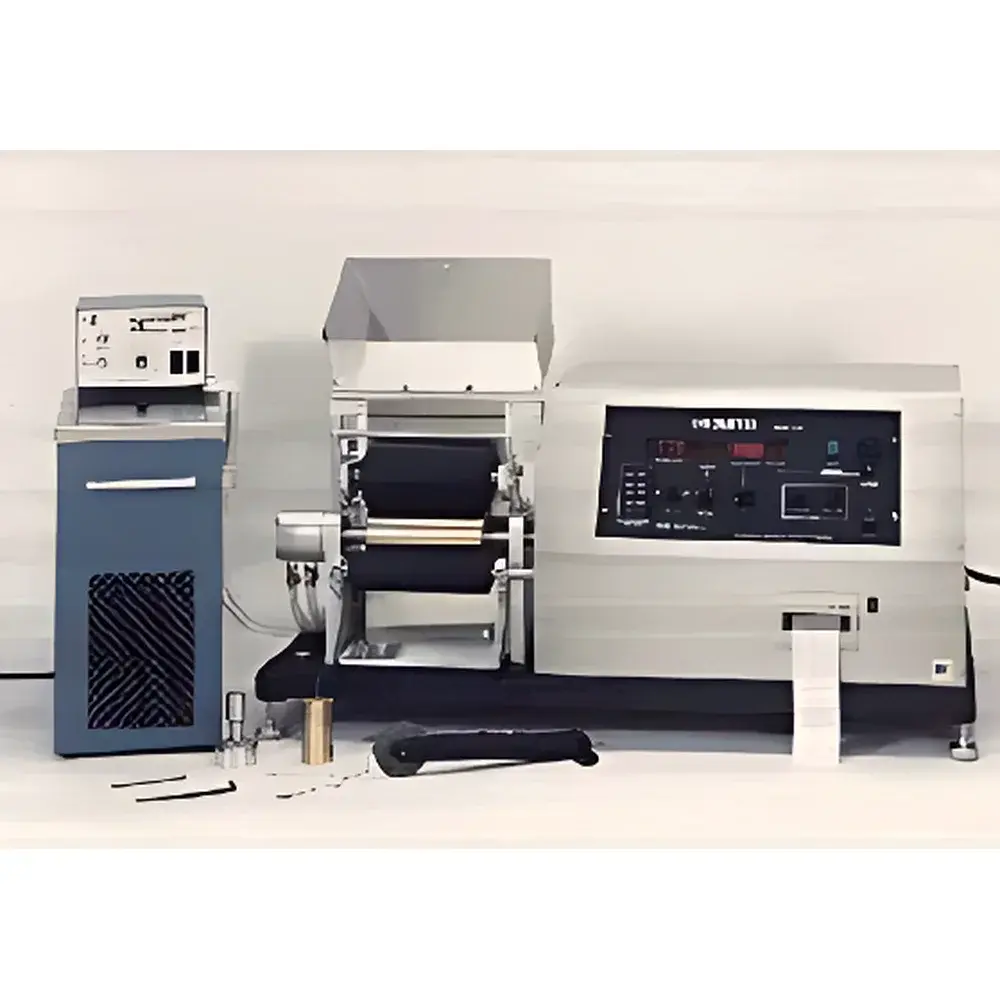
Thwing-Albert Model 106 Electronic Ink Tack Tester
| Origin | USA |
|---|---|
| Manufacturer Type | Authorized Distributor |
| Origin Category | Imported |
| Model | 106 |
| Pricing | Upon Request |
Overview
The Thwing-Albert Model 106 Electronic Ink Tack Tester is a precision-engineered instrument designed for quantitative evaluation of ink tack—the resistance to separation under shear during the ink transfer process in offset, gravure, and flexographic printing. It operates on the principle of controlled rotational separation between two parallel rollers under defined temperature, speed, film thickness, and dwell time conditions. The device measures the torque required to separate a thin ink film sheared between an upper covered roller and a vibrating covered roller, with a third thermostatically controlled roller maintaining precise thermal equilibrium. Results are reported in gram-meters (g·m), a standardized unit reflecting the tangential force moment generated at separation, directly correlating with ink’s rheological behavior under dynamic printing conditions. Unlike empirical or visual assessments, the Model 106 delivers traceable, repeatable numerical data essential for QC laboratories, R&D formulation validation, and process capability analysis across ink manufacturing and packaging printing supply chains.
Key Features
- Solid-state electronic architecture ensuring long-term stability, minimal drift, and high signal-to-noise ratio in torque and speed measurement.
- 14-digit LED display showing real-time values for tack (g·m), roller speed (RPM), temperature (°F), and elapsed test time (s).
- Five preset fixed speeds: 150, 400, 800, 1200, and 2000 RPM; plus continuously adjustable speed range from 0–3000 RPM (4000 RPM optional with enhanced motor drive).
- Integrated automatic sequence mode: initiates at 150 RPM for 15 s to ensure uniform ink distribution, then transitions seamlessly to user-selected test speed.
- High-fidelity sensing system comprising a direct-contact liquid bath thermistor, magnetic encoder for RPM verification, and LVDT-coupled torque arm for sub-milligram resolution displacement detection.
- Stainless-steel structural frame compliant with ISO 8502-3 surface cleanliness requirements—resistant to solvent exposure and suitable for GLP-aligned lab environments.
- Onboard thermal printer embedded in front control panel for immediate hard-copy output of tack curves and endpoint values (10-, 30-, or 60-second print intervals configurable).
- Dual-stage circuit protection: main/auxiliary breakers rated at 15 A / 0.5 A eliminate fuse replacement downtime and support stable operation under variable load profiles.
- Analog outputs (0–10 VDC) for tack and RPM, plus standard binary-coded decimal (BCD) output for integration with SCADA or LIMS platforms.
Sample Compatibility & Compliance
The Model 106 accommodates all conventional offset, UV-curable, water-based, and solvent-borne inks—including those exhibiting plastic deformation, non-volatile film formation, or thixotropic recovery. Roller covering materials (e.g., polyurethane, rubber composites) are selected per ASTM D1319 and ISO 2834-1 to ensure consistent ink adhesion and shear response. Temperature control is maintained via an external recirculating chiller unit (90 °F nominal setpoint, ±0.5 °F stability), conforming to ISO 13820 environmental conditioning protocols. Instrument calibration utilizes certified 30 g reference weights traceable to NIST SRM 2170, supporting audit readiness for FDA 21 CFR Part 11-compliant data integrity workflows when paired with validated software.
Software & Data Management
While the Model 106 operates as a standalone hardware platform, its analog and BCD outputs enable seamless interfacing with third-party acquisition systems (e.g., LabVIEW, MATLAB, or custom Python-based DAQ). Time-stamped tack curves can be logged at 10 Hz resolution, enabling post-test analysis of transient tack decay, yield point estimation, and comparative hysteresis profiling. When integrated into enterprise QA/QC networks, data streams comply with ASTM E2500-13 guidelines for instrument qualification and support full ALCOA+ (Attributable, Legible, Contemporaneous, Original, Accurate, Complete, Consistent, Enduring, Available) documentation standards.
Applications
- Quantitative comparison of ink tack across batches, suppliers, or reformulations to ensure consistency in press performance.
- Evaluation of solvent evaporation kinetics and its effect on tack development during web drying cycles.
- Correlation studies between measured tack values and actual press-related defects such as picking, misting, or poor dot gain.
- Validation of ink–substrate interaction models under controlled thermal and mechanical boundary conditions.
- Supporting ISO 2834-2 Annex B compliance testing for industrial ink certification programs.
- Research into rheo-optical coupling effects where tack behavior is monitored alongside inline spectrophotometric film integrity assessment.
FAQ
What does “tack” mean in ink testing, and how is it different from viscosity?
Tack refers to the adhesive pull or resistance to splitting of an ink film under dynamic separation—measured in g·m—whereas viscosity describes internal resistance to flow under steady shear (Pa·s). Tack is a transient, time-temperature-speed-dependent property critical to ink transfer efficiency.
Is the Model 106 compliant with international printing standards?
Yes—it aligns with ISO 2834-1 (ink tack measurement methodology), ASTM D1319 (roller covering specifications), and supports test protocols referenced in ISO 12647-1 for process control in commercial printing.
Can the instrument operate continuously for extended QC shifts?
With its solid-state design, low standby power draw (0.22 A), and robust thermal management, the Model 106 is engineered for 8–12 hour daily operation in production lab environments.
What maintenance is required for long-term accuracy?
Annual calibration using NIST-traceable weights and verification of chiller temperature stability per ISO/IEC 17025 are recommended; roller covering inspection and cleaning per manufacturer schedule ensure reproducible surface interaction.
Is remote data export supported?
Direct USB or RS-232 connectivity is not built-in, but analog/BCD outputs allow integration with industrial PLCs or PC-based DAQ systems for automated logging and SPC charting.





