
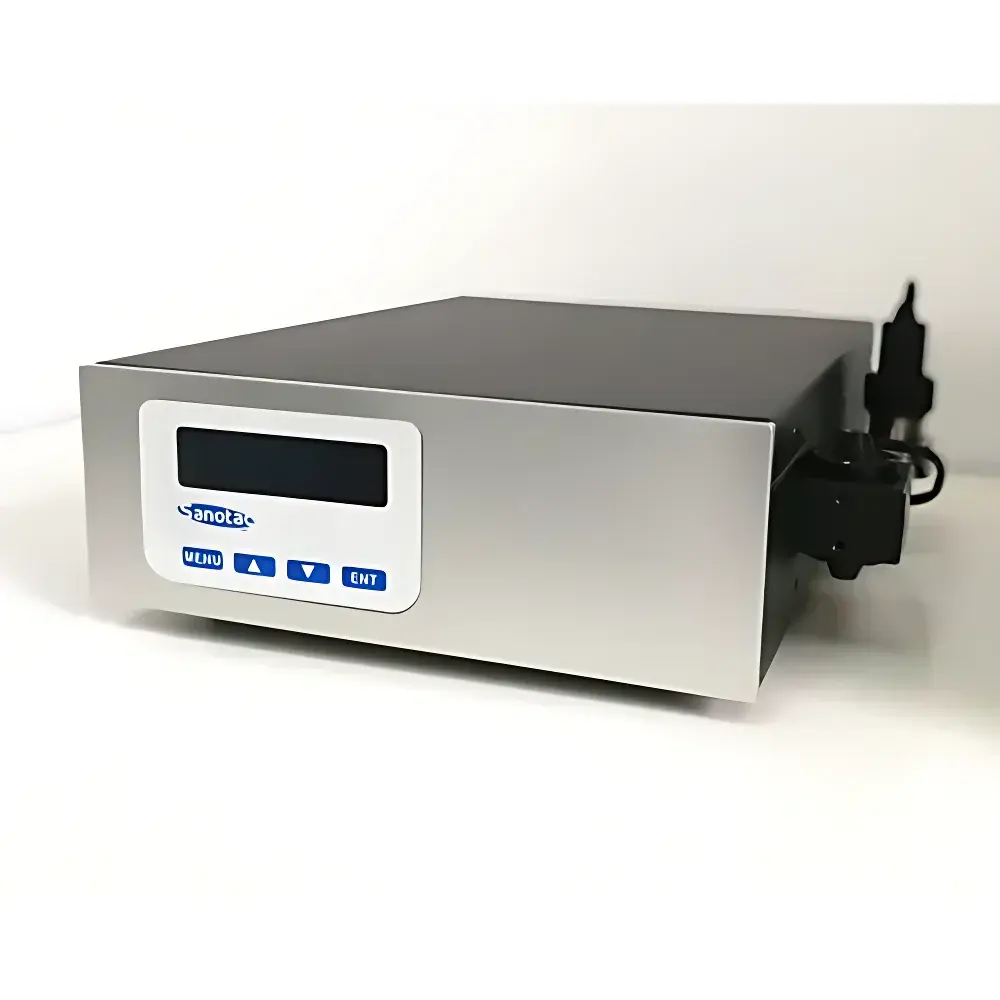
Sanotac C100 Online Conductivity Detector for Protein Purification Systems
| Brand | Sanotac |
|---|---|
| Model | C100 |
| Origin | Shanghai, China |
| Manufacturer Type | Direct Manufacturer |
| Instrument Type | Conductivity Detector |
| Conductivity Range | 1 µS/cm – 500 mS/cm |
| Temperature Reading Range | 0–99 °C |
| Temperature Accuracy | ±1 °C |
| Flow Rate Compatibility | 0–100 mL/min |
| Tubing Connection | 1/16" OD |
| Display | 256×64 dot matrix backlit LCD |
| Control Interface | Front-panel manual control or PC-based remote control via USB/Ethernet |
| Software Compliance | FDA 21 CFR Part 11 (user authentication, audit trail, electronic signature) |
| Power Supply | 85–264 VAC, 50 Hz |
| Dimensions | 370 × 240 × 95 mm |
Overview
The Sanotac C100 Online Conductivity Detector is a purpose-built, high-stability electrochemical sensor engineered for real-time monitoring of ionic strength in liquid-phase chromatographic purification workflows—particularly in biopharmaceutical downstream processing. Operating on the principle of two-electrode or four-electrode conductivity measurement (configurable per application), the C100 detects changes in solution conductance resulting from variations in buffer composition, salt concentration, or eluent gradients during ion exchange, hydrophobic interaction, or size-exclusion chromatography. Its design prioritizes low electrical noise, thermal drift compensation, and rapid response time (< 0.5 s), enabling precise tracking of conductivity transitions across multi-step gradient elutions. Unlike generic benchtop meters, the C100 integrates natively into automated protein purification platforms—providing analog (0–5 V / 4–20 mA) and digital (RS-232/USB/Ethernet) output interfaces compatible with third-party PLCs, fraction collectors, and chromatography data systems (CDS).
Key Features
- Wide dynamic conductivity range: 1 µS/cm to 500 mS/cm—covering ultrapure water rinse conditions through high-salt elution buffers (e.g., 2 M NaCl)
- Integrated temperature sensor with automatic temperature compensation (ATC) using built-in Pt100 RTD; accuracy ±1 °C over 0–99 °C
- Self-calibrating electrode system with user-accessible manual calibration protocol and selectable cell constant (K = 0.01, 0.1, 1.0 cm⁻¹) for optimal resolution across ranges
- Low-noise analog signal conditioning circuitry ensuring baseline stability < ±0.02 mS/cm over 24 h (under constant flow and temperature)
- Compact 1/16″ stainless-steel flow cell with chemically resistant PEEK and ETFE wetted parts—compatible with 0.1–100 mL/min flow rates and pressures up to 10 bar
- Dual-mode operation: standalone front-panel control with intuitive membrane keypad or full remote operation via Windows-based software workstation
Sample Compatibility & Compliance
The C100 is validated for continuous inline use with biological macromolecules—including monoclonal antibodies (mAbs), recombinant proteins, viral vectors, plasmid DNA, polysaccharides, and vaccine intermediates—without risk of adsorption or denaturation. All fluidic pathways meet USP Class VI and ISO 10993 biocompatibility standards. The detector’s firmware and associated software adhere strictly to FDA 21 CFR Part 11 requirements: role-based user access control (administrator/operator/auditor), immutable audit trails recording all parameter changes and calibration events, time-stamped electronic signatures, and secure data export in CSV/PDF formats. It supports GLP/GMP-aligned validation protocols including IQ/OQ/PQ documentation templates and meets relevant sections of ISO 9001:2015 and ISO/IEC 17025:2017 for analytical instrument qualification.
Software & Data Management
The Sanotac Chromatography Control Suite (SCCS) v3.x is a Windows 10/11-compatible application providing real-time waveform visualization, event-triggered fraction collection logic, and synchronized logging of conductivity, temperature, and system pressure (when interfaced with optional sensors). Data files are stored in encrypted binary format with SHA-256 hash integrity verification. The software enables method-based calibration storage, automatic range-switching based on measured values, and configurable alarm thresholds (e.g., conductivity deviation >5% triggers audible/visual alert and pauses pump). Raw datasets include metadata headers compliant with ISA-88 and ISA-95 standards for traceability in regulated environments. Audit logs retain ≥18 months of operational history and support export to LIMS or ELN platforms via ODBC or REST API.
Applications
- Monitoring conductivity gradients during stepwise or linear elution in IEX chromatography of therapeutic proteins
- Verifying buffer exchange efficiency in desalting and diafiltration steps pre- and post-column
- Validating wash stringency in affinity capture processes (e.g., Protein A resin regeneration)
- Tracking conductivity shifts indicative of aggregate formation or buffer mismatch in formulation screening
- Supporting process analytical technology (PAT) initiatives under ICH Q8/Q9/Q10 frameworks for continuous manufacturing
- Enabling closed-loop feedback control when paired with programmable peristaltic or HPLC pumps in GMP-compliant purification suites
FAQ
What conductivity cell constant options are supported by the C100?
The C100 supports user-selectable cell constants of 0.01 cm⁻¹ (for ultrapure water and low-conductivity buffers), 0.1 cm⁻¹ (standard for most protein purification applications), and 1.0 cm⁻¹ (optimized for high-salt eluents up to 500 mS/cm).
Is the flow cell autoclavable?
No—the C100 flow cell is not designed for autoclaving. It is compatible with CIP/SIP protocols using 0.5–1.0 M NaOH, 20% ethanol, or 0.1% phosphoric acid at temperatures ≤80 °C.
Can the C100 be integrated with ÄKTA or Bio-Rad NGC systems?
Yes—via analog voltage output (0–5 V) or Modbus TCP communication. Sanotac provides documented interface specifications and sample configuration scripts for common CDS platforms.
Does the device require periodic electrode maintenance?
Electrodes should be rinsed with deionized water after each run and inspected monthly for fouling. A mild enzymatic cleaner (e.g., Tergazyme®) may be used for protein residue removal; polishing is not required.
How is temperature compensation applied in real time?
The built-in Pt100 sensor continuously measures fluid temperature upstream of the electrode array; conductivity values are automatically corrected to 25 °C using the linear temperature coefficient (α = 2.0 %/°C) defined in ASTM D1125–20.
Related Products




