
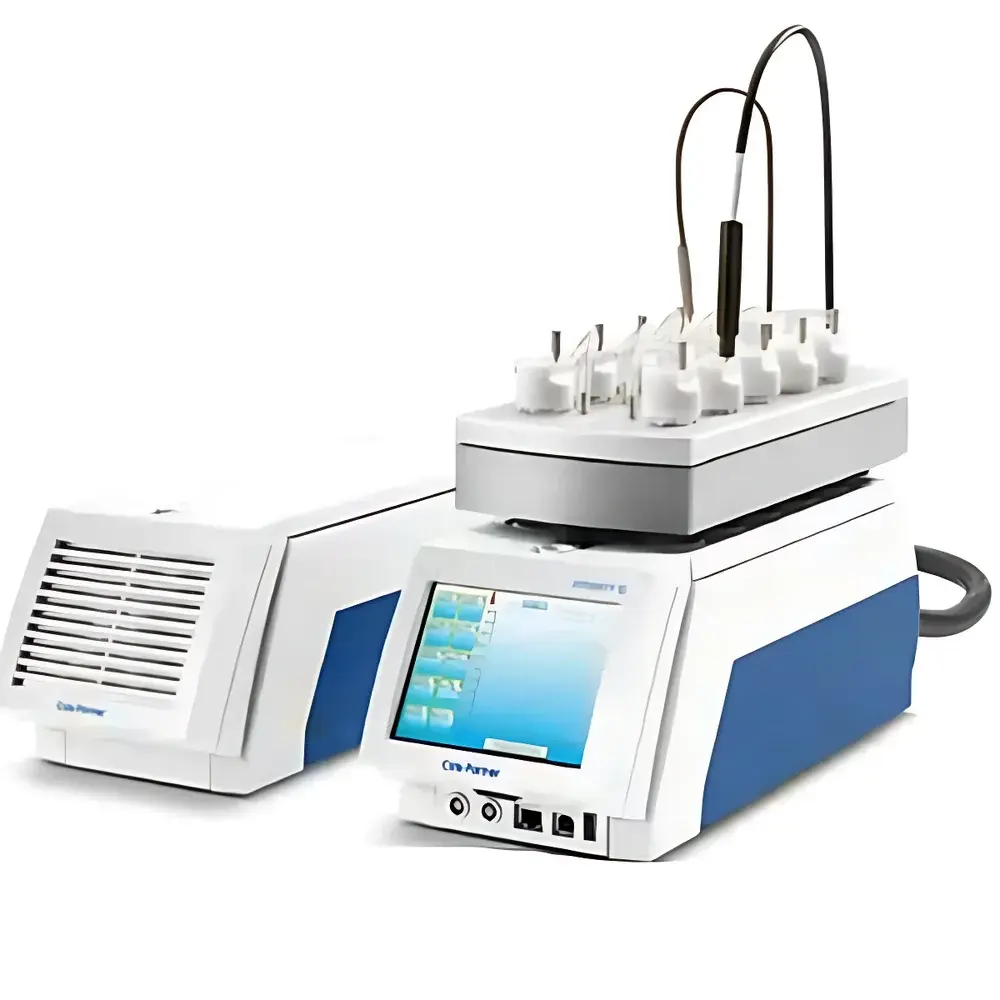
Cole-Parmer Integrity 10 Parallel Reaction & Crystallization Workstation
| Brand | Cole-Parmer |
|---|---|
| Model | 36630-00 |
| Origin | USA |
| Instrument Type | Benchtop |
| Temperature Range | −30 °C to +150 °C |
| Stirring Speed | 350–1200 rpm |
| Independent Reaction Vessels | 10 |
| Vessel Volume Capacity | 1–25 mL |
| Temperature Resolution | 0.01 °C |
| Temperature Accuracy | ±0.5 °C |
| Stirring Speed Resolution | 1 rpm |
| Stirring Speed Accuracy | ±10 rpm |
| Max Heating/Cooling Rate | 5 °C/min |
| Inter-vessel Temp Differential | Up to 180 °C |
| Optional Accessories | Reflux condensers, inert gas/vacuum manifolds, multi-channel NIR probes (Clarity System), Multi-Temp10 thermal control module, Integrity software suite |
Overview
The Cole-Parmer Integrity 10 Parallel Reaction & Crystallization Workstation is an engineered benchtop platform for high-throughput, thermally and mechanically controlled reaction screening—specifically designed for process development, polymorph screening, solubility mapping, and crystallization kinetics in pharmaceutical, fine chemical, and materials science laboratories. Built on Couette-type magnetic stirring geometry and Peltier-based active thermal regulation, the system enables simultaneous, independent operation of ten discrete reaction zones under programmable temperature profiles and agitation conditions. Each vessel operates within a sealed, chemically resistant environment compatible with vacuum, nitrogen, or argon atmospheres—critical for oxygen-sensitive reactions or solvent volatility control. The architecture supports GLP-compliant experimental traceability through automated data logging of temperature, stir rate, time, and optional infrared-derived concentration metrics.
Key Features
- 10 independently controlled reaction stations with individual PID-regulated thermal control and magnetic stirring
- Wide operational temperature range: −30 °C to +150 °C, with inter-vessel differential capability up to 180 °C for comparative phase behavior studies
- Precise thermal control: 0.01 °C resolution, ±0.5 °C accuracy, and ramp rates adjustable from 0.1 to 5 °C/min in 0.1 °C/min increments
- Stirring performance: 350–1200 rpm with 1 rpm resolution and ±10 rpm repeatability; optimized for viscosities up to glycerol at 25 °C using standard 12/4.5 mm or 10/6 mm stir bars
- Modular gas handling: PTFE-lined inlet/outlet ports enable integration with inert gas purging or vacuum-assisted solvent removal systems (e.g., via 36630-97 Reflux/Inert Gas Kit)
- Touchscreen interface with embedded microprocessor control; no external PC required for basic operation
- Expandable sensor architecture: Supports non-invasive and immersion-type NIR probes (36630-90, 36630-88, 36630-91) for real-time monitoring of dissolution onset, supersaturation, and crystal nucleation events
Sample Compatibility & Compliance
The Integrity 10 accommodates a broad range of vessel formats—including 24×150 mm SVL-threaded glass tubes (36630-85), conical microtubes (1–3 mL, 36630-83/87), and custom-fit reactors—enabling scalable experimentation from mg-scale screening to early-stage process optimization. All wetted components are constructed from chemically inert materials (borosilicate glass, PTFE, stainless steel 316), ensuring compatibility with organic solvents, aqueous buffers, strong acids/bases, and halogenated media. The system meets mechanical safety requirements per IEC 61010-1 and electromagnetic compatibility standards (EN 61326-1). When operated with Integrity software (36630-92) and audit-trail-enabled hardware modules (e.g., Multi-Temp10 with timestamped probe readings), it supports FDA 21 CFR Part 11 compliance for electronic records and signatures in regulated environments.
Software & Data Management
Integrity software (v3.2+) provides full remote supervision, method programming, and synchronized multi-parameter acquisition. Users define complex temperature ramps, hold steps, and stir profiles per vessel—then export time-stamped CSV or XML datasets containing temperature, RPM, and optional NIR absorbance values. The software includes built-in curve-fitting tools for Arrhenius analysis, nucleation induction time calculation, and metastable zone width (MSZW) determination. Audit trails record all user actions, parameter changes, and calibration events with operator ID and timestamp—fully traceable for internal QA review or regulatory inspection. Data exports are structured to align with LIMS ingestion protocols and support automated reporting workflows compliant with ISO/IEC 17025 documentation practices.
Applications
- Polymorph and salt screening across temperature-composition space
- Crystallization kinetic profiling: nucleation rate, growth rate, and agglomeration behavior under controlled supersaturation
- Solubility and dissolution equilibrium studies using integrated Clarity System NIR probes
- Reaction optimization for catalytic hydrogenation, Suzuki coupling, or esterification under inert or reduced-pressure conditions
- Thermal stability assessment of APIs and intermediates via isothermal hold experiments
- Early-stage formulation development requiring parallel evaluation of excipient compatibility and phase separation thresholds
FAQ
Can the Integrity 10 operate under vacuum or inert atmosphere?
Yes—using the optional 36630-97 Reflux/Inert Gas Kit with PTFE gas lines and SVL-threaded caps (36630-94 or 36630-95), the system maintains sealed, pressure-controlled environments suitable for moisture- or oxygen-sensitive chemistry.
What vessel types are supported out-of-the-box?
Standard configurations include 24×150 mm SVL-threaded glass tubes (36630-85), 1–3 mL conical microtubes (36630-83/87), and 250 mL vessels (via RS-250D variants); custom adapters are available upon request.
Is NIR probe data synchronized with thermal/stir profiles?
Yes—when connected via the 36630-89 Multi-IR Probe Insertion Module, up to four NIR channels are time-aligned with temperature and RPM logs at user-defined acquisition intervals (1–60 s).
Does the system support 21 CFR Part 11 compliance?
Full compliance is achievable when used with Integrity software v3.2+, Multi-Temp10 module, and enabled audit-trail functionality—including electronic signatures, role-based access control, and immutable raw data archiving.
What is the maximum recommended viscosity for reliable stirring?
The system maintains consistent agitation up to ~1,000 mPa·s (equivalent to glycerol at 25 °C) using the supplied 10/6 mm elliptical stir bars; higher viscosities may require lower rpm settings or alternative bar geometries.




