
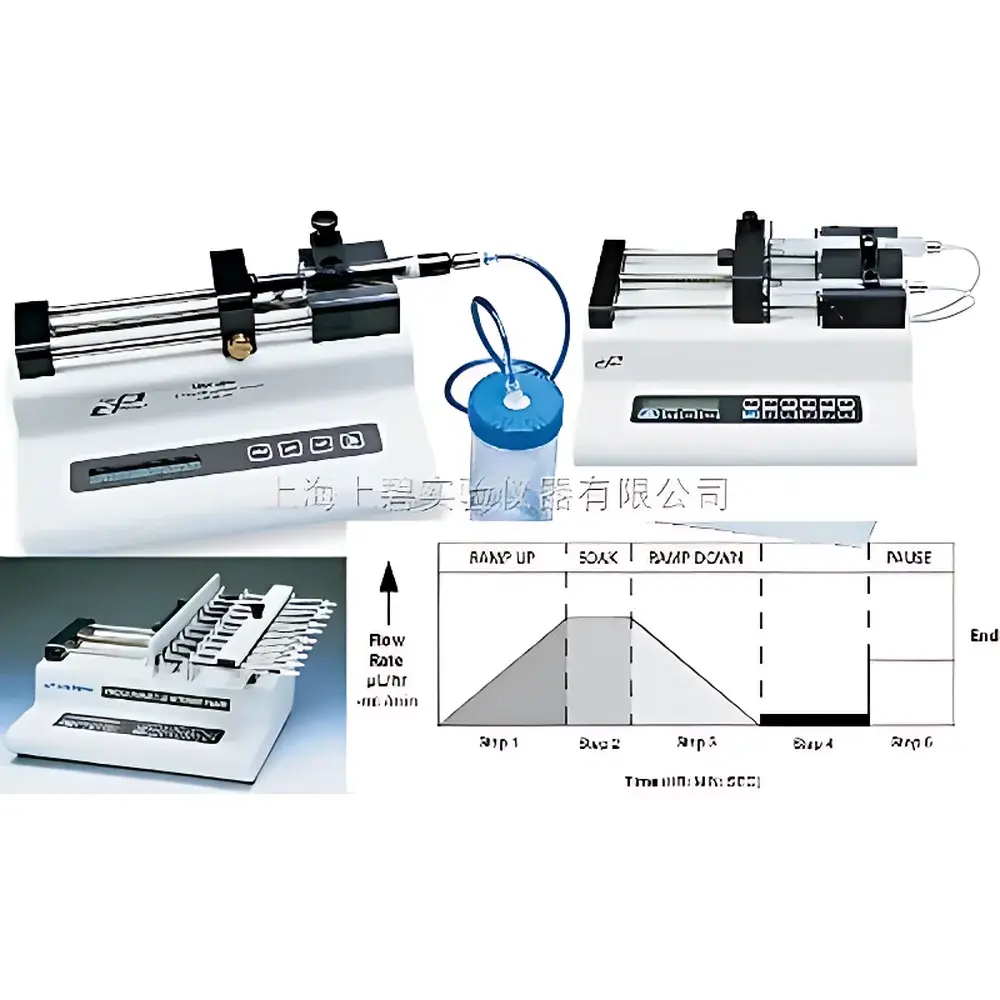
Cole-Parmer 74900-Series Multi-Channel Syringe Pumps (1-, 2-, and 10-Channel Configurations)
| Brand | Cole-Parmer |
|---|---|
| Origin | USA |
| Model | 74900-05 (Single-Channel), 74900-15/74900-25/74900-65/74901-05 (Dual-Channel), 74900-35/74900-45/74900-85/74901-15 (10-Channel) |
| Accuracy | ±0.5% |
| Repeatability | ±0.1% |
| Flow Rate Range (Single) | 0.2 µL/h–500 mL/h |
| Flow Rate Range (Dual/10-Channel) | 1 nL/h–147 mL/min |
| Syringe Capacity | 10 µL–140 mL |
| Linear Force | 9.1 kg (Single), 18.1 kg (Dual/10-Channel) |
| Power Supply | 230 V, 50/60 Hz |
| Certifications | CE |
| Interface | RS232, TTL I/O (Programmable Models) |
| Dimensions (L×W×H, cm) | 23×10×15 (Single), 28×12.7×23.5 (Dual), 28×15.2×30.5 (10-Channel) |
Overview
The Cole-Parmer 74900-Series Syringe Pumps are precision-engineered electromechanical fluid delivery systems designed for reproducible, low-flow-rate applications in analytical chemistry, microfluidics, pharmacokinetic studies, and controlled reagent dosing. Based on stepper motor-driven linear actuation and calibrated syringe barrel displacement, these pumps operate on volumetric displacement principles—eliminating dependency on fluid viscosity or backpressure for accuracy within specified operational ranges. Each configuration (1-, 2-, and 10-channel) maintains consistent metrological traceability to NIST-traceable standards through factory calibration and firmware-controlled microstepping resolution. The architecture supports both continuous infusion and discrete bolus delivery with programmable directionality (infuse-only or infuse-withdraw), enabling bidirectional protocols essential for closed-loop sample preparation and titration workflows.
Key Features
- Backlit LCD interface with real-time flow rate, volume dispensed, elapsed time, and syringe ID confirmation—enabling rapid visual verification without external software.
- Auto-syringe recognition via mechanical encoding; automatically selects appropriate unit scaling (nL/h, µL/h, mL/h) and validates plunger diameter input against preloaded syringe libraries (e.g., Hamilton, BD, SGE).
- Persistent memory retention: All operational parameters—including target flow rate, total volume, direction, and pause status—are retained across power cycles and system restarts, ensuring protocol continuity in unattended overnight runs.
- On-the-fly parameter adjustment: Flow rate, volume, and direction can be modified during active operation without halting the pump—critical for adaptive assay development and dynamic concentration gradient generation.
- Dual and 10-channel models integrate synchronized multi-axis control logic, maintaining inter-channel timing skew < ±50 ms under full-load conditions—validated per ASTM E2656-20 for multi-pump coordination in parallel processing environments.
- Programmable models support up to eight user-defined sequences, each configurable with conditional steps (e.g., “infuse 50 µL → pause 30 s → withdraw 10 µL → repeat ×10”), with maximum sequence duration of 12 hours per program.
Sample Compatibility & Compliance
These syringe pumps accommodate standard Luer-lock and Luer-slip syringes from 10 µL to 140 mL capacity, including glass, polypropylene, and fluoropolymer-lined variants. Compatibility extends to chemically aggressive solvents (e.g., DMSO, THF, concentrated acids/bases) when paired with compatible syringe barrels and PTFE/NBR pump heads. All units comply with CE marking requirements under Directive 2014/30/EU (EMC) and 2014/35/EU (LVD). Dual- and 10-channel programmable versions support audit-ready operation under GLP and GMP frameworks: firmware logs timestamped start/stop events, parameter changes, and error states; RS232 output enables integration with LIMS for electronic record retention compliant with FDA 21 CFR Part 11 Annex 11 requirements.
Software & Data Management
RS232 serial communication allows direct connection to Windows/Linux-based host systems using ASCII command protocol (SCPI-compatible syntax). Optional Cole-Parmer Pump Control Software provides GUI-based scheduling, real-time monitoring, and batch export of run logs in CSV format. TTL I/O ports (2 inputs, 2 outputs) enable hardware-level synchronization with external devices—e.g., triggering a spectrophotometer acquisition upon injection completion or pausing pump operation upon sensor-detected pressure threshold breach. Firmware supports firmware update via serial interface, with version history and checksum validation to ensure integrity during deployment in regulated environments.
Applications
- Controlled reagent addition in automated titrators and flow-injection analyzers (FIA)
- Microscale solvent delivery in HPLC and UHPLC mobile phase blending modules
- Cell culture media perfusion and nutrient gradient generation in organ-on-chip platforms
- Calibration standard preparation for ICP-MS and GC-MS quantitation workflows
- Pharmacological dose-response assays requiring sub-nanoliter precision across multiple compound wells
- Electrospinning precursor solution feeding with synchronized voltage ramping
FAQ
What syringe sizes are supported across the 74900-Series?
Syringes ranging from 10 µL to 140 mL are fully supported; the system auto-detects plunger diameter and adjusts step resolution accordingly.
Can dual- or 10-channel models operate independently per channel?
Yes—each channel maintains independent parameter sets (flow rate, volume, direction), though synchronization commands (e.g., simultaneous start/stop) are available via RS232 or TTL triggers.
Is firmware upgrade capability available in the field?
Yes—firmware updates are delivered as signed binary packages and applied via RS232 using Cole-Parmer’s validated update utility, preserving all user configurations.
How is accuracy maintained over extended operation at ultra-low flow rates (e.g., <10 nL/h)?
Accuracy is preserved through temperature-compensated microstepping algorithms and real-time encoder feedback on lead screw position, with periodic zero-point recalibration recommended every 200 hours of cumulative runtime.
Do programmable models meet 21 CFR Part 11 requirements for electronic records?
When deployed with validated software and procedural controls (e.g., role-based access, audit trail review, electronic signatures), the system satisfies technical criteria for Part 11 compliance; full validation documentation is available upon request.



