
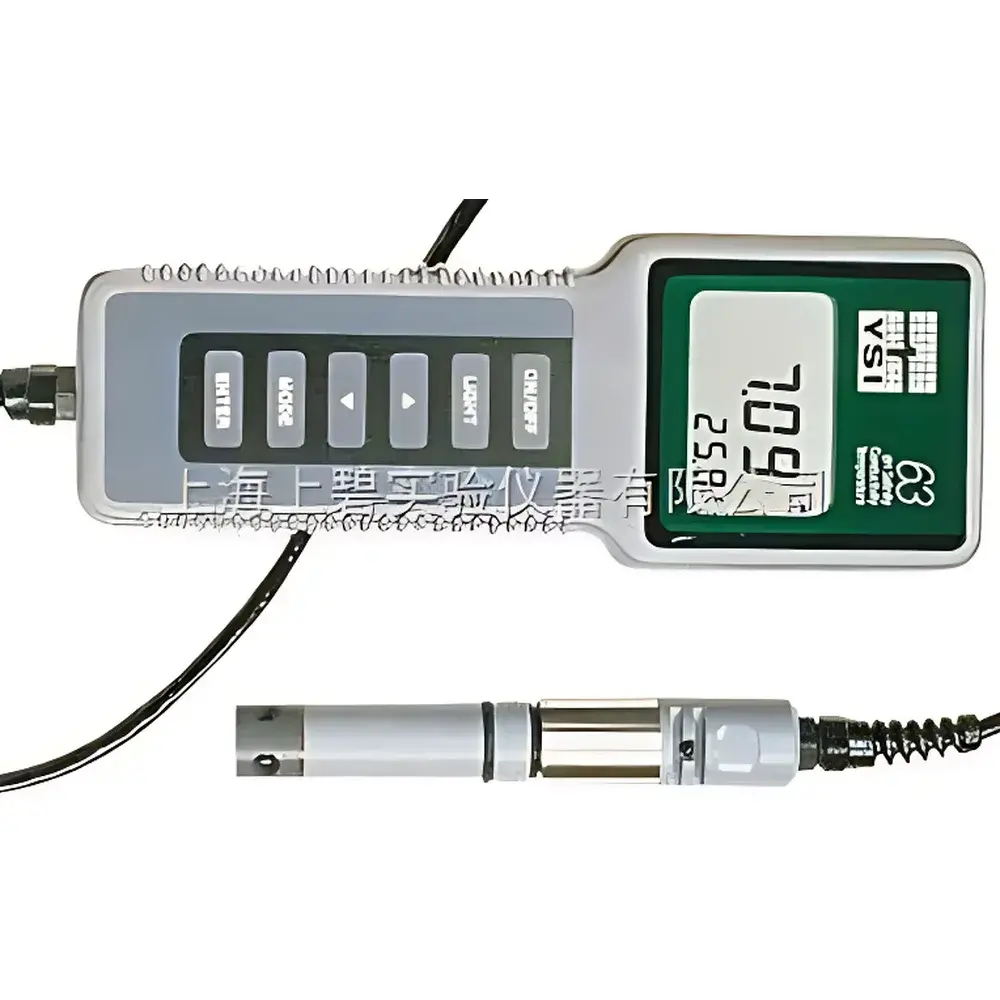
YSI 63-10 Multi-Parameter Water Quality Analyzer
| Origin | USA |
|---|---|
| Manufacturer Type | Authorized Distributor |
| Origin Category | Imported Instrument |
| Model | 63-10 |
| Price Range | USD 2,800 – 14,200 |
| Instrument Type | In-Situ / Field-Deployable Water Quality Analyzer |
Overview
The YSI 63-10 Multi-Parameter Water Quality Analyzer is a rugged, field-optimized instrument engineered for reliable in-situ measurement of pH, conductivity, salinity, and temperature in freshwater, estuarine, and coastal environments. Designed around Couette-flow-compatible electrochemical sensor architecture and integrated thermistor-based thermal compensation, the system delivers traceable, repeatable data under variable ambient conditions—including low-light, high-humidity, and splash-prone field settings. Its modular probe design supports direct immersion up to 30 meters depth, with full submersion capability verified per IP65 ingress protection standards. Unlike benchtop analyzers requiring laboratory calibration stability, the 63-10 implements real-time automatic temperature compensation (ATC) for both pH and conductivity channels, referencing user-selectable standard temperatures (15–25 °C) and adjustable linear temperature coefficients (0–4 %/°C), ensuring metrological consistency across seasonal thermal gradients.
Key Features
- Integrated tri-sensor probe: Combined glass-body pH electrode, four-pole nickel conductivity cell, and precision NTC thermistor—fully submersible and field-replaceable without tools
- Ergonomic handheld console with backlit LCD display (128 × 64 pixels), optimized for gloved operation and low-ambient visibility
- Shielded coaxial cable architecture with stress-relief ferrules at all connector interfaces, minimizing mechanical fatigue and extending service life beyond 5,000 insertion cycles
- Non-volatile memory storing up to 50 measurement sets; data retention maintained during battery replacement or power interruption
- Self-diagnostic boot sequence verifying sensor continuity, reference junction integrity, and microprocessor functionality prior to sampling
- Automatic buffer recognition during pH calibration (1-, 2-, or 3-point), supporting NIST-traceable buffers (pH 4.01, 7.00, 10.01)
- Auto-ranging conductivity measurement across four decades (0.1 μS/cm to 400.0 mS/cm), with resolution dynamically matched to active range
- Onboard salinity calculation per PSS-78 (Practical Salinity Scale), derived from conductivity, temperature, and pressure-independent algorithms
Sample Compatibility & Compliance
The YSI 63-10 is validated for use with natural waters—including rivers, lakes, wetlands, aquaculture systems, and tidal zones—where suspended solids, biofouling potential, and variable ionic strength demand robust sensor design. Its stainless-steel probe housing and polypropylene protective shroud meet ASTM D5128-18 requirements for field-deployable water quality sensors. While not certified for continuous unattended operation, the instrument complies with GLP documentation protocols when paired with YSI’s optional data logging accessories. All electrical interfaces conform to IEC 61000-4-2 (ESD immunity) and IEC 61000-4-3 (radiated RF immunity) standards. Calibration traceability aligns with ISO/IEC 17025:2017 clause 6.6 for field instruments used in environmental monitoring programs.
Software & Data Management
Data export is supported via RS-232 serial interface (DB9 male) compatible with Windows-based terminal emulators and third-party environmental data management platforms (e.g., EQuIS, Aquarius). No proprietary software installation is required for basic data retrieval; ASCII-formatted output includes timestamp (YYYY-MM-DD HH:MM:SS), parameter values, units, and QC flags. The internal memory retains full audit trail metadata—including calibration date, buffer IDs, and operator-entered site codes—enabling retrospective validation per EPA Method 160.1 and USGS National Field Manual Chapter A6 guidelines. For regulated applications, external USB-to-serial adapters may be employed to generate 21 CFR Part 11–compliant electronic records when integrated into validated laboratory information management systems (LIMS).
Applications
- Regulatory compliance monitoring under Clean Water Act Section 303(d) impaired waters assessments
- Wetland restoration project baseline and post-intervention water chemistry profiling
- Aquaculture facility intake and effluent characterization per FDA Seafood HACCP guidelines
- University and government-led limnological surveys requiring portable, multi-parameter redundancy
- Stormwater outfall screening in municipal separate storm sewer systems (MS4)
- Long-term ecological research networks (e.g., LTER, NEON) requiring interoperable, maintenance-minimized instrumentation
FAQ
What is the maximum operational depth for the 63-10 probe?
The probe is rated for continuous immersion to 30 meters depth, validated under static hydrostatic pressure testing per ISO 22868:2021 Annex B.
Can the pH electrode be recalibrated in the field without returning to the lab?
Yes—two-point calibration using dry-storage buffers (pH 4.01 and 7.00) is fully supported; the instrument automatically detects buffer identity and adjusts slope/offset accordingly.
Does the conductivity cell require periodic cleaning or polarization conditioning?
No—four-pole nickel electrodes are chemically inert and self-polarizing; routine rinsing with deionized water suffices between deployments.
Is the temperature sensor independently calibrated, or does it rely on pH/conductivity compensation algorithms?
The NTC thermistor is factory-calibrated against NIST SRM 1750 and functions as a primary sensor; all ATC functions derive directly from its raw resistance reading.
How is data integrity preserved during battery replacement?
Non-volatile EEPROM retains all stored measurements and calibration history; no data loss occurs during hot-swap of six AA alkaline cells.
Related Products







