
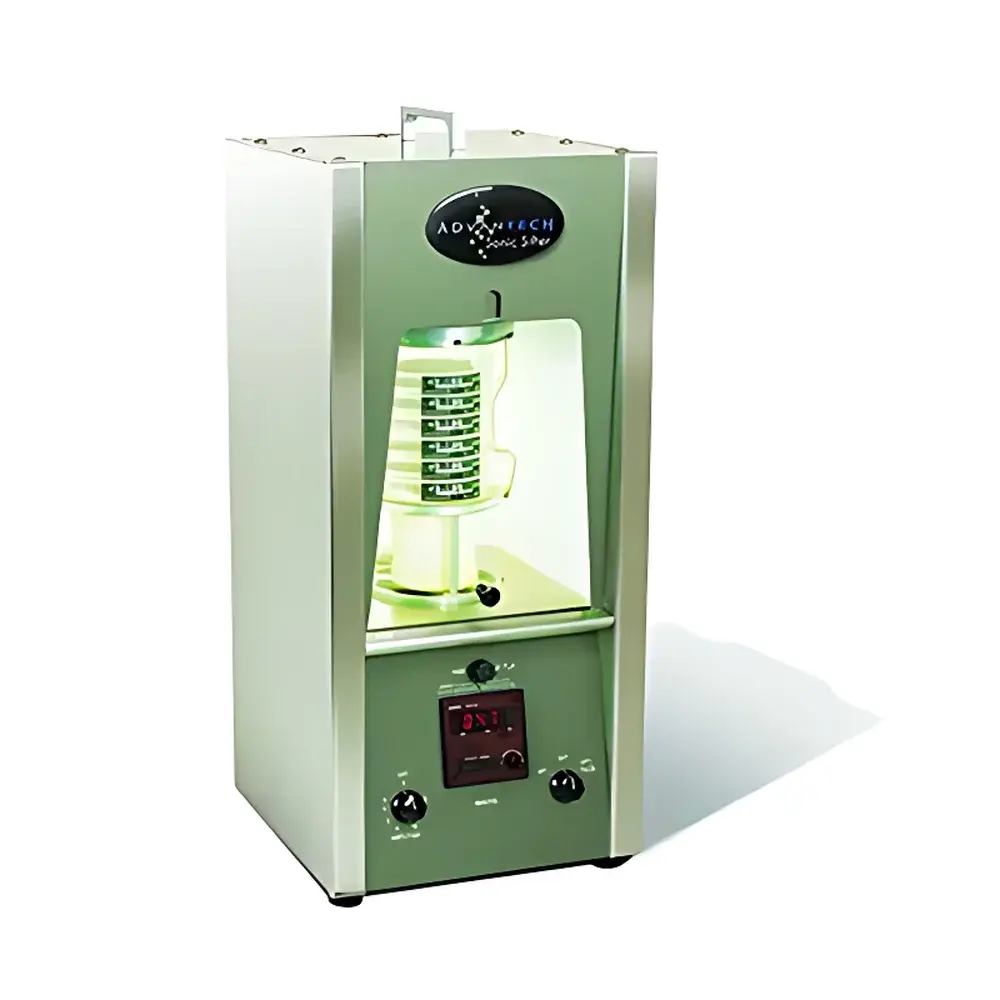
Sonic Sifter L3P-25 Acoustic Sieve Analyzer
| Origin | USA |
|---|---|
| Manufacturer Type | Authorized Distributor |
| Origin Category | Imported |
| Model | L3P-25 |
| Power Supply | 240 VAC, 50 Hz |
| Dimensions (W×D×H) | 25 cm × 31 cm × 61 cm |
| Weight | 20 kg |
| Operating Temperature Range | −18 °C to +49 °C (non-condensing) |
| Timer Accuracy | ±2 s per 24 h |
| Vibration Frequency | 60 Hz (vertical oscillating air column) |
| Standard Sieve Diameter | 3 in (76.2 mm) |
| Standard Sieve Height | 5/8 in (15.9 mm) |
| Particle Size Range | 3 µm to 5.6 mm |
| Precision Sieve Material | Electroplated Nickel |
| Compliance | ASTM E11, ASTM E161, ISO 3310-1, ISO 565 |
Overview
The Sonic Sifter L3P-25 Acoustic Sieve Analyzer is an advanced dry-sieving instrument engineered for high-fidelity particle size distribution analysis of free-flowing and cohesive powders. Unlike conventional mechanical or vibratory sieving systems—whose aggressive motion induces particle attrition, mesh blinding, and sample loss—the L3P-25 employs a patented acoustic energy delivery mechanism. It generates a precisely controlled, vertically oriented oscillating air column at 60 Hz, producing gentle yet effective mechanical pulses that shear agglomerates and reposition particles within the air stream without direct mechanical contact between the sample and moving components. This principle enables rapid, non-destructive separation while preserving native particle morphology—a critical requirement for pharmaceutical excipients, catalysts, metal powders, and nanomaterials where structural integrity directly impacts functional performance. The system operates without vacuum aspiration or external airflow regulation, eliminating dependency on auxiliary pumps and reducing cross-contamination risk.
Key Features
- Acoustic pulse-driven sieving at 60 Hz, delivering consistent vertical mechanical shear via oscillating air column—no rotating motors, eccentric weights, or cam-driven mechanisms.
- Adjustable power output allows optimization for material-specific density, cohesiveness, and electrostatic behavior; ideal for fine, hygroscopic, or static-prone powders.
- Integrated electronic timer with ±2-second accuracy over 24 hours—traceable and suitable for GLP-compliant documentation workflows.
- Stainless steel housing with acrylic observation frame for real-time visual assessment of sieve endpoint and power-level calibration.
- No consumable drive components: zero wear on internal actuators, no belt slippage, no bearing degradation—ensuring long-term measurement stability and minimal downtime.
- Compact benchtop footprint (25 × 31 × 61 cm) and low mass (20 kg) facilitate integration into regulated QC labs, R&D cleanrooms, and university instrumentation suites.
Sample Compatibility & Compliance
The L3P-25 accommodates dry powders ranging from ultrafine nanoparticles (3 µm) to coarse granules (5.6 mm), including materials prone to aggregation, electrostatic adhesion, or moisture sensitivity. Its acoustic method eliminates the need for wet sieving in many cases—though optional aqueous dispersion compatibility is supported through validated procedural protocols. All standard sieves are serialized and traceable to manufacturing batch records, including mesh cloth certification per ASTM E11 and ISO 3310-1. Precision electroplated nickel sieves (e.g., L3-M3 to L3-M20 series) extend resolution down to 3 µm and are certified per ASTM E161 for metrological reliability. The system meets requirements for ISO/IEC 17025-accredited laboratories and supports audit-ready documentation when paired with compliant data management practices.
Software & Data Management
While the L3P-25 operates as a standalone hardware platform with analog controls, it is fully compatible with laboratory information management systems (LIMS) and electronic lab notebooks (ELN) via manual entry of timestamped sieve stack weights and fraction masses. Each serialized sieve carries permanent laser-marked identifiers—including manufacture date, mesh cloth lot number, and conformance certificate reference—enabling full chain-of-custody tracking. For regulated environments (e.g., FDA-regulated pharmaceutical QA/QC), users may implement 21 CFR Part 11-compliant procedures using external digital scales with RS-232/USB output and validated spreadsheet templates or third-party data acquisition software. Audit trails, user access logs, and calibration records are maintained externally per institutional SOPs.
Applications
- Pharmaceutical solid dosage development: API and excipient particle sizing prior to tableting or capsule filling.
- Advanced materials R&D: Metal additive manufacturing powders (e.g., Ti-6Al-4V, Inconel), battery cathode/anode materials, and ceramic precursors.
- Food & agricultural science: Flour, starch, spice, and feed pellet grading under GMP-aligned protocols.
- Geotechnical and mineral processing: Soil classification, aggregate gradation, and tailings characterization per ASTM D6913.
- Quality assurance in contract manufacturing: Batch release testing against USP , EP 2.9.31, and JP 6.05 standards.
FAQ
Does the L3P-25 require vacuum or compressed air?
No. It operates solely on electrical input (240 VAC, 50 Hz) and generates its own oscillating air column internally—no external air supply, vacuum pump, or filtration system is needed.
Are sieves included with the base unit?
No. The L3P-25 is supplied without sieves. A complete stackable sieve assembly must be selected separately based on application requirements (e.g., L3-S200 for 75 µm cutoff or L3-M10 for 10 µm resolution).
Can the L3P-25 perform wet sieving?
It is designed for dry sieving. However, pre-dispersed aqueous suspensions may be processed using validated wet-dry transition protocols—consult technical documentation for ISO 13320-aligned dispersion guidelines.
Is the timer calibrated and traceable?
Yes. The internal quartz-based timer is factory-calibrated with documented uncertainty (±2 s/24 h) and supports periodic verification using NIST-traceable time references.
What regulatory standards does the L3P-25 support?
It complies with mechanical and dimensional requirements of ASTM E11, ISO 3310-1, and ASTM E161. Full compliance with FDA 21 CFR Part 11 or EU Annex 11 requires integration with validated external data capture systems and procedural controls.



