
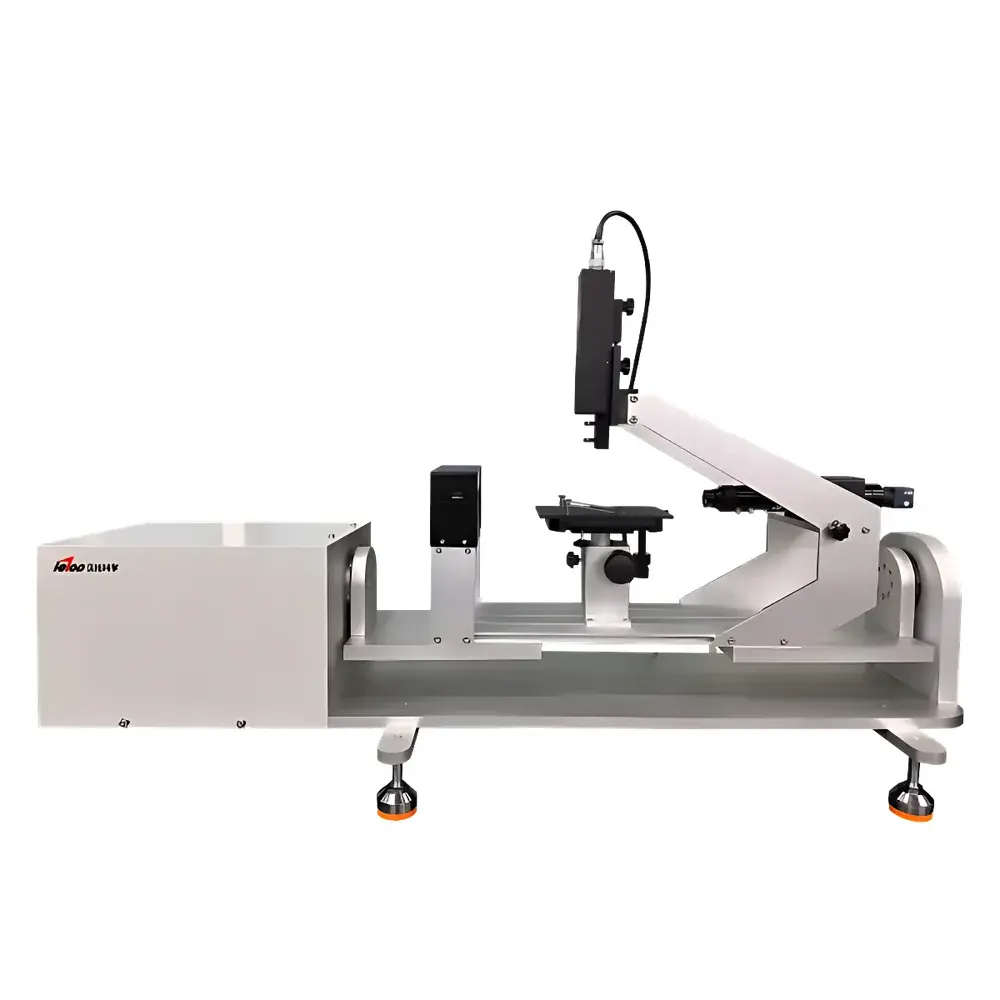
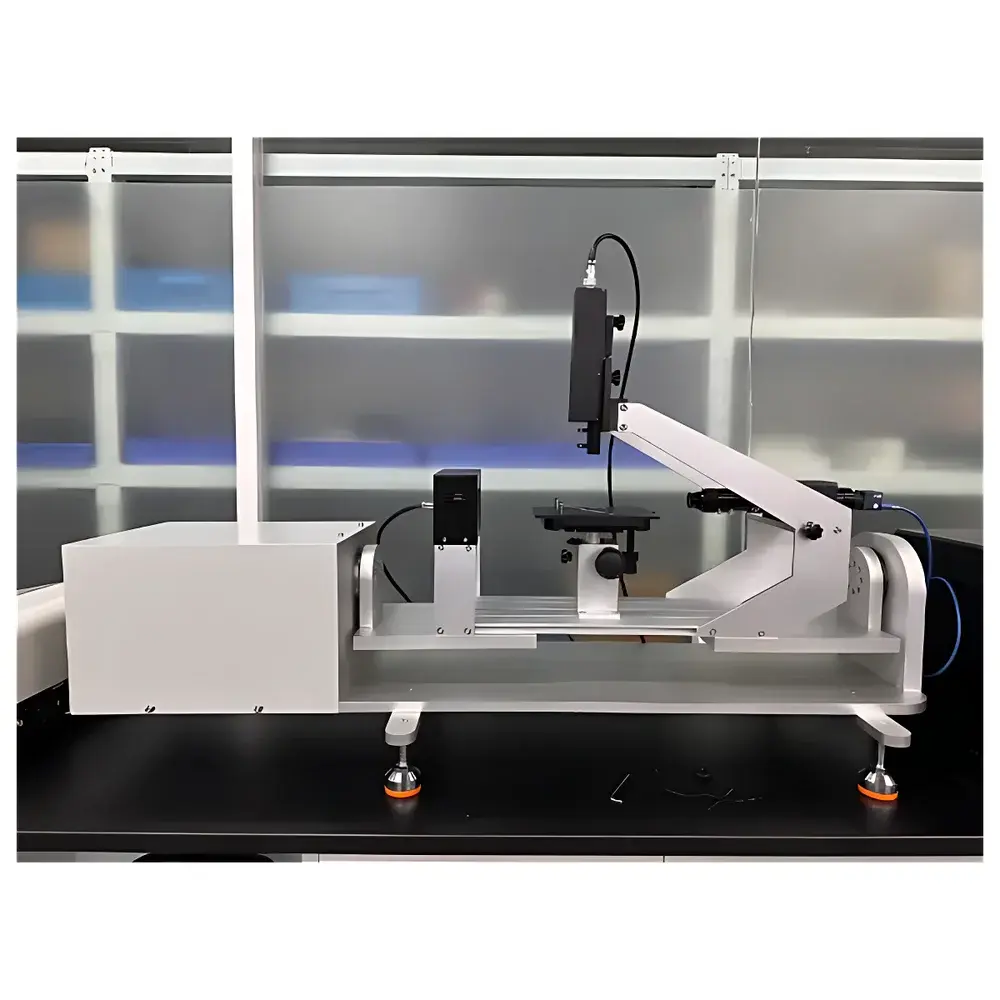
Betop Scientific Alpha-S ROLL Automated Tilt-Stage Optical Contact Angle Analyzer
| Brand | Betop Scientific |
|---|---|
| Origin | Guangdong, China |
| Manufacturer Type | Direct Manufacturer |
| Instrument Category | Domestic |
| Model | Alpha-S ROLL |
| Instrument Class | Video-Based Optical Contact Angle Analyzer |
| Form Factor | Benchtop Laboratory System |
| Contact Angle Range | 0–180° |
| Contact Angle Accuracy | ±0.1° |
| Contact Angle Resolution | ±0.01° |
| Tilt Angle Range | 0–90° |
| Tilt Angle Accuracy | ±0.01° |
| Surface/Interfacial Tension Range | 0–1000 mN/m |
| Surface/Interfacial Tension Accuracy | ±0.01 mN/m |
| Optical Magnification | 0.7×–4.5× (adjustable focus) |
| High-Speed Imaging | 210 fps @ 130 pixel resolution |
| Dispensing Precision | 0.01 µL |
| Dispenser Travel | X/Y/Z = 100 mm × 100 mm × 50 mm (standard) |
| Sample Stage Dimensions | 100 mm × 100 mm |
| Max. Sample Dimensions | 300 mm × ∞ × 160 mm (W × D × H) |
| Max. Sample Weight | 5 kg |
| Image Capture Modes | Side-view, Top-view (optional), Dynamic Rolling Event Capture |
| Fitting Algorithms | 6 standard methods (e.g., Circle, Ellipse, Young-Laplace, SCA, Baseline-Independent, Tangent) |
| Surface Energy Models | OWRK, Fowkes, Wu, van Oss-Chaudhury-Good |
| Optional Accessories | Vacuum Sample Holder (for thin films), Motorized Tilt Platform, Top-View Imaging Module (for concave surfaces) |
Overview
The Betop Scientific Alpha-S ROLL is a fully automated, tilt-stage optical contact angle analyzer engineered for high-precision quantification of wettability and interfacial thermodynamics at solid–liquid and solid–gas interfaces. It operates on the principle of video-based silhouette imaging: a high-resolution industrial camera captures side- or top-view profiles of sessile or pendant liquid droplets under controlled environmental conditions, while advanced image processing algorithms extract contour geometry to compute contact angles via geometric or physical modeling (e.g., Young–Laplace fitting). The integrated motorized tilt stage enables dynamic measurement of advancing, receding, roll-off, and sliding angles—critical parameters for assessing surface heterogeneity, hysteresis, and functional performance in coatings, microfluidics, and biomaterials. Designed for ISO/IEC 17025-aligned laboratories, the system supports traceable calibration protocols and complies with ASTM D7334 (Standard Practice for Surface Wettability Assessment), ISO 19403 (Contact angle measurement series), and USP (Surface Characterization of Pharmaceutical Materials).
Key Features
- Fully automated tilt mechanism driven by high-torque stepper motors, delivering angular positioning repeatability better than ±0.01° over 0–90° range
- Optical path optimized for minimal chromatic aberration: adjustable magnification (0.7×–4.5×) with parfocal lens assembly and uniform LED cold illumination (620 nm peak, flicker-free)
- Real-time high-speed imaging at up to 210 frames per second (130-pixel resolution), synchronized with dispenser actuation and stage motion for precise event capture during droplet rolling or sliding
- Intelligent baseline detection algorithm that automatically identifies three-phase contact line and substrate plane—even on textured, curved, or low-contrast surfaces
- Modular software architecture supporting six validated contact angle fitting models (Circle, Ellipse, Young–Laplace, SCA, Baseline-Independent, Tangent) with uncertainty propagation reporting
- Integrated syringe pump with 0.01 µL dispensing resolution and bidirectional XYZ translation (100 mm × 100 mm × 50 mm) for reproducible droplet placement across heterogeneous samples
Sample Compatibility & Compliance
The Alpha-S ROLL accommodates diverse sample geometries—from rigid planar substrates (glass, silicon wafers, metals) to flexible films, porous membranes, and irregularly shaped components (max. 300 mm width × unlimited depth × 160 mm height; 5 kg load capacity). Optional vacuum sample holders enable stable fixation of ultra-thin polymer films (<10 µm), while the top-view module permits accurate contact angle analysis on concave or recessed surfaces (e.g., microchannels, etched trenches). All measurement workflows adhere to GLP/GMP documentation standards: audit trails record operator ID, timestamp, instrument configuration, raw images, and parameter edits. Data files comply with ASTM E2500-22 (Digital Data Management) and support 21 CFR Part 11-compliant electronic signatures when deployed with validated LIMS integration.
Software & Data Management
The proprietary AlphaSoft v4.2 platform provides a unified interface for acquisition, analysis, and reporting. It includes batch-processing mode for multi-sample comparative studies, automatic ROI selection based on edge contrast gradients, and time-resolved contact angle tracking during continuous tilting. Surface energy calculations implement OWRK, Fowkes, Wu, and van Oss–Chaudhury–Good models with built-in reference liquid databases (water, diiodomethane, ethylene glycol, formamide). Export formats include CSV (with metadata headers), PNG/TIFF (annotated images), PDF (formatted reports with pass/fail thresholds), and XML (for LIMS ingestion). All raw image sequences are stored losslessly with embedded EXIF metadata (exposure time, gain, lens focal length, stage coordinates).
Applications
- Quantitative evaluation of plasma, corona, flame, or chemical surface treatments on polymers, textiles, and composites
- Development and QC of hydrophobic/hydrophilic coatings for medical devices, optical lenses, and architectural glass
- Adhesion science research: work of adhesion, spreading coefficient, and interfacial tension prediction for adhesive formulations
- Quality assurance of semiconductor wafer cleaning processes via contact angle mapping of residual organic contamination
- Characterization of paper, filter media, and packaging materials for inkjet printing, barrier coating, and moisture resistance validation
- Correlation of static/dynamic contact angles with capillary rise behavior in porous media for geotechnical and filtration modeling
FAQ
What is the difference between static and dynamic contact angle measurements?
Static contact angle refers to the equilibrium angle formed by a sessile droplet at rest on a horizontal surface. Dynamic measurements—advancing, receding, and roll-off angles—are obtained by incrementally tilting the substrate until the droplet begins to move, revealing surface energy heterogeneity and pinning effects.
Can the Alpha-S ROLL measure contact angles on curved or non-planar surfaces?
Yes—using the optional top-view imaging module and curvature-compensated fitting algorithms, it supports contact angle analysis on convex cylinders, concave wells, and microstructured surfaces with sub-millimeter radii.
Is the system compatible with regulated pharmaceutical or biotech environments?
When configured with 21 CFR Part 11-compliant user authentication, electronic signature, and audit trail modules, the Alpha-S ROLL meets FDA requirements for data integrity in GxP workflows.
How does the system handle low-contrast or transparent samples?
The software employs adaptive histogram equalization and multi-threshold segmentation to isolate droplet boundaries on low-reflectivity substrates (e.g., black silicon, carbon fiber), and supports background subtraction using pre-droplet reference frames.
What surface tension models are implemented for solid surface energy calculation?
The system implements four peer-reviewed theoretical frameworks: Owens–Wendt–Rabel–Kaelble (OWRK), Fowkes, Wu harmonic mean, and van Oss–Chaudhury–Good acid–base approaches—with built-in solvent libraries and uncertainty estimation for each component.



