
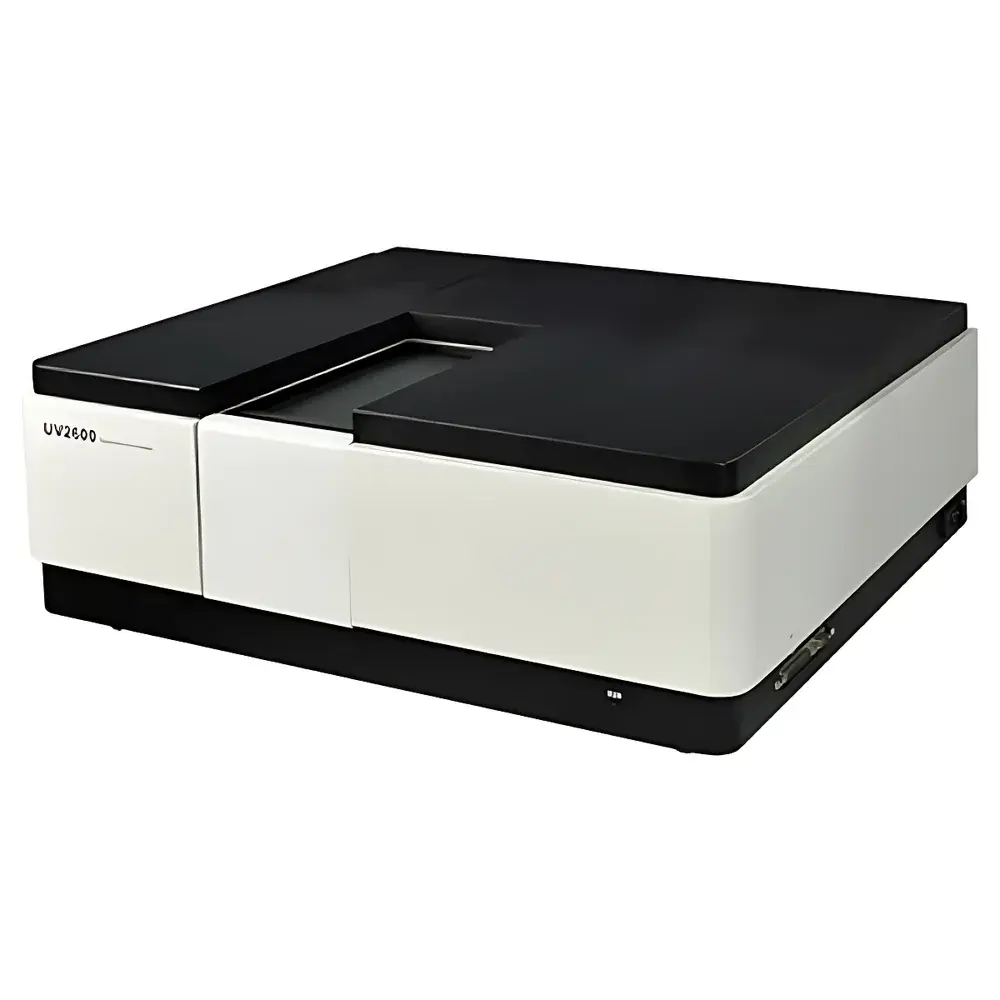
Techcomp UV2600 Dual-Beam Ultraviolet-Visible Spectrophotometer
| Brand | Techcomp |
|---|---|
| Origin | Shanghai, China |
| Model | UV2600 |
| Optical System | Dual-beam |
| Detector | Photomultiplier Tube (PMT) |
| Wavelength Range | 190–900 nm |
| Wavelength Accuracy | ±0.3 nm |
| Spectral Bandwidth | 0.1, 0.2, 0.5, 1, 2, 5 nm (automatically selectable) |
| Stray Light | <0.010% T (at 220 nm with NaI |
| Software | UV Analyst (Windows 2000/XP/Vista compatible) |
| Sample Volume Minimum | 50 µL |
| Compliance | GLP/GMP-supporting diagnostics, self-validation routines |
Overview
The Techcomp UV2600 is a high-performance dual-beam ultraviolet-visible (UV-Vis) spectrophotometer engineered for precision quantitative and qualitative analysis across research laboratories, quality control environments, and educational institutions. Based on the Czerny-Turner monochromator optical architecture with extended focal length, the instrument delivers exceptional spectral resolution and photometric stability. Its dual-beam design employs pulse-modulated beam splitting—ensuring both sample and reference paths are illuminated by the same source and detected by the same photomultiplier tube (PMT). This configuration eliminates inter-channel variability and significantly enhances baseline reproducibility over time and temperature fluctuations. The UV2600 operates across a broad spectral range of 190–900 nm, covering deep UV through near-infrared, enabling applications from nucleic acid quantification to dye characterization and pharmaceutical assay development.
Key Features
- Dual-beam optical architecture with pulse-modulated beam division for superior baseline stability and long-term photometric repeatability
- High-fidelity Czerny-Turner monochromator with extended focal length, delivering <0.010% T stray light performance (verified at 220 nm using NaI and at 340/360 nm using NaNO₂)
- Automatically selectable spectral bandwidths (0.1, 0.2, 0.5, 1, 2, 5 nm), optimized for resolution vs. signal-to-noise trade-offs in diverse sample matrices
- Real-time photometric current correction, eliminating manual zeroing steps and reducing operator-induced error
- Integrated deuterium and tungsten-halogen lamp system with tool-free lamp replacement—no optical realignment required
- Minimum sample volume requirement of 50 µL, supporting microvolume cuvette and flow-cell configurations
- Wavelength accuracy of ±0.3 nm across the full 190–900 nm range, traceable to NIST-traceable standards
Sample Compatibility & Compliance
The UV2600 accommodates standard 10-mm pathlength quartz or fused-silica cuvettes, as well as microvolume adapters and optional automated accessories including thermostatted autosamplers and 6-position programmable cell changers. All hardware and software functions support Good Laboratory Practice (GLP) and Good Manufacturing Practice (GMP) workflows: built-in diagnostic routines validate wavelength accuracy, photometric linearity, stray light, and baseline flatness prior to measurement. Audit trail functionality—including user ID, timestamp, method parameters, and raw data export metadata—is embedded within UV Analyst software. Instrument performance verification aligns with ISO 9001 calibration requirements and supports compliance with USP , ASTM E275, and ICH Q2(R2) guidelines for analytical instrument qualification.
Software & Data Management
UV Analyst is a native Windows-based application (compatible with Windows 2000, XP, and Vista) designed for multi-tasking operation and concurrent display of multiple data windows. It provides intuitive access to six core operational modes: photometric measurement, spectral scanning, quantitative analysis (including single/multi-point calibration and equation-based concentration calculation), kinetic/time-scan acquisition, nucleic acid/protein analysis (A260/A280 ratio, extinction coefficient application), and derivative spectroscopy. Raw absorbance, transmittance, and reflectance data are stored in ASCII-compatible formats (.txt, .csv) and proprietary binary files with embedded metadata. Data export supports LIMS integration, and all processing steps—including smoothing, peak detection, and baseline correction—are fully documented and reversible. Software validation documentation and IQ/OQ protocols are available upon request for regulated environments.
Applications
The UV2600 serves as a foundational analytical platform in multiple domains: determination of DNA/RNA concentration and purity (A260/A280, A260/A230); quantification of proteins via Bradford, Lowry, or BCA assays; evaluation of enzyme kinetics and inhibitor screening; verification of dye lot consistency in textile and ink manufacturing; analysis of active pharmaceutical ingredients (APIs) and excipients per pharmacopoeial methods; water quality assessment (nitrate, phosphate, COD); and routine QC testing in food and beverage production. Its low stray light and high wavelength fidelity make it suitable for measuring highly absorbing or turbid samples where conventional instruments exhibit nonlinearity or spectral distortion.
FAQ
What operating systems are supported by UV Analyst software?
UV Analyst is validated for Windows 2000, Windows XP, and Windows Vista. For modern Windows environments (Windows 10/11), compatibility mode or virtualization may be required.
Does the UV2600 meet regulatory requirements for pharmaceutical testing?
Yes—the instrument supports GLP/GMP workflows through integrated diagnostics, audit-trail logging, and method parameter traceability. Full 21 CFR Part 11 compliance requires additional IT infrastructure and procedural controls beyond the base system.
Can the UV2600 perform kinetic measurements?
Yes—time-scan mode enables continuous monitoring of absorbance changes over user-defined intervals, with configurable sampling frequency and duration.
Is external calibration required before use?
No—built-in self-diagnostic routines verify wavelength accuracy, photometric linearity, and stray light performance prior to each session. Optional NIST-traceable calibration kits are available for periodic verification.
What is the minimum detectable sample volume?
With standard 10-mm cuvettes, the minimum recommended volume is 2.5 mL; however, microvolume accessories enable reliable measurements down to 50 µL using specialized capillary or fiber-optic probes.




