
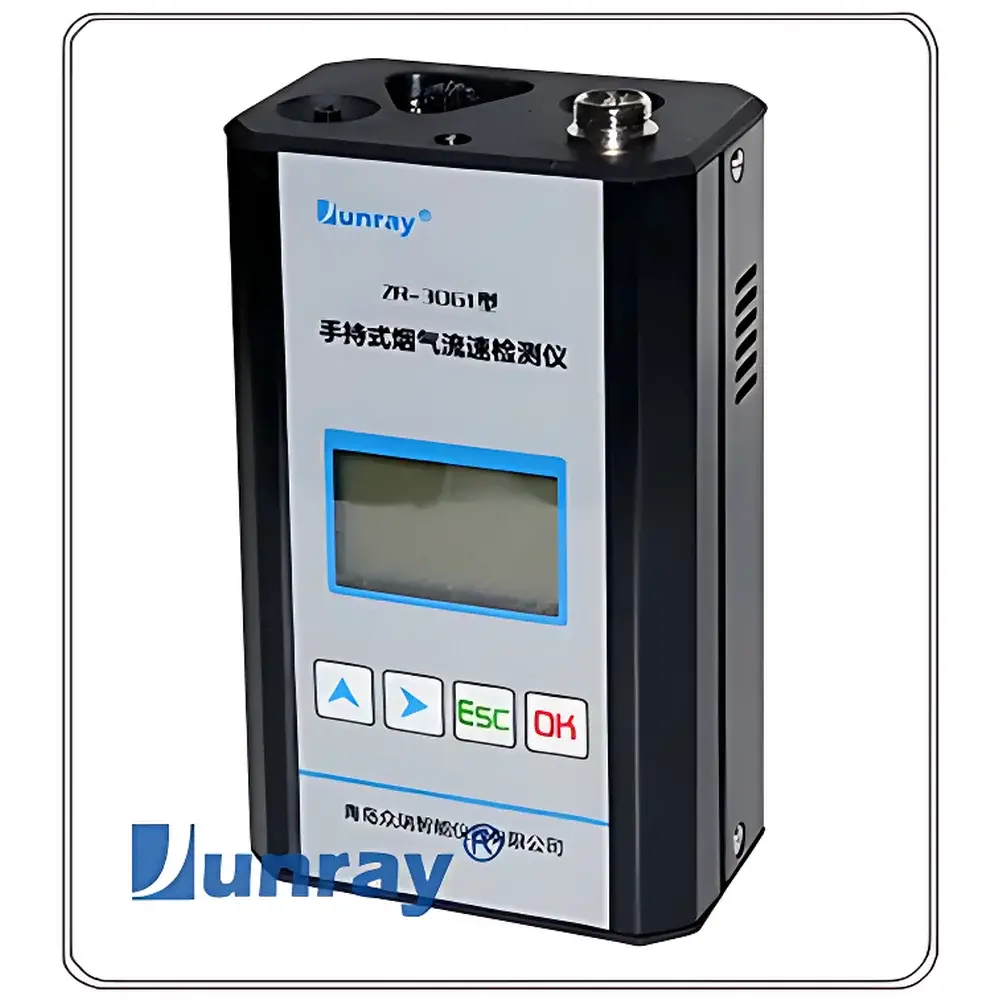
Junray ZR-3061 Handheld Flue Gas Velocity Analyzer
| Brand | Junray |
|---|---|
| Origin | Shandong, China |
| Manufacturer Type | Direct Manufacturer |
| Model | ZR-3061 |
| Measurement Range | Not specified |
| Accuracy (Indication Error) | ≤ ±5% |
| Repeatability | ≤ 2% |
| Response Time | ≤ 20 s |
| Stability | ≤ ±5% |
| Measured Parameter | SO₂ |
| Compliance Standard | GB/T 16157–1996 |
Overview
The Junray ZR-3061 Handheld Flue Gas Velocity Analyzer is a portable, field-deployable instrument engineered for in-situ measurement of gas velocity, volumetric flow rate, dynamic pressure, static pressure, and temperature in industrial flue ducts and exhaust stacks. It operates on the principle of differential pressure sensing—specifically, pitot-static tube methodology—combined with integrated thermistor-based temperature compensation to derive true volumetric flow under non-ideal stack conditions. Designed for compliance-driven environmental monitoring, the ZR-3061 supports routine emissions auditing, stack testing, and continuous emission monitoring system (CEMS) verification in accordance with China’s national standard GB/T 16157–1996, which governs particulate and gaseous pollutant sampling from stationary sources. Its compact form factor and battery-powered architecture enable rapid deployment across boiler rooms, kiln exhausts, incinerator stacks, and HVAC ventilation ducts without requiring external power or fixed mounting.
Key Features
- Integrated pitot-static probe with high-precision imported differential pressure sensor, optimized for low-flow and turbulent flow regimes with minimal thermal drift
- Real-time calculation of average flue gas velocity, total volumetric flow (Nm³/h), dynamic pressure (Pa), static pressure (Pa), and stack temperature (°C)
- Backlit LCD display with intuitive Chinese-language menu interface—designed for operation by field technicians with minimal training
- Rechargeable lithium-ion battery providing ≥24 hours of continuous operation on a single charge, supporting multi-shift field campaigns
- Onboard zero-point auto-correction and software-based calibration routines to maintain metrological integrity between scheduled maintenance intervals
- Internal data storage capacity for up to 200 complete measurement records, retained after power-off with timestamp and parameter metadata
- Optional Bluetooth-enabled thermal printer (with built-in Li-ion battery) for immediate generation of field-ready test reports compliant with audit documentation requirements
Sample Compatibility & Compliance
The ZR-3061 is validated for use in dry, non-corrosive, and moderately particulate-laden flue gases typical of coal-fired boilers, natural gas furnaces, biomass combustion units, and municipal waste incinerators. It is not rated for wet-stack applications, high-HCl/HF environments, or explosive atmospheres (ATEX/IECEx). All measurements adhere to the methodological framework defined in GB/T 16157–1996, including probe positioning protocols, traverse point selection, and pressure correction for moisture content and molecular weight. While primarily aligned with Chinese regulatory frameworks, its differential pressure-based velocity derivation is traceable to ISO 9096 (Determination of dust mass concentration in flue gases) and ASTM D5744 (Standard Practice for Determining Flow Rate in Stacks Using Pitot Tubes), enabling cross-referenced reporting in multinational facility audits.
Software & Data Management
Data export is supported via USB interface (device mode) to standard Windows-based PCs running Junray’s proprietary configuration and reporting software. The software enables batch download, CSV export, and generation of PDF-formatted reports containing measurement metadata (date/time, operator ID, location tag, ambient conditions), raw sensor outputs, and calculated parameters—including uncertainty estimates derived from repeatability and indication error specifications. Audit trails are maintained for all calibration events and firmware updates. Though not certified to FDA 21 CFR Part 11, the system supports GLP-aligned documentation practices through manual signature fields and version-controlled report templates.
Applications
- Periodic stack testing for environmental permit compliance (e.g., discharge permits under China’s “Emission Permit System”)
- Pre- and post-installation verification of scrubbers, ESPs, and fabric filters
- Baseline characterization prior to CEMS installation or performance qualification
- Energy efficiency assessments—including combustion air balance and excess oxygen analysis when paired with optional O₂ sensors
- Technical support for third-party environmental consulting firms conducting Tier 1 and Tier 2 emissions inventories
- Training and demonstration use in vocational institutions focused on pollution control engineering
FAQ
What flue gas components can the ZR-3061 directly measure?
The ZR-3061 measures physical flow parameters only: velocity, dynamic/static pressure, temperature, and derived volumetric flow. SO₂ detection capability is not inherent to this model; it requires integration with an external electrochemical or NDIR gas module.
Is the instrument suitable for high-temperature stacks exceeding 200°C?
No—the standard probe assembly is rated for continuous operation up to 180°C. For higher-temperature applications, custom high-temp probes with active cooling or water-jacketed housings must be specified separately.
Does the ZR-3061 support automatic isokinetic sampling calculations?
No—it does not perform isokinetic sampling control. However, its real-time velocity output can be used to manually adjust sampling probe suction rates during concurrent particulate sampling per GB/T 16157–1996 Annex B.
Can measurement data be synchronized with cloud-based environmental monitoring platforms?
Not natively—the device lacks embedded cellular/Wi-Fi connectivity. Integration with SCADA or cloud dashboards requires intermediary gateway hardware and custom API mapping.
What is the recommended calibration interval?
Junray recommends annual calibration against NIST-traceable pressure and temperature standards, or more frequently if subjected to mechanical shock, condensation exposure, or >500 hours of cumulative field use.
Related Products







