
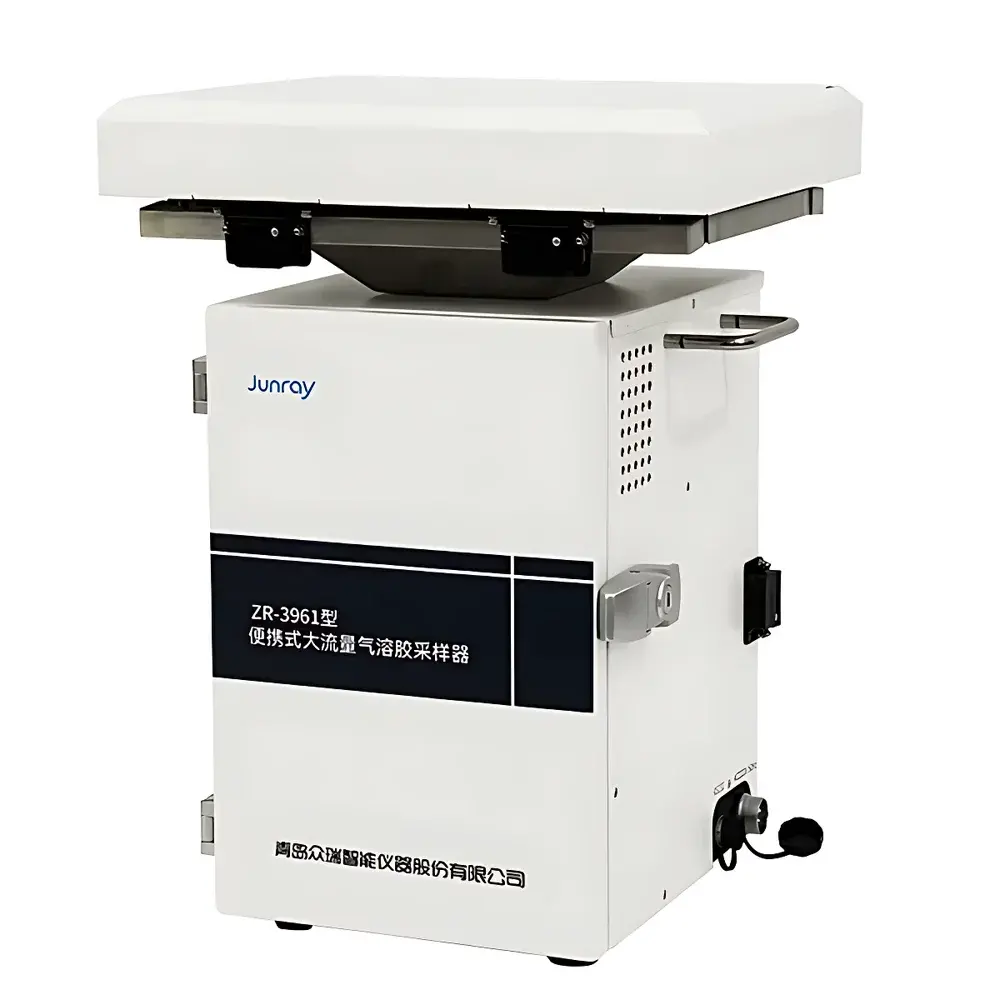
Junray ZR-3961 Portable High-Flow Aerosol Sampler
| Brand | Junray |
|---|---|
| Origin | Shandong, China |
| Manufacturer Type | OEM Manufacturer |
| Country of Origin | China |
| Model | ZR-3961 |
| Pricing | Upon Request |
Overview
The Junray ZR-3961 Portable High-Flow Aerosol Sampler is an engineered field-deployable instrument designed for quantitative collection of airborne particulate matter—including radioactive aerosols—across environmental, occupational health, nuclear safety, and emergency response applications. It operates on the principle of isokinetic high-flow filtration, drawing ambient air through standardized filter media (e.g., quartz fiber, cellulose ester, or mixed cellulose ester membranes) at precisely controlled volumetric flow rates up to 100 L/min. Its robust mechanical architecture supports continuous operation under variable ambient conditions—from −20 °C to +50 °C—making it suitable for both indoor monitoring and outdoor deployment in remote or austere environments. The device complies with core regulatory frameworks governing radiological sampling integrity, including HJ 61-2021 (Technical Specifications for Radiation Environmental Monitoring), HJ 1149-2020 (Emergency Monitoring for Radiological Incidents), and HJ 1155-2020 (Technical Guidelines for Emergency Radiological Monitoring). As a Class I portable sampler per Chinese national standards, it integrates metrological traceability via internal flow calibration routines aligned with ISO 5725 (accuracy and precision of measurement methods) and ASTM D1357 (standard practice for sampling airborne particles).
Key Features
- High-brightness, wide-temperature TFT touchscreen display (−20 °C to +60 °C operational range) with intuitive Chinese/English bilingual GUI and graphical real-time feedback;
- Integrated rechargeable lithium-ion battery pack enabling ≥8 hours of continuous sampling at 100 L/min without external power—supporting full functionality including data export, printing, and configuration changes;
- Auto-scan capability via integrated 2D barcode reader for rapid, error-free assignment of filter identification codes directly to sampling records;
- Tilt-detection sensor triggering immediate audible/visual alarm and automatic pump shutdown to prevent filter media displacement or sample loss;
- Embedded RFID/NFC electronic tag for asset management—enabling seamless integration into laboratory inventory systems via handheld scanners;
- Onboard automatic flow calibration using built-in thermal mass flow sensor and NIST-traceable reference standard; recalibration interval configurable per QA/QC protocols;
- Real-time graphical visualization of instantaneous flow rate (L/min) with second-by-second logging and minute-averaged data export in CSV format;
- Non-volatile flash memory supporting storage of >100,000 complete sampling records—including timestamps, flow profiles, battery status, tilt events, and user annotations;
- Flexible sampling modes: time-based (programmable start/stop), volume-based (target total volume), and interval-based (cyclical on/off sequences);
- Power-failure resilience with auto-resume functionality: retains all pre-interruption parameters, logs exact UTC timestamps for power-down and restoration, and resumes sampling without manual intervention.
Sample Compatibility & Compliance
The ZR-3961 accommodates standard 8×10 cm or 47 mm diameter filter cassettes, compatible with gamma spectrometry (per HJ 1149-2020), alpha/beta counting (per EJ/T 631-1992), and gravimetric analysis (per HJ 22-1998). Its airflow path geometry minimizes particle bounce and re-entrainment, ensuring representative capture efficiency across PM10, PM2.5, and ultrafine fractions (dp ≥ 0.1 µm). All firmware and hardware design elements adhere to GLP-compliant data integrity requirements: each record includes digital signatures, immutable audit trails, and tamper-evident metadata (operator ID, GPS coordinates if externally linked, calibration certificate ID). Device firmware is validated per IEC 62304 (medical-grade software lifecycle), and electrical safety conforms to GB 4793.1–2019 (equivalent to IEC 61010-1).
Software & Data Management
Data extraction occurs via USB-C interface or optional Bluetooth 5.0 module, exporting timestamped datasets compliant with ISO/IEC 17025 Annex A.2 (data control requirements). The proprietary Junray DataLink Suite (v3.2+) provides encrypted local database management, automated report generation (PDF/Excel), and batch synchronization with LIMS platforms via HL7 or ASTM E1384 interfaces. Audit logs meet FDA 21 CFR Part 11 criteria: electronic signatures, role-based access control, and full revision history for all parameter changes. Firmware updates are digitally signed and delivered via secure HTTPS endpoint.
Applications
- Radiation environmental monitoring networks (fixed and mobile stations per HJ 1009-2019);
- Nuclear facility perimeter surveillance and stack emission verification;
- Post-incident radiological reconnaissance following nuclear or dirty-device events;
- Occupational exposure assessment in uranium processing, medical isotope production, and decommissioning sites;
- Indoor air quality studies targeting radon progeny, thoron decay products, and actinide-bearing aerosols;
- Method validation and inter-laboratory comparison exercises under CNAS accreditation scope.
FAQ
Does the ZR-3961 support external GPS synchronization for geotagged sampling records?
Yes—via optional RS-232 or TTL-level serial interface, enabling NMEA 0183-compatible GPS receivers to embed latitude, longitude, and altitude into each sampling event.
Can the instrument be calibrated against a primary standard flowmeter?
Yes—the internal thermal mass flow sensor allows two-point calibration using a certified laminar flow element or critical orifice bank traceable to NIM (National Institute of Metrology, China).
Is the device certified for use in explosion-hazardous areas?
No—it is not intrinsically safe or ATEX-certified; operation is restricted to non-classified zones per GB 3836.1–2010.
What filter media types are validated for use with this sampler?
Quartz fiber (QMA/QMB), polyvinyl chloride (PVC), mixed cellulose ester (MCE), and polycarbonate track-etch (PCTE) membranes—each validated per HJ 1149-2020 filter efficiency curves.
How is data integrity ensured during long-term unattended deployments?
Through cyclic checksum verification of stored records, write-once memory partitioning, and hardware-enforced write-protection after finalization of sampling batches.







