
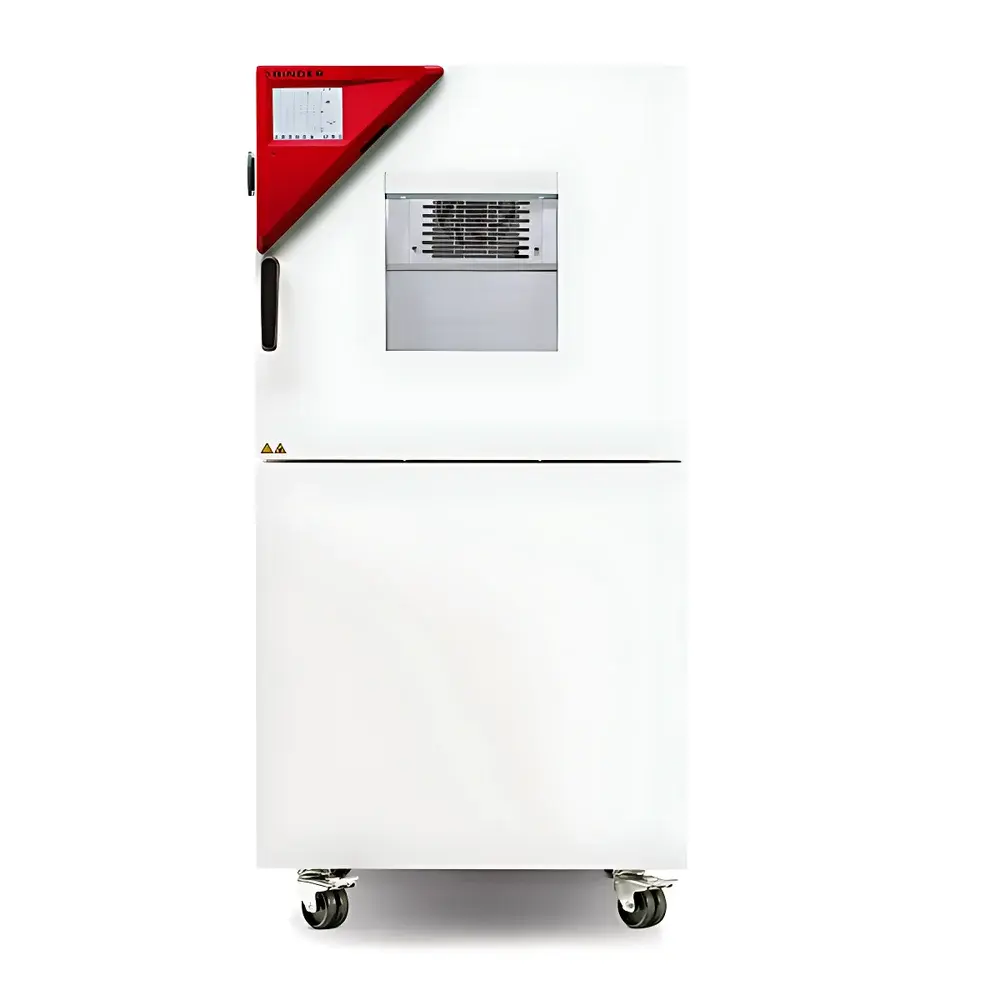
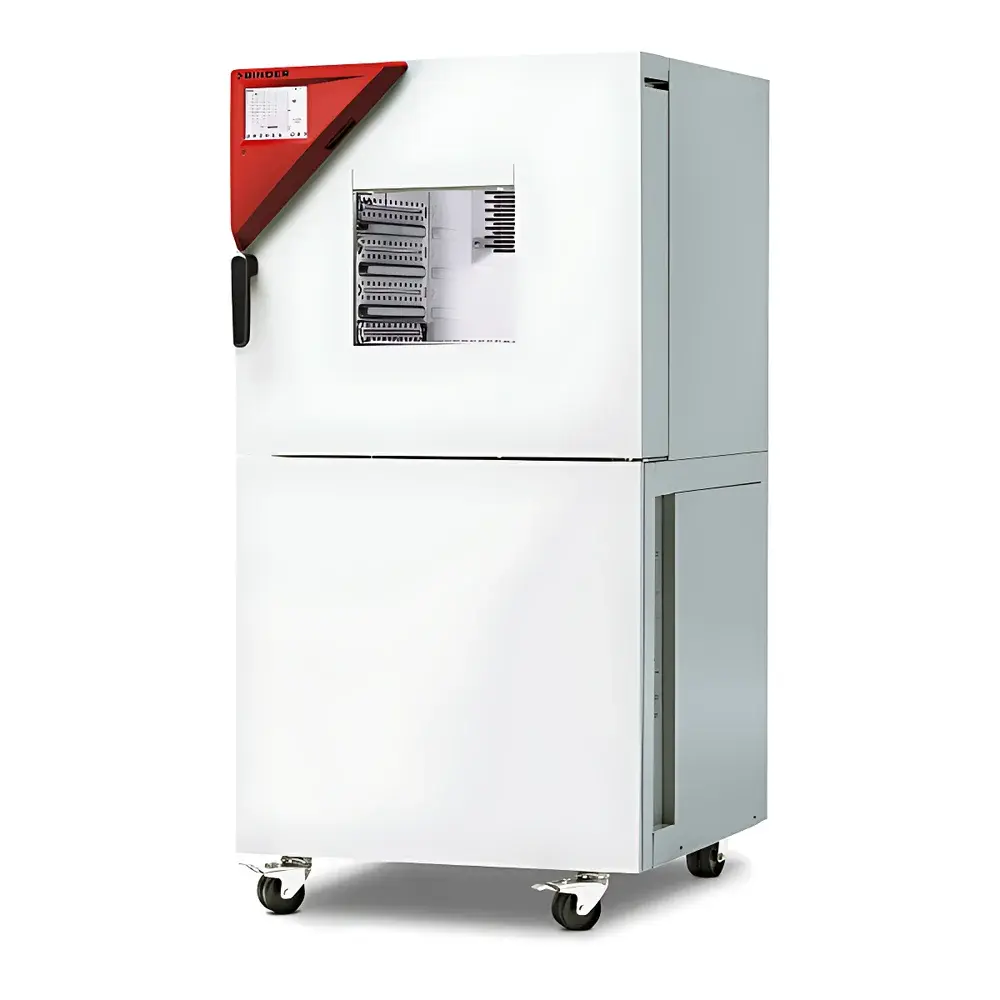
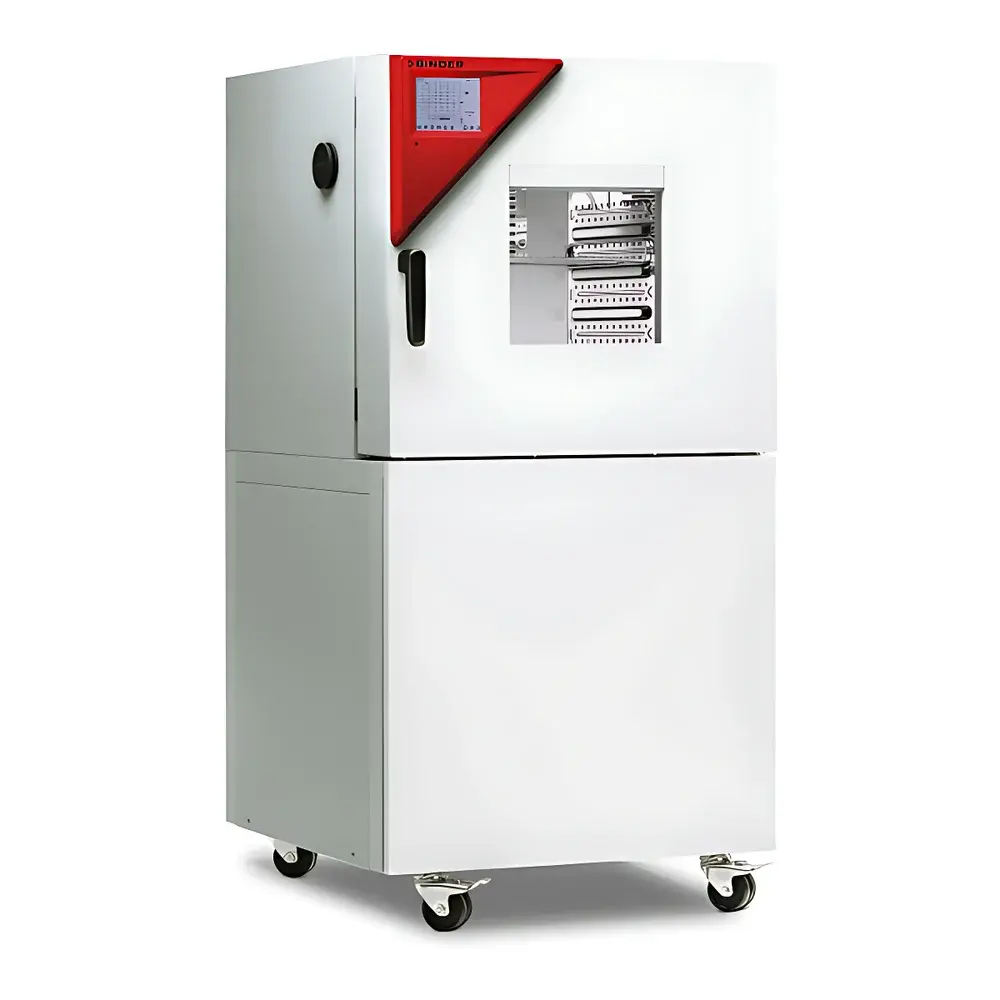
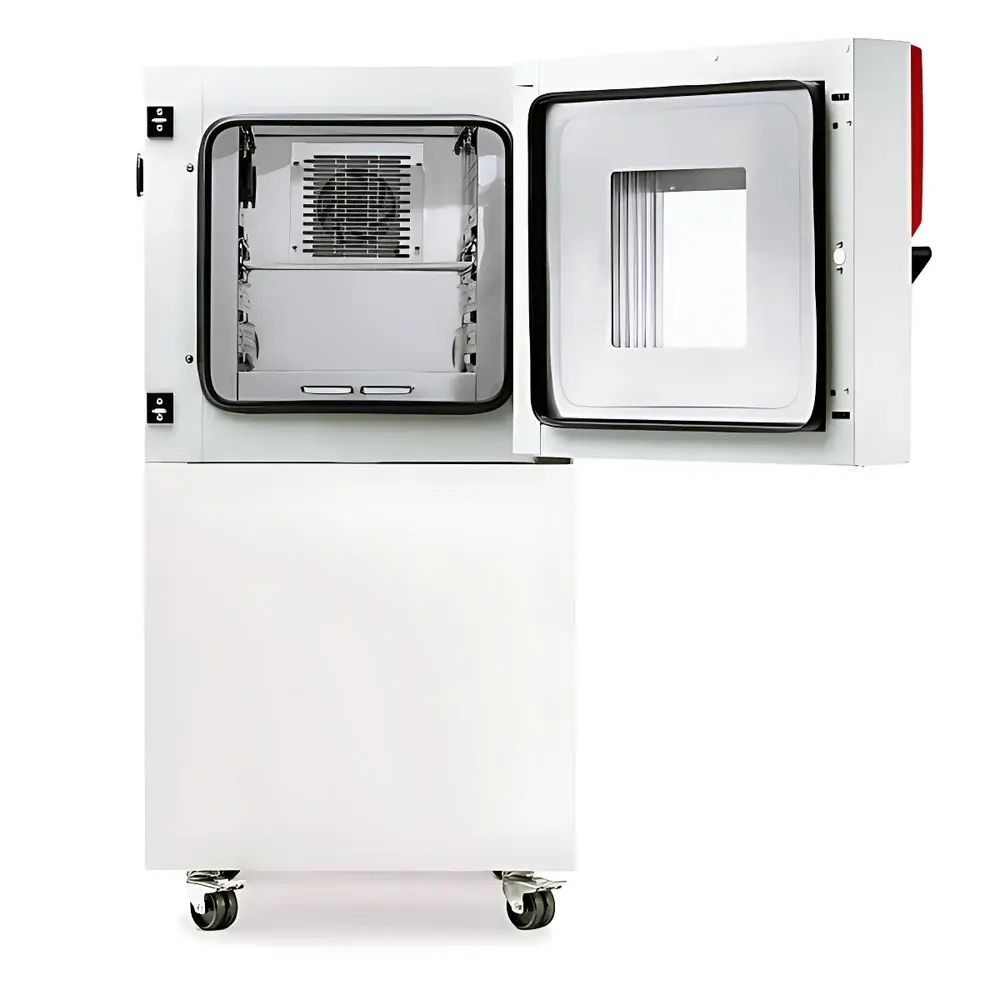
BINDER MK56 High-Low Temperature Cycling Climate Chamber
| Brand | BINDER |
|---|---|
| Origin | Germany |
| Manufacturer | BINDER GmbH |
| Type | Imported Industrial Environmental Test Chamber |
| Model | MK 56 |
| Temperature Range | −40 °C to +180 °C |
| Cooling Method | Compressor-Based Refrigeration |
| Explosion-Proof | Standard (Non-Explosion-Proof) |
| Temperature Fluctuation | ±0.1 °C to ±0.5 °C |
| Temperature Uniformity | ±0.5 °C to ±1.5 °C |
| Average Heating Rate (per IEC 60068-3-5) | 5.0 °C/min |
| Average Cooling Rate (per IEC 60068-3-5) | 5.0 °C/min |
| Internal Chamber Dimensions | 720 mm × 778 mm × 1445 mm |
| Controller Interface | Touchscreen with APT Line™ Preheating Cavity Technology |
| Data Logging | Internal Recorder with USB Export |
| Viewing Window | Heated, LED-Illuminated Safety Glass |
| Condensation Protection | Programmable Interval & Real-Time Control |
| Alarm System | Optical and Acoustic Fault Diagnostics |
Overview
The BINDER MK56 High-Low Temperature Cycling Climate Chamber is an industrial-grade environmental test system engineered for precise, repeatable thermal cycling across extreme temperature ranges—from −40 °C to +180 °C. Designed in accordance with IEC 60068-3-5 for climatic testing, the MK56 implements a dual-stage compressor-based refrigeration system coupled with high-efficiency resistive heating elements to achieve symmetrical average ramp rates of 5.0 °C/min during both heating and cooling phases. Its core architecture integrates BINDER’s proprietary APT Line™ preheating cavity technology, which actively conditions air prior to chamber entry—minimizing thermal lag, reducing condensation risk on samples and interior surfaces, and improving transient response fidelity. The chamber is constructed with stainless steel inner walls, double-glazed heated observation windows, and a fully insulated enclosure to ensure long-term thermal stability and mechanical robustness under continuous cyclic operation.
Key Features
- IEC 60068-3-5–compliant thermal ramp performance: 5.0 °C/min average rate for both heating and cooling, validated under standardized load conditions
- APT Line™ preheating cavity technology for optimized airflow conditioning, enabling rapid stabilization and reduced dew-point excursions
- Intuitive 7-inch capacitive touchscreen controller supporting real-time programming, interval-based condensation protection, and multi-segment ramp-soak profiles
- Heated, LED-illuminated safety glass viewing window with anti-fog coating—enabling visual monitoring without thermal disturbance
- Integrated internal data logger with timestamped temperature records (1-second resolution), exportable via USB to CSV or Excel-compatible formats
- Dual alarm system featuring both optical indicators and audible alerts for overtemperature, sensor failure, door open, refrigerant pressure deviation, and power interruption
- Stainless steel interior (AISI 304), reinforced structural frame, and CE/EMC-compliant electrical architecture meeting EN 61000-6-2 and EN 61000-6-4
Sample Compatibility & Compliance
The MK56 accommodates a broad spectrum of sample types—including electronic assemblies, automotive components, polymer specimens, PCBs, aerospace materials, and pharmaceutical packaging—without requiring external modifications. Its internal volume (720 × 778 × 1445 mm, ~0.81 m³) supports standard test fixtures and custom mounting racks. The chamber meets key international standards for environmental testing: IEC 60068-2-1 (cold), IEC 60068-2-2 (dry heat), IEC 60068-2-14 (change of temperature), and ISO 16750-4 (road vehicles). It is suitable for GLP-compliant laboratories when operated with audit-trail-enabled software extensions and calibrated traceable sensors (NIST-traceable calibration certificates available upon request). While not intrinsically explosion-proof, optional inert gas purge interfaces (N₂ or dry air) can be integrated for low-oxygen testing protocols.
Software & Data Management
The MK56 operates natively via its embedded APT-COM™ controller firmware, supporting up to 99 programmable test sequences with 999 segments per program. All measurement data—including chamber setpoint, actual temperature (multiple sensor inputs), ramp rate, and alarm status—are logged internally with microsecond-level time stamping. USB export enables seamless integration into LIMS or QMS platforms. For advanced traceability, optional BINDER APT-COM² PC software provides remote monitoring, real-time graphing, automated report generation (PDF/CSV), and full 21 CFR Part 11 compliance support—including user access control, electronic signatures, and immutable audit trails. Calibration data, maintenance logs, and sensor drift compensation parameters are stored within the controller’s secure memory partition.
Applications
The MK56 serves critical roles in product qualification, reliability engineering, and quality assurance workflows. Typical use cases include thermal shock screening per MIL-STD-810H Method 503.7; solder joint fatigue analysis in electronics; accelerated aging of elastomers and adhesives; validation of battery thermal management systems; and stability testing of medical device housings under cyclic humidity-free thermal stress. Its consistent uniformity (±0.5 °C to ±1.5 °C) and tight fluctuation control (±0.1 °C at steady state) make it suitable for applications requiring high reproducibility—such as comparative studies across multiple labs or multi-lot production verification.
FAQ
What is the maximum thermal ramp rate achievable with the MK56 under no-load conditions?
The MK56 achieves an average ramp rate of 5.0 °C/min per IEC 60068-3-5, verified with empty chamber and nominal line voltage. Actual rates may vary slightly depending on load mass, thermal mass distribution, and ambient room conditions.
Does the MK56 support humidity control?
No—the MK56 is a dry-thermal cycling chamber. For combined temperature/humidity testing, BINDER’s KBF or VIVO series chambers are recommended.
Can the internal data logger be configured for external network access?
The standard unit supports local USB export only. Ethernet connectivity and cloud-based data streaming require the optional APT-COM² software suite with dedicated communication module.
Is third-party calibration supported?
Yes—BINDER-certified service partners and accredited metrology labs can perform on-site calibration using NIST-traceable reference probes. Factory calibration reports include uncertainty budgets per ISO/IEC 17025.
What maintenance intervals are recommended for compressor-based operation?
Compressor oil inspection every 24 months; refrigerant pressure and leak check annually; air filter replacement quarterly; full preventive maintenance (including sensor recalibration and seal integrity verification) every 36 months—per BINDER Service Manual SM-MK56 Rev. 4.2.



