
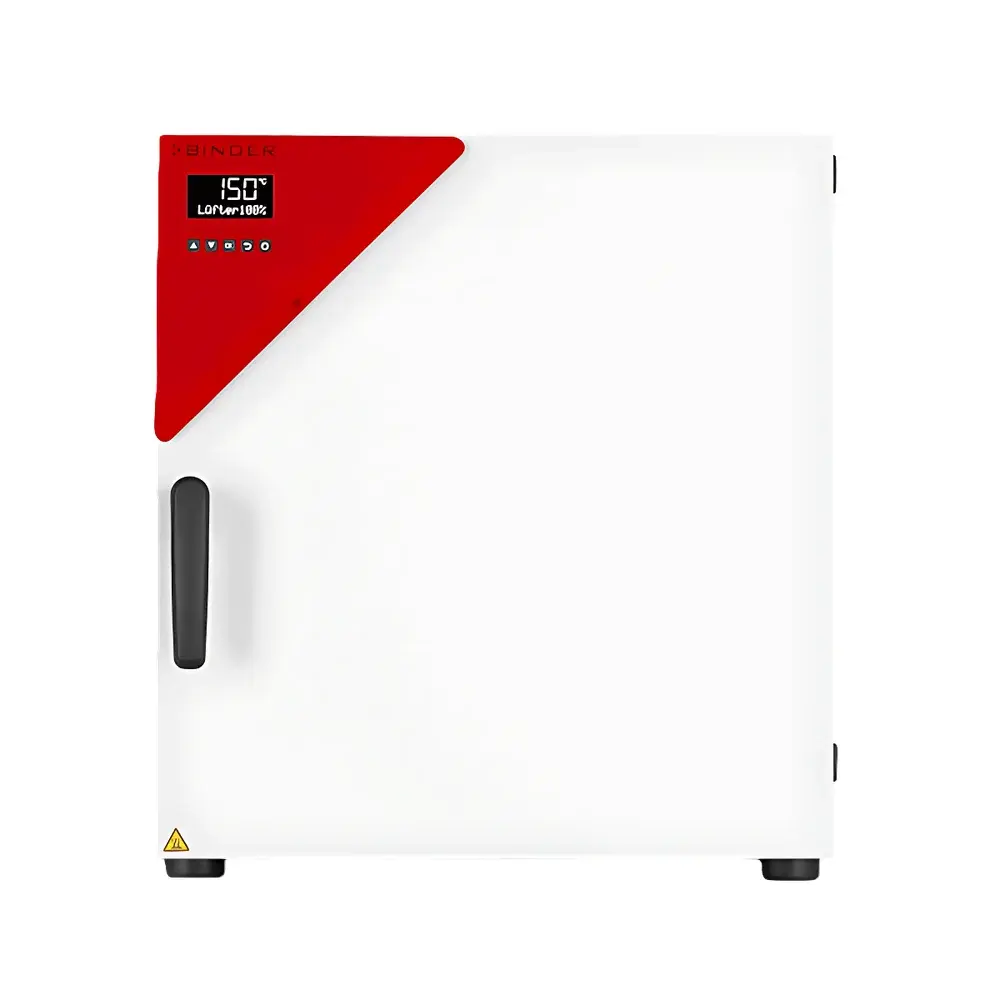
BINDER FD56 Forced-Convection High-Temperature Drying Oven
| Brand | BINDER |
|---|---|
| Origin | Germany |
| Manufacturer | BINDER GmbH |
| Model | FD 56 |
| Temperature Range | +10 °C to 300 °C |
| Temperature Uniformity | ±1.7 °C (at 150 °C) |
| Temperature Stability | ±0.3 °C (at 150 °C) |
| Internal Chamber Dimensions (W×D×H) | 400 × 440 × 345 mm |
| External Dimensions (W×D×H) | 560 × 625 × 565 mm |
| Chamber Material | Stainless Steel (AISI 304) |
| Heating System | APT Line Preheating Chamber |
| Air Circulation | Forced Convection with Adjustable-Speed Fan |
| Controller | LCD Display with USB Data Logging Interface |
| Safety Class | Independent Adjustable Temperature Safety Device, Class 2 (DIN 12880), Optical Alarm |
| Shelving | Chrome-Plated Adjustable Shelves |
| Exhaust Valve | Integrated Mechanical Ventilation Control |
| Operating Ambient Temperature | 15–30 °C |
Overview
The BINDER FD56 is a precision-engineered forced-convection high-temperature drying oven designed for demanding laboratory and industrial quality control environments. Built upon BINDER’s APT Line thermal architecture, the FD56 employs a preheated air chamber and tangential fan system to ensure rapid thermal response and exceptional spatial temperature uniformity across its 60.7 L stainless-steel interior. Unlike natural convection ovens, this model actively circulates conditioned air at variable speeds—enabling consistent heat transfer to samples regardless of load configuration or placement. Its operational range spans from ambient +10 °C to 300 °C, making it suitable for applications including gravimetric moisture analysis, polymer curing, powder drying, pre-conditioning of test specimens per ASTM D618 and ISO 291, and residual solvent removal in pharmaceutical intermediates. The unit complies with DIN 12880 for safety-critical thermal equipment and meets essential requirements for GLP-compliant laboratories where traceable, repeatable thermal processing is mandatory.
Key Features
- APT Line preheating chamber technology ensures minimal thermal lag and improved setpoint accuracy, particularly during ramp-and-soak cycles.
- Forced convection system with electronically controlled tangential fan delivers uniform airflow and reduces temperature gradients to ±1.7 °C (measured per DIN 12880 at 150 °C).
- Microprocessor-based controller with backlit LCD display supports intuitive parameter input, real-time monitoring, and programmable multi-step profiles.
- Dual-stage temperature safety circuit (Class 2 per DIN 12880) provides independent overtemperature protection with optical alarm and automatic power cutoff.
- Stainless-steel interior (AISI 304) resists corrosion from acidic vapors, solvents, and repeated cleaning agents—ensuring long-term dimensional stability and compliance with ISO 14644 cleanroom-compatible maintenance protocols.
- Integrated mechanical exhaust valve enables precise control of internal pressure and vapor evacuation—critical for volatile organic compound (VOC) removal and solvent recovery workflows.
- USB interface supports time-stamped data export (temperature, setpoint, alarm status) for audit-ready recordkeeping aligned with FDA 21 CFR Part 11 Annex 11 principles.
Sample Compatibility & Compliance
The FD56 accommodates standard laboratory glassware (e.g., weighing dishes, crucibles, Petri dishes), metal sample trays, and polymer molds up to 400 mm wide. Its chrome-plated adjustable shelving system allows vertical reconfiguration to optimize airflow around heterogeneous loads. The oven is validated for use in accordance with ISO/IEC 17025 calibration traceability frameworks and supports routine performance qualification (PQ) per IQ/OQ/PQ protocols. It conforms to EN 61000-6-3 (EMC emission standards), EN 61000-6-2 (immunity), and carries CE marking under the EU Machinery Directive 2006/42/EC and Low Voltage Directive 2014/35/EU. Optional validation documentation packages—including as-found/as-left calibration reports and temperature mapping templates—are available upon request for GMP-regulated facilities.
Software & Data Management
While the FD56 operates via embedded firmware without proprietary PC software, its USB port enables direct export of comma-separated value (CSV) log files containing timestamped temperature readings, setpoint history, and event flags (e.g., door opening, safety activation). These logs are compatible with common laboratory information management systems (LIMS) and statistical process control (SPC) platforms such as JMP, Minitab, or LabWare. For facilities requiring electronic signature and audit trail functionality, integration with third-party supervisory control systems (e.g., Siemens Desigo CC, Ignition SCADA) is supported via Modbus RTU over RS-485 (optional interface module). All data records retain full metadata—including operator ID, instrument serial number, and environmental timestamp—to satisfy ALCOA+ data integrity criteria.
Applications
- Moisture content determination per AOAC 950.46, USP , and ISO 5530-1 using standardized drying protocols.
- Thermal aging studies of elastomers and composites per ASTM D573 and ISO 188.
- Pre-drying of filter papers, silica gel, and desiccants prior to gravimetric analysis.
- Post-cleaning drying of surgical instruments and reusable labware in ISO 13485-certified medical device manufacturing.
- Curing of epoxy coatings and adhesive bonds in materials R&D labs.
- Stabilization of reference standards and certified reference materials (CRMs) under controlled thermal conditions.
FAQ
What is the maximum load capacity for the FD56 chamber?
The FD56 does not specify a weight limit per shelf; however, total loaded mass should not exceed 30 kg to maintain airflow integrity and thermal uniformity. Shelf loading must allow ≥25 mm clearance from chamber walls and rear fan housing.
Is the FD56 suitable for sterilization applications?
No—it is not designed or validated for microbial sterilization (e.g., dry-heat sterilization per ISO 17665). It supports depyrogenation and drying but lacks the validation-grade sensors and cycle documentation required for sterile processing.
Can the USB logging function be configured for interval-based sampling?
Yes—the built-in logger records data at 1-minute intervals by default; this interval is fixed and non-adjustable via front-panel controls. Custom sampling rates require external data acquisition hardware.
Does the FD56 support remote monitoring via Ethernet or Wi-Fi?
Not natively. Remote access requires optional RS-485-to-Ethernet gateways or integration into facility-wide building management systems (BMS) using Modbus TCP.
How often should temperature uniformity verification be performed?
Per ISO/IEC 17025 and internal SOPs, quarterly mapping (9-point sensor grid) is recommended for routine operation; additional verification is required after relocation, major service, or process deviations.



