
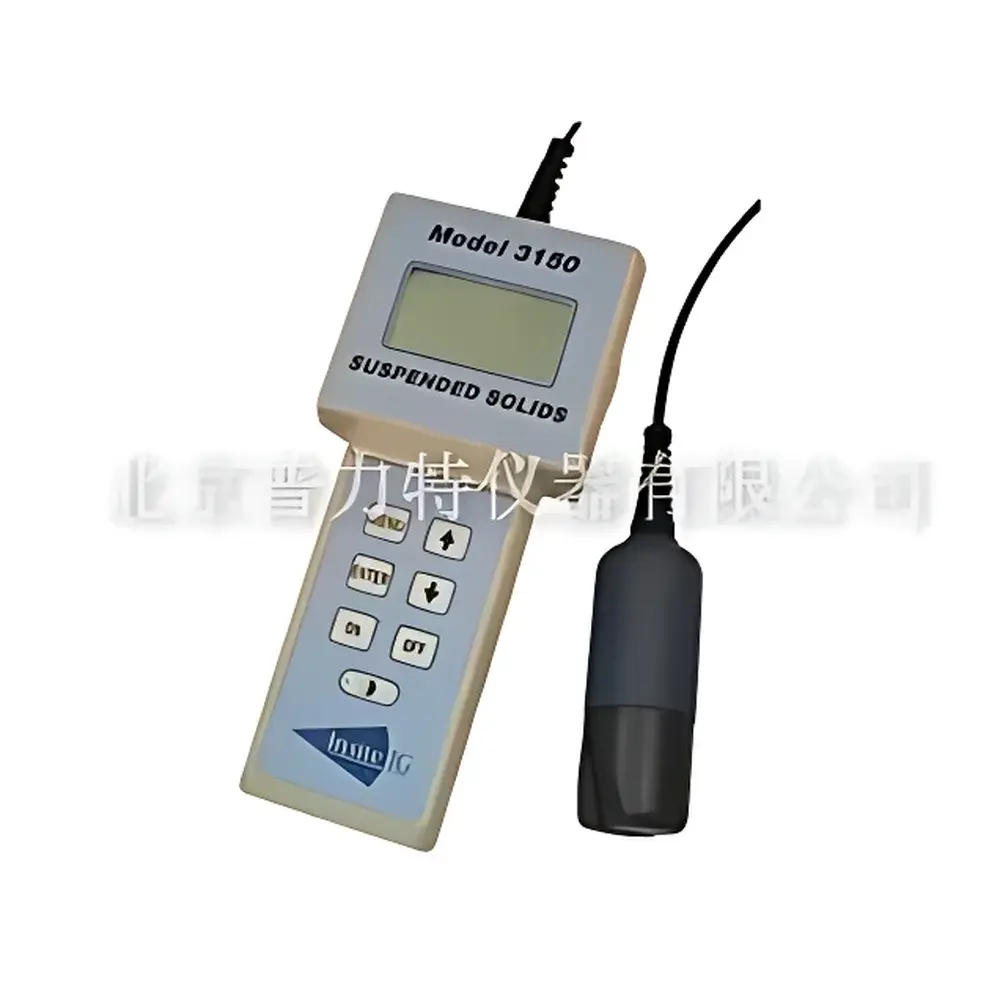
Hach 3150 Portable Suspended Solids Analyzer
| Origin | USA |
|---|---|
| Manufacturer Type | Authorized Distributor |
| Origin Category | Imported |
| Model | 3150 |
| Instrument Type | Portable |
| Price Range | USD $2,800 – $7,200 (FOB) |
| Measurement Principle | Single-Beam Infrared Absorption |
Overview
The Hach 3150 Portable Suspended Solids Analyzer is an engineered field-deployable instrument designed for real-time, in-situ quantification of suspended solids concentration in aqueous environments using single-beam infrared (IR) absorption photometry. Unlike turbidity-based methods, the 3150 employs a fixed-wavelength IR emitter (typically 850 nm) to minimize interference from color, dissolved organics, and light-scattering artifacts common in wastewater matrices. Its optical path is optimized for high signal-to-noise ratio across broad concentration ranges—from low-turbidity influent streams to highly concentrated activated sludge suspensions. The analyzer is calibrated independently for two operational modes: Mixed Liquor Suspended Solids (MLSS) in aeration basins (1000–5000 mg/L) and Return Activated Sludge (RAS) in secondary clarifier underflow lines (7000–20,000 mg/L)—enabling process-specific accuracy without manual range switching or sensor recalibration.
Key Features
- Infrared optical sensor with automatic color-compensation algorithm, dynamically adjusting emitter intensity based on ambient light spectral temperature to maintain measurement stability under variable lighting or colored water conditions
- Dual-mode calibration architecture: factory-traceable, application-specific calibration curves for MLSS and RAS—each validated per ASTM D5907 and ISO 11923 protocols
- High-resolution LCD display with adjustable contrast, backlighting, and UV-resistant polymer overlay for legibility in direct sunlight or low-light field conditions
- Integrated rechargeable lithium-ion battery providing ≥16 hours of continuous operation; supports hot-swappable battery packs for extended monitoring campaigns
- NEMA 4X-rated polycarbonate housing with epoxy-polyurethane encapsulated electronics, rated for IP66 ingress protection and 100 psi hydrostatic pressure tolerance
- Self-diagnostic firmware performing periodic sensor health checks—including LED output verification, photodetector linearity validation, and thermal drift compensation
- Real-time measurement logging with timestamped data storage (≥10,000 records), exportable via RS-232 serial interface to Hach’s DataStream software or third-party SCADA systems
Sample Compatibility & Compliance
The 3150 is validated for use in raw sewage, primary effluent, activated sludge, digested sludge, and clarified secondary effluent. It meets EPA Method 160.2 requirements for suspended solids estimation in wastewater treatment process control and complies with ISO/IEC 17025–accredited calibration traceability when used with Hach-certified reference standards (e.g., Hach SS Standard Set, Cat. No. 2694200). Sensor immersion depth and flow velocity thresholds are defined per USP analytical instrument qualification guidelines for field-use devices. The unit supports GLP-compliant audit trails when paired with Hach’s compliant data management module (optional add-on), satisfying FDA 21 CFR Part 11 electronic record requirements for regulated utilities.
Software & Data Management
Data acquisition and configuration are managed via Hach’s DataStream Desktop v4.2 software (Windows-compatible), which enables remote calibration updates, firmware version control, and batch export to CSV or Excel-compatible formats. All logged measurements include embedded metadata: date/time stamp, temperature reading (via integrated Pt100 RTD), sensor ID, calibration mode (MLSS/RAS), and diagnostic status flags. The RS-232 interface supports Modbus RTU protocol for integration into PLC-based control systems. Optional cloud synchronization (via Hach Connect gateway) provides secure TLS 1.2–encrypted transmission to enterprise asset management platforms.
Applications
- Continuous MLSS monitoring in aerobic and anoxic bioreactors to optimize aeration energy consumption and prevent nitrification failure
- RAS concentration tracking at clarifier underflow pumps to maintain optimal sludge blanket height and prevent washout
- Sludge blanket profiling in final clarifiers using vertical sensor profiling kits (sold separately)
- Performance verification of membrane bioreactor (MBR) effluent filtration integrity
- Field validation of laboratory gravimetric TSS results (EPA 160.2) during QA/QC audits
- Emergency response deployment for stormwater runoff characterization following CSO events
FAQ
What is the recommended calibration frequency for routine wastewater plant operation?
Calibration verification is advised before each daily shift; full two-point calibration (low/high) is required weekly or after sensor cleaning, per Hach Technical Bulletin TB-3150-02.
Can the 3150 be used in seawater or brackish influent applications?
Yes—the IR optical system is insensitive to salinity-induced refractive index shifts; however, biofouling mitigation (e.g., wiper blade kit, Cat. No. 3150-WK) is strongly recommended for long-term submerged deployments.
Does the device support external temperature compensation for density-corrected mg/L reporting?
No—the 3150 reports raw mass concentration (mg/L) as measured at sample temperature; density correction must be applied externally using concurrent temperature and specific gravity inputs.
Is the RS-232 output compatible with Modbus TCP gateways?
Yes—when connected to a certified RS-232-to-Modbus TCP converter (e.g., Moxa NPort 5110), the 3150 integrates seamlessly into Ethernet-based DCS architectures.
What is the warranty coverage and service interval for the optical sensor head?
Standard warranty: 24 months parts and labor; optical sensor recalibration and verification recommended annually by an ISO/IEC 17025-accredited Hach Service Center.







