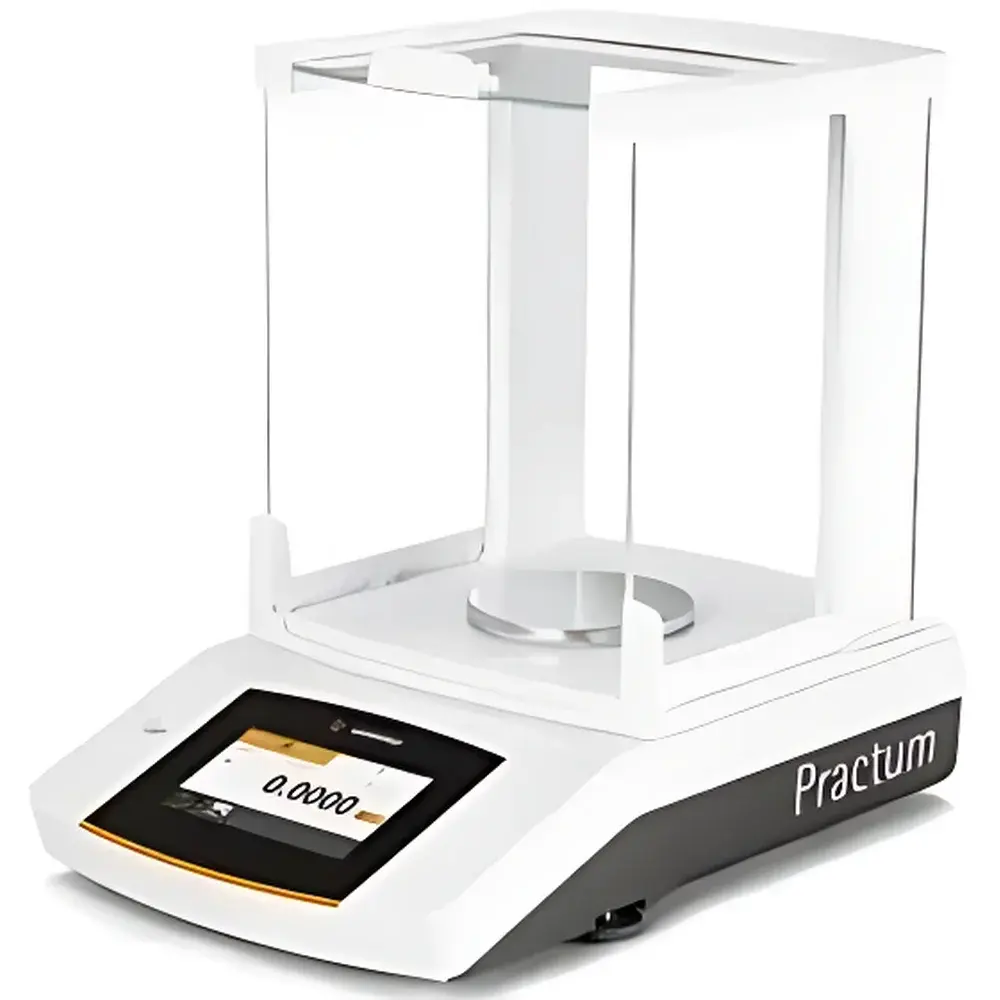
Sartorius PRACTUM124-1CN Analytical Balance
| Brand | Sartorius |
|---|---|
| Origin | Germany |
| Model | PRACTUM124-1CN (P124) |
| Maximum Capacity | 120 g |
| Readability | 0.1 mg |
| Repeatability | 0.1 mg |
| Calibration | External |
| Weighing Pan Diameter | Ø90 mm |
| Stabilization Time | ≤4 s |
| Dimensions (W × D × H) | 216 × 360 × 320 mm |
| Net Weight | 4.5 kg |
| Compliance | ISO/IEC 17025, GLP/GMP-ready, ASTM E899, USP <41> |
Overview
The Sartorius PRACTUM124-1CN is a high-precision analytical balance engineered for routine laboratory applications requiring reliable mass measurement at the 0.1 mg readability level. Designed and manufactured in Germany, it operates on electromagnetic force compensation (EMFC) principle—where sample mass is determined by the current required to restore the weighing pan to its null position after load application. This architecture ensures exceptional linearity, minimal drift, and long-term stability under standard ambient conditions (20 ± 5 °C, RH ≤ 80 %, non-condensing). The PRACTUM124-1CN is optimized for users seeking robust performance without complexity: its intuitive interface, integrated leveling system, and modular design support rapid deployment in teaching labs, QC environments, and regulated pharmaceutical or chemical testing workflows.
Key Features
- Electromagnetic force compensation sensor with 0.1 mg resolution and ≤0.1 mg repeatability—validated per ISO 5725-2 for precision consistency across repeated measurements.
- Integrated draft shield with practical sliding doors and rigid acrylic construction—designed to minimize air currents while enabling unobstructed access during weighing of tall or irregularly shaped containers.
- Underhook weighing capability—facilitates density determination, magnetic susceptibility testing, or net weight measurement of large-volume vessels via suspended-load configuration.
- Front-mounted bubble level and oversized leveling feet—allow rapid, tool-free horizontal alignment; critical for maintaining metrological integrity in shared or mobile lab settings.
- USB interface compliant with CDC (Communication Device Class) protocol—enables direct data streaming to Microsoft Excel, LIMS, or ELN platforms without proprietary drivers.
- Regulatory lock function—permits administrators to restrict access to calibration, unit conversion, or tare settings—supporting pedagogical control in academic labs and audit readiness in GxP environments.
- Programmable print interval output—supports time-stamped mass logging for kinetic studies, evaporation rate analysis, or moisture loss monitoring.
Sample Compatibility & Compliance
The PRACTUM124-1CN accommodates samples up to 120 g within a Ø90 mm stainless steel weighing pan and 209 mm vertical clearance beneath the draft shield. Its compact footprint (216 × 360 × 320 mm) and 4.5 kg mass ensure mechanical stability on standard lab benches—even when used alongside vibration-sensitive instrumentation. The balance meets fundamental requirements for traceable mass measurement under ISO/IEC 17025:2017 (clause 6.4.10), supports GLP documentation through timestamped data export, and aligns with USP “Balances” for pharmaceutical weighing applications. While external calibration is required (e.g., using certified Class E2 or F1 weights), the device provides full calibration history logging—including date, operator ID, and deviation values—when paired with Sartorius DataControl software or third-party audit-compliant systems.
Software & Data Management
Data acquisition is natively supported via USB virtual COM port, enabling seamless integration into existing laboratory informatics infrastructure. No additional software installation is necessary for basic data transfer: Excel-compatible CSV or TXT files are generated upon request or at user-defined intervals. For enhanced traceability, optional Sartorius LabX Lite software provides electronic signature support, automated report generation, and 21 CFR Part 11-compliant audit trails—including user authentication, change tracking, and immutable record retention. All exported data includes metadata such as balance ID, timestamp (YYYY-MM-DD HH:MM:SS), environmental status (leveling OK/stable), and measurement mode (standard/weighing/density).
Applications
- Quantitative preparation of reference standards and working solutions in analytical chemistry laboratories.
- Weighing of active pharmaceutical ingredients (APIs) and excipients during formulation development and batch release testing.
- Gravimetric analysis including ash content, moisture determination (via loss-on-drying), and residue-on-ignition protocols.
- Calibration of volumetric glassware using water density correction (ISO 4787).
- Student training in metrology fundamentals—leveraging regulatory lock to enforce procedural discipline and reduce operational errors.
- Density measurement of solids and liquids using the built-in density determination mode with auxiliary sinker kit (optional).
FAQ
What calibration standards are recommended for the PRACTUM124-1CN?
Class E2 stainless steel weights (certified to ISO 9001 and traceable to national metrology institutes) are recommended for routine verification and adjustment. Annual recalibration by an accredited service provider is advised for GxP compliance.
Is internal calibration available on this model?
No—the PRACTUM124-1CN uses external calibration only. Internal motorized calibration is featured in higher-tier QUINTIX and SECURA series models.
Can the balance be connected to a networked LIMS?
Yes—via USB-to-serial adapter or dedicated RS-232 interface (optional), provided the LIMS accepts ASCII-based serial input or supports Windows COM port mapping.
Does the device meet FDA 21 CFR Part 11 requirements out-of-the-box?
Not independently—the balance itself provides raw data and timestamps, but full Part 11 compliance requires validated software (e.g., LabX) and organizational SOPs covering electronic signatures, audit trails, and access controls.
What is the warm-up time before first use?
A minimum of 30 minutes is recommended after power-on to achieve thermal equilibrium of the EMFC sensor and ensure optimal repeatability and linearity.