
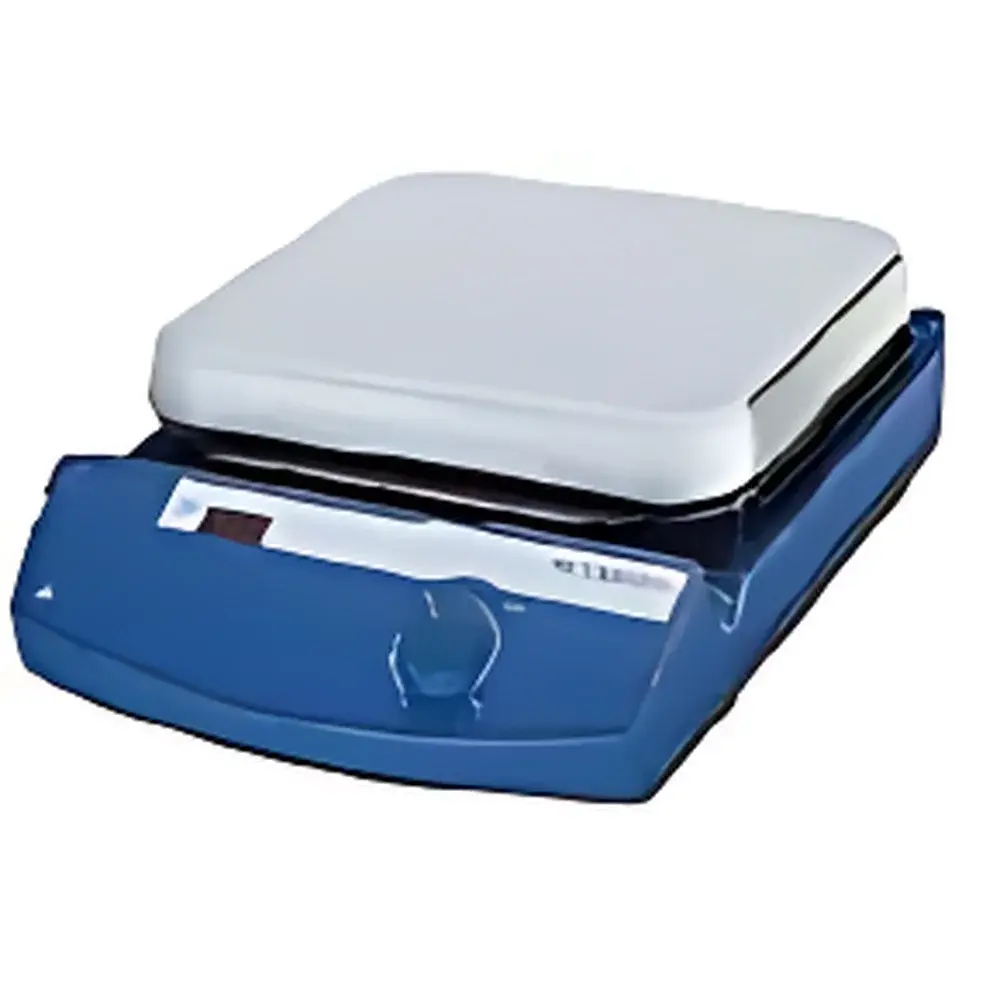
IKA C-MAG HP4 / HP7 / HP10 Electric Heating Plates
| Brand | IKA |
|---|---|
| Origin | Germany |
| Model Series | C-MAG HP4, C-MAG HP7, C-MAG HP10 |
| Heating Power | 250 W (HP4) / 1000 W (HP7) / 1500 W (HP10) |
| Max. Heating Temperature | 500 °C |
| Temperature Uniformity | ±10 K (HP4/HP10), ±3 K with ETSD5 sensor (HP7/HP10) |
| Plate Dimensions | 100 × 100 mm (HP4) / 180 × 180 mm (HP7) / 260 × 260 mm (HP10) |
| Display | Digital LED |
| Safety Cut-off | 550 °C |
| Ingress Protection | IP21 |
| Voltage Compatibility | 100–230 V, 50/60 Hz |
| Plate Material | Seamless Ceramic |
Overview
The IKA C-MAG HP4, HP7, and HP10 electric heating plates are precision-engineered laboratory heating platforms designed for reliable, repeatable thermal control in sample preparation, digestion, evaporation, and reaction support applications. These devices operate on resistive heating principles, delivering stable surface temperatures across chemically inert ceramic plates. Unlike open-coil or aluminum-surface heaters, the monolithic ceramic plate construction ensures exceptional resistance to acids, alkalis, and organic solvents—critical for aggressive digestion protocols (e.g., EPA Method 3050B, ISO 11466) and long-term use in QC/QA labs. Each model integrates microprocessor-based temperature regulation with real-time feedback from internal thermistors, enabling consistent thermal output under variable ambient and load conditions. The HP7 and HP10 variants support external Pt100 contact sensors (ETSD5), allowing closed-loop control of solution temperature rather than just plate surface temperature—a capability essential for method-compliant heating in pharmacopeial (USP , EP 2.2.43) and environmental testing workflows.
Key Features
- Ceramic heating plate: Seamless, pore-free Al₂O₃-based surface rated for continuous operation up to 500 °C; resistant to HNO₃, HF, HCl, NaOH, and common organic solvents.
- Overtemperature safety cutoff: Automatic power termination at 550 °C prevents thermal runaway and safeguards both samples and instrumentation.
- Elevated control panel design: Positioned above the heating surface to minimize liquid splash exposure, improve ergonomics, and enhance visibility of digital readouts during active use.
- Dual-mode temperature control: Internal sensor mode (±10 K accuracy) for general heating; optional external ETSD5 Pt100 probe interface (±3 K accuracy) for media-specific temperature regulation—compliant with GLP/GMP documentation requirements.
- LED status indicators: Pulsing thermal warning light alerts users to elevated surface temperature, reducing risk of accidental contact burns (aligned with ISO 13857 safety distance guidelines).
- Universal voltage compatibility: Auto-ranging 100–230 V, 50/60 Hz input eliminates need for transformers in multinational lab deployments.
- IP21-rated enclosure: Protects internal electronics against vertically falling drips and solid objects ≥12.5 mm—suitable for standard wet-lab environments per DIN EN 60529.
Sample Compatibility & Compliance
These heating plates accommodate a broad range of laboratory vessels—including borosilicate glass beakers (50–2000 mL), PTFE digestion vessels, quartz crucibles, and stainless-steel reactors—without thermal distortion or adhesion. The uniform heat distribution across the full plate area minimizes thermal gradients that could compromise digestion efficiency or solvent evaporation kinetics. All models meet CE marking requirements and conform to IEC 61010-1 (Safety Requirements for Electrical Equipment for Measurement, Control, and Laboratory Use). When used with ETSD5 and validated SOPs, the HP7 and HP10 support temperature-critical applications referenced in ASTM D5291 (petroleum product digestion), ISO 17294-2 (water analysis), and FDA 21 CFR Part 11–compliant data acquisition when paired with IKA Labworldsoft™ (audit trail enabled).
Software & Data Management
While the C-MAG HP series operates as standalone instruments, the HP7 and HP10 models feature an RS232 interface compatible with IKA Labworldsoft™ software (v5.0+). This enables remote parameter setting, real-time temperature logging, export of time-stamped CSV datasets, and integration into LIMS environments. Sensor-triggered event logging—including overtemperature alarms, power interruptions, and setpoint deviations—is retained in non-volatile memory for retrospective analysis. For regulated environments, Labworldsoft supports electronic signatures, user access levels, and 21 CFR Part 11–compliant audit trails when deployed on validated Windows OS platforms.
Applications
- Acid digestion of soil, sediment, and biological tissues prior to ICP-OES/MS analysis.
- Controlled solvent evaporation in gravimetric residue determination (e.g., ASTM D189, ISO 34-1).
- Pre-heating and temperature stabilization of reagents in ELISA, PCR setup, and enzymatic assays.
- Support heating for reflux, Soxhlet extraction, and distillation assemblies.
- Calibration verification of liquid-in-glass thermometers and RTDs using fixed-point reference baths.
- Material testing laboratories performing thermal aging studies on polymer films and coatings (ASTM D573, ISO 188).
FAQ
Can the HP4 model be used with an external temperature sensor?
No—the HP4 lacks the ETSD5 interface; only HP7 and HP10 support external Pt100 probe input for solution-level temperature control.
What is the typical warm-up time to reach 400 °C?
From ambient (23 °C), HP4 requires ~22 min, HP7 ~12 min, and HP10 ~10 min to stabilize at 400 °C with a 1 L water load (per IKA test protocol H15).
Is the ceramic plate replaceable if cracked?
Yes—ceramic plates are field-replaceable service parts (P/N: 3000000000017); replacement requires calibration verification per ISO/IEC 17025 Clause 6.5.
Do these units comply with energy efficiency standards such as ENERGY STAR or EU Ecodesign?
They fall outside current ENERGY STAR scope for lab equipment but meet EU Ecodesign Directive 2019/2020 standby power limits (<0.5 W) and RoHS 2011/65/EU material restrictions.
Can multiple units be daisy-chained for synchronized operation?
No—each unit operates independently; synchronization requires external PLC control via analog 0–10 V or digital I/O modules (not included).



