
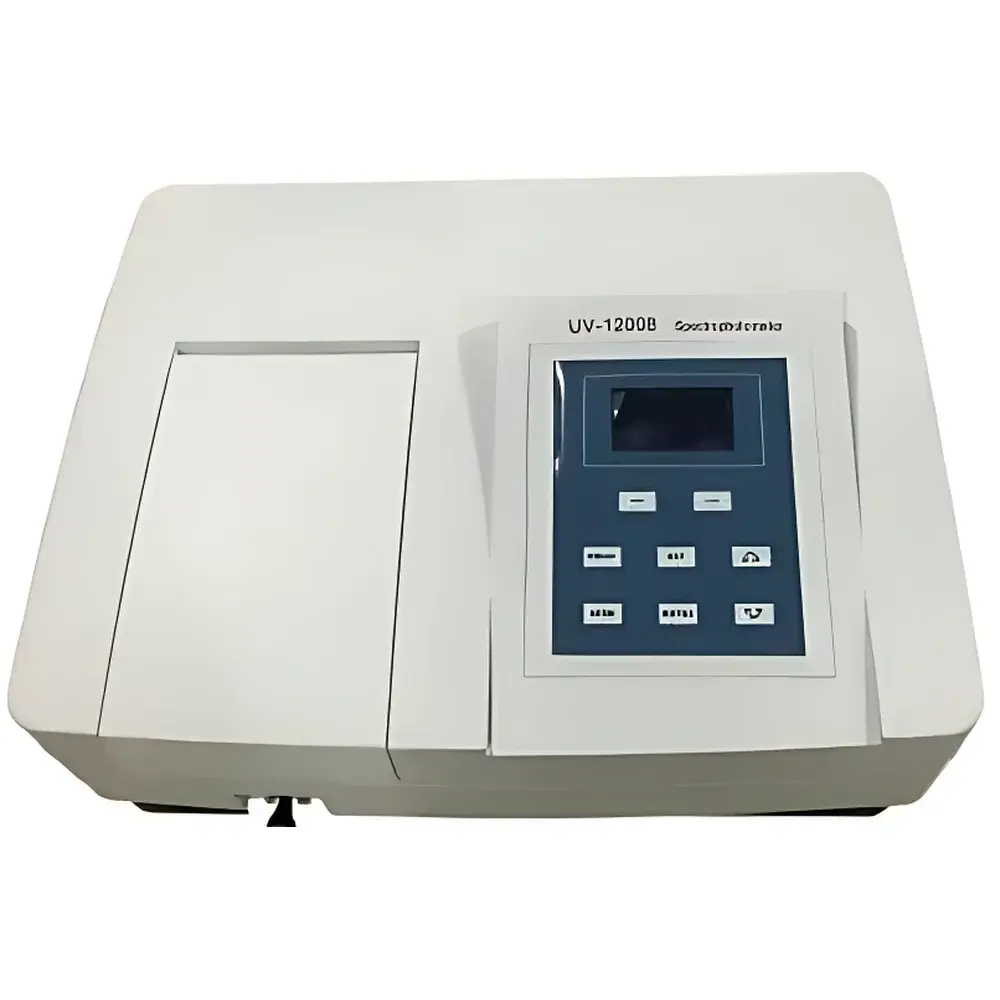
MAPADA UV-1200B Single-Beam Ultraviolet-Visible Spectrophotometer
| Brand | MAPADA |
|---|---|
| Origin | Shanghai, China |
| Model | UV-1200B |
| Optical System | Single-beam |
| Detector | Silicon photodiode (imported) |
| Wavelength Range | 200–1000 nm |
| Spectral Bandwidth | 4 nm |
| Wavelength Accuracy | ±1 nm |
| Wavelength Repeatability | 0.5 nm |
| Stray Light | ≤0.2% T @ 360 nm |
| Photometric Accuracy | ±0.5% T |
| Photometric Repeatability | 0.3% T |
| Baseline Stability | ±0.002 A/h @ 500 nm |
| Absorbance Range | –0.3 to 3.0 A |
| Transmittance Range | 0–200% T |
| Display | 128 × 64 dot-matrix LCD |
| Data Interface | USB port |
| Lamp Type | Plug-in deuterium and tungsten lamps |
| Sample Compartment | Accommodates cuvettes from 5 to 100 mm pathlength |
| Dimensions | 490 × 360 × 210 mm |
| Weight | 12 kg |
Overview
The MAPADA UV-1200B is a single-beam ultraviolet-visible (UV-Vis) spectrophotometer engineered for routine quantitative and qualitative analysis in academic laboratories, quality control environments, and industrial R&D settings. It operates on the principle of Beer–Lambert law-based absorption spectroscopy, measuring the attenuation of monochromatic light as it passes through a sample solution across the spectral range of 200–1000 nm. Its optical architecture integrates a high-efficiency 1200 lines/mm holographic grating and an imported silicon photodiode detector, delivering stable baseline performance and reliable photometric response. Designed for operational simplicity without compromising analytical integrity, the UV-1200B supports absorbance (A), transmittance (%T), and concentration modes—enabling direct calibration curve generation and sample quantification. The instrument meets foundational requirements for method validation under ISO/IEC 17025 and aligns with general compliance expectations for UV-Vis instrumentation referenced in USP , ASTM E275, and ISO 6059.
Key Features
- Single-beam optical design with automatic wavelength scanning and lamp switching—deuterium lamp for UV region (200–350 nm) and tungsten-halogen lamp for visible/NIR region (350–1000 nm)
- Plug-in lamp module architecture eliminates optical realignment during lamp replacement, reducing maintenance downtime and preserving long-term wavelength fidelity
- 128 × 64 dot-matrix LCD display enables on-board visualization of calibration curves, regression equations (including correlation coefficient R²), and up to 200 stored measurement records
- Internal memory retains up to 100 user-defined standard curves for rapid recall—critical for batch testing and multi-analyte workflows
- USB interface supports bidirectional data exchange with external PCs; compatible with MAPADA’s suite of spectral acquisition and reporting software for GLP-compliant data handling
- Wide sample compartment accommodates standard rectangular cuvettes with optical path lengths from 5 mm to 100 mm—including micro-volume and flow-cell configurations
- Thermal and mechanical stability optimized via rigid chassis construction and low-drift power regulation, achieving baseline drift of ≤±0.002 A/h at 500 nm
Sample Compatibility & Compliance
The UV-1200B accepts standard quartz, glass, or plastic cuvettes (10 mm nominal pathlength recommended for routine use) and supports liquid, solution-phase samples in transparent, low-turbidity matrices. It is suitable for applications involving pharmaceutical excipients, dye concentrations, enzyme kinetics (via fixed-time or kinetic mode using external timers), water quality parameters (e.g., nitrate, phosphate), and polymer absorbance profiling. While not certified for regulated GMP production environments, its photometric accuracy (±0.5% T), stray light performance (≤0.2% T @ 360 nm), and wavelength repeatability (0.5 nm) satisfy method suitability criteria outlined in ISO 10933 and ASTM E380 for non-critical analytical tasks. Instrument firmware supports manual and automated wavelength verification protocols required for internal QC audits.
Software & Data Management
Data export is facilitated via native USB connectivity, enabling seamless transfer of spectra, calibration tables, and measurement logs to Windows-based workstations. Optional MAPADA application software provides extended functionality including multi-point calibration, derivative spectroscopy, peak search, and time-scan kinetics. Audit-trail capabilities include timestamped operator ID entry (when integrated with domain-authenticated PCs), version-controlled method files, and exportable CSV/Excel reports compliant with basic 21 CFR Part 11 documentation expectations—though full electronic signature implementation requires third-party LIMS integration. All onboard data—including 200 test results and 100 curves—is retained during power cycling and remains accessible without host PC dependency.
Applications
- Quantitative determination of active pharmaceutical ingredients (APIs) in dissolution media per USP
- Verification of nucleic acid purity (A260/A280 ratio) in molecular biology labs
- Colorimetric assays such as Bradford, Lowry, and BCA protein quantification
- Monitoring of chemical reaction progress via time-resolved absorbance changes
- Quality assessment of dyestuffs, pigments, and optical filters in manufacturing QA
- Environmental analysis of trace metal complexes (e.g., Fe-phenanthroline) and organic pollutants (e.g., benzophenone derivatives)
- Educational instruction in analytical chemistry curricula—supporting hands-on experiments in spectroscopic theory and calibration practice
FAQ
What is the minimum detectable absorbance for the UV-1200B?
The instrument achieves reliable measurements down to –0.3 A (i.e., negative absorbance values are supported for background correction), with optimal linearity maintained between 0.01 A and 2.0 A.
Can the UV-1200B perform kinetic measurements?
It does not feature built-in kinetic scan capability; however, sequential single-wavelength readings can be manually triggered or externally timed to approximate pseudo-kinetic profiles.
Is the wavelength scale factory-calibrated and field-verifiable?
Yes—automatic wavelength calibration uses internal reference peaks; users may validate accuracy using NIST-traceable holmium oxide or didymium filters.
Does the UV-1200B support RS-232 or Ethernet connectivity?
No—only USB 2.0 interface is provided; no legacy serial or network ports are included.
What cuvette materials are recommended for UV-range measurements?
Quartz cuvettes are required for measurements below 340 nm; fused silica or high-transmission UV-grade quartz is advised for extended UV durability.





