
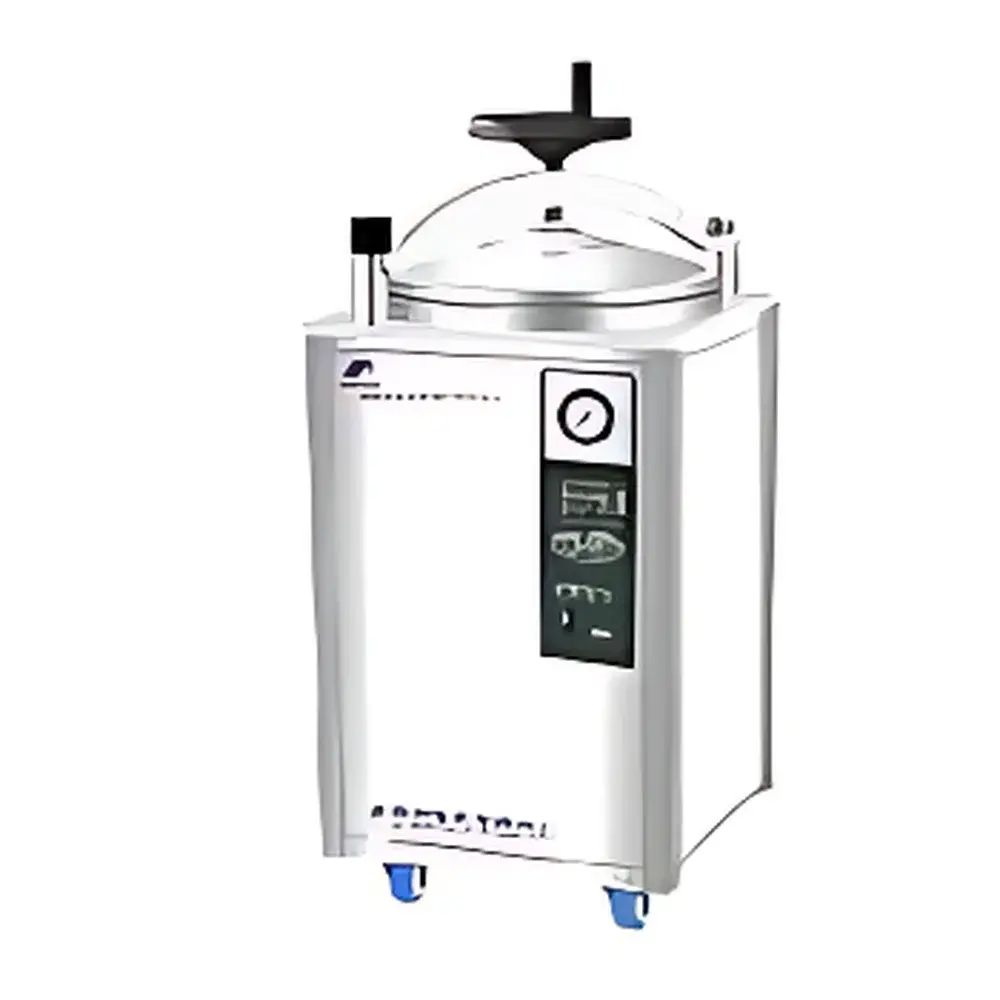
Shen’an LDZH-200L Vertical High-Pressure Steam Sterilizer
| Brand | Shen'an / She Medical Devices |
|---|---|
| Origin | Shanghai, China |
| Model | LDZH-200L |
| Chamber Volume | 200 L |
| Maximum Temperature | 134 °C |
| Maximum Working Pressure | 0.217 MPa |
| Chamber Dimensions | Φ500 × 1000 mm |
| External Dimensions | 630 × 700 × 1600 mm |
| Construction Material | Full Stainless Steel (3.0 mm wall thickness) |
| Power Supply | 380 V / 6 kW |
| Net Weight | 238 kg |
| Control Type | Microprocessor-based Automatic Cycle Control |
| Safety Features | Interlocked Door Mechanism, Low-Water Protection, Self-Inflating Seal, Dual-Scale Class II Pressure Gauge |
| Sterilization Temperature Range | 50–134 °C |
| Time Setting Range | 0–99 hours |
| Exhaust Modes | Full Exhaust, Micro-Exhaust, No Exhaust |
| Alarm | Audible End-of-Cycle Alert |
| Display | LED Digital Status Interface |
Overview
The Shen’an LDZH-200L is a vertically oriented, microprocessor-controlled high-pressure steam sterilizer engineered for reliable, repeatable terminal sterilization of heat-stable laboratory and healthcare materials. Operating on the validated principle of saturated steam under pressure—where elevated temperature and pressure synergistically denature microbial proteins and nucleic acids—the LDZH-200L achieves sterility assurance levels (SAL) of 10⁻⁶ in accordance with ISO 17665-1:2017 and EN 285:2015 standards for steam sterilization processes. With a 200-liter stainless-steel chamber (Φ500 × 1000 mm), it accommodates large instrument trays, glassware batches, media bottles, and porous loads commonly encountered in central sterile supply departments (CSSD), research laboratories, and academic institutions. Its rated working pressure of 0.217 MPa corresponds to a saturation temperature of 134 °C—enabling accelerated sterilization cycles for wrapped instruments and porous loads per WHO and CDC-recommended protocols.
Key Features
- Robust vertical architecture with full 304 stainless-steel construction (3.0 mm chamber wall thickness) ensuring long-term corrosion resistance and structural integrity under repeated thermal cycling.
- Interlocked handwheel door mechanism with self-inflating silicone gasket, providing positive pressure sealing and preventing accidental opening during pressurized operation—compliant with ASME BPVC Section VIII requirements for pressure vessel safety.
- Microprocessor-based control system with LED digital display for real-time monitoring of temperature, pressure, time, and cycle phase; supports programmable sterilization sequences with user-defined setpoints.
- Triple-stage exhaust system: configurable full, micro, or no-exhaust modes to optimize drying performance and prevent liquid boil-over in media flasks or sensitive porous loads.
- Dual-scale Class II pressure gauge (MPa and psi) with redundant mechanical verification—meeting EN 13060:2014 accuracy requirements for small steam sterilizers.
- Integrated low-water cutoff protection and audible end-of-cycle alarm to prevent dry-heating damage and support operator awareness in multi-unit environments.
- Compliance-ready design features including cycle log retention, parameter traceability, and non-volatile memory for up to 99 user-defined programs—facilitating GLP/GMP documentation workflows.
Sample Compatibility & Compliance
The LDZH-200L is validated for sterilizing a broad spectrum of load types: unwrapped and wrapped surgical instruments, textile packs, rubber tubing, culture media (liquid and agar), glassware, and polymer-based labware compatible with moist heat exposure. It meets essential regulatory benchmarks including ISO 17665-1 (sterilization process development), EN 285 (large steam sterilizers), and EN 13060 (small steam sterilizers). While not FDA 510(k)-cleared as a medical device in the U.S., its design aligns with AAMI ST79:2017 guidance for healthcare sterilization and supports validation activities required under FDA 21 CFR Part 820 and EU MDR Annex I GSPRs. All pressure components are certified to PED 2014/68/EU and CE-marked for use within the European Economic Area.
Software & Data Management
The LDZH-200L operates via embedded firmware without external PC dependency. Cycle parameters—including temperature profile, pressure curve, dwell time, and exhaust sequence—are stored in non-volatile memory with timestamped execution logs. Optional RS232 or USB data export (via accessory interface module) enables transfer of cycle reports to LIMS or electronic quality records systems. Audit trail functionality supports revision-controlled recordkeeping for ISO 9001, ISO 13485, and GLP-compliant environments. Firmware updates are performed locally using secure boot protocol to maintain configuration integrity and cybersecurity baseline alignment per IEC 62443-4-2.
Applications
- Terminal sterilization of reusable surgical kits and dental handpieces in outpatient clinics and hospital CSSDs.
- Bulk preparation and sterilization of microbiological growth media in academic and industrial R&D labs.
- Decontamination of biohazardous waste containers and contaminated PPE prior to disposal.
- Validation of autoclave performance using biological indicators (e.g., Geobacillus stearothermophilus spore strips) per ISO 11138-3.
- Process qualification of steam penetration into complex lumens and porous packaging configurations per AAMI TIR30.
- Supporting ISO 11140-1-compliant chemical indicator testing for routine sterilizer monitoring.
FAQ
What is the maximum allowable operating temperature and corresponding pressure?
The LDZH-200L is rated for a maximum operating temperature of 134 °C at 0.217 MPa (2.2 bar gauge), consistent with Class B vacuum-assisted sterilization cycles.
Does the unit include validation support documentation?
Yes—factory-supplied IQ/OQ documentation templates, calibration certificates for pressure and temperature sensors, and DQ rationale are provided upon request to support installation and operational qualification.
Can the sterilizer be integrated into a facility’s building management system (BMS)?
While native BACnet or Modbus integration is not standard, analog 4–20 mA outputs for temperature and pressure signals are available as an optional retrofit for third-party SCADA interfacing.
Is the chamber volume nominal or effective?
The 200 L specification refers to the geometric internal chamber volume; effective load capacity depends on basket configuration and load density—typically 60–75% of nominal volume for optimal steam circulation per EN 285 Annex C.
What maintenance intervals are recommended for long-term reliability?
Daily: visual inspection of door seal and drain strainer. Quarterly: verification of pressure sensor linearity and safety valve function. Annually: full recalibration by accredited service provider and replacement of gasket assembly per manufacturer’s service bulletin.



