
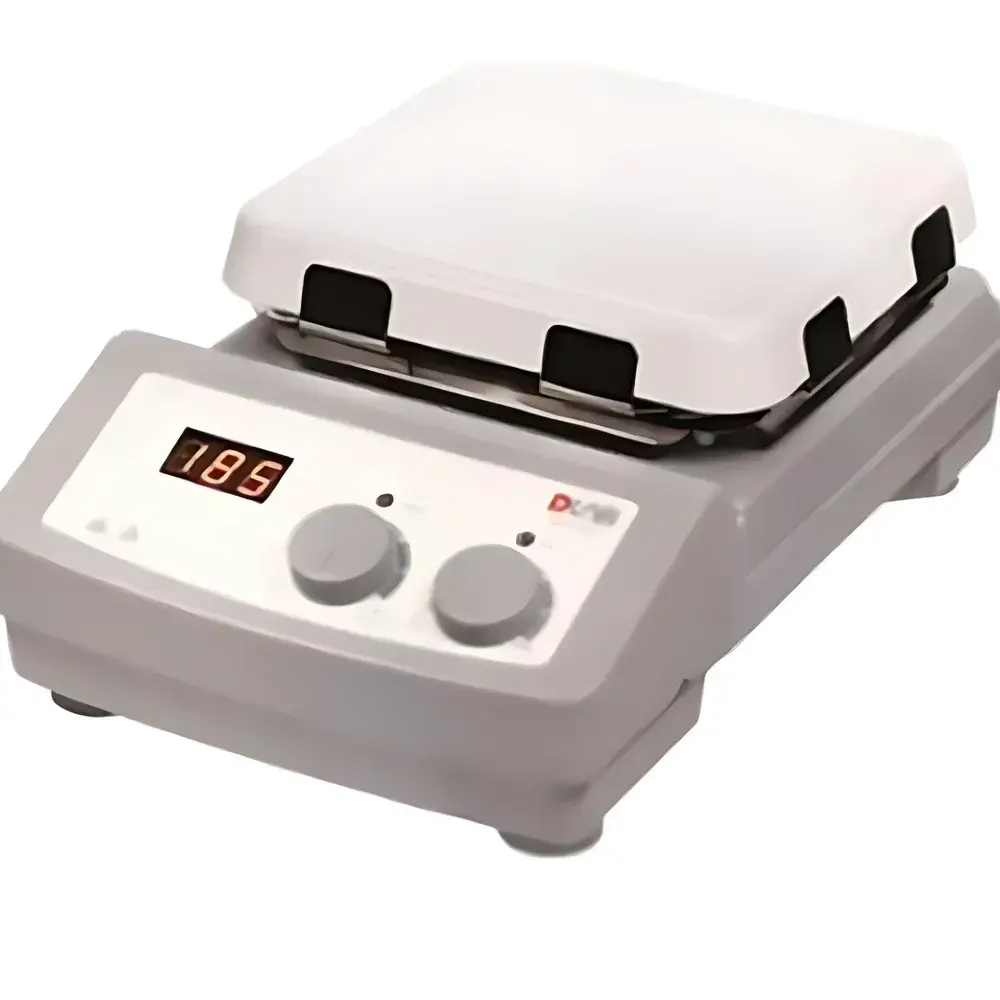
DLAB MS7-H550-S 7-Inch Glass-Ceramic Digital Hotplate Magnetic Stirrer
| Brand | DLAB |
|---|---|
| Origin | Shanghai, China |
| Model | MS7-H550-S |
| Maximum Stirring Volume | 10 L (H₂O) |
| Speed Range | 0–1500 rpm |
| Heating Temperature Range | Ambient to 550 °C |
| External Temperature Sensor | PT1000 (±0.5 °C control accuracy) |
| Workplate Dimensions | 184 × 184 mm (7-inch square) |
| Heating Power | 1000 W |
| Motor Type | Shielded Pole AC Motor |
| Safety Certification | CE, cTUVus, FCC |
| IP Rating | IP21 |
| Over-Temperature Cutoff | 580 °C |
| Residual Heat Warning Threshold | >50 °C |
| Display | Dual LED (setpoint & actual temperature), speed and temperature resolution: ±1 °C / 1 rpm |
Overview
The DLAB MS7-H550-S is a high-performance digital hotplate magnetic stirrer engineered for precision thermal and mechanical control in demanding laboratory environments. It operates on the principle of magnetic coupling—rotating a PTFE- or glass-coated stir bar within a vessel via a rotating magnetic field generated beneath a non-magnetic, thermally stable glass-ceramic work surface. Simultaneously, resistive heating elements embedded beneath the plate deliver uniform, controllable thermal energy up to 550 °C. This dual-function architecture supports applications requiring both vigorous mixing and precise, sustained heating—particularly where solvent reflux, catalytic reactions, or temperature-dependent solubilization protocols are employed. Designed for continuous operation under load, the unit integrates PID-based temperature regulation with real-time feedback from either internal plate sensors or an externally connected PT1000 probe, enabling accurate sample-level thermal management rather than surrogate plate-surface estimation.
Key Features
- 7-inch (184 × 184 mm) black glass-ceramic work surface: chemically inert, scratch-resistant, and thermally stable up to 550 °C; non-porous structure prevents reagent absorption and simplifies decontamination.
- Dual-mode temperature control: internal sensor for plate-setpoint operation or optional external PT1000 probe (included as accessory) for direct sample temperature monitoring and closed-loop regulation (±0.5 °C accuracy).
- Robust safety architecture: independent over-temperature cutoff at 580 °C; residual heat warning indicator activates when surface temperature exceeds 50 °C post-shutdown—even with power connected—preventing accidental contact burns.
- IP21-rated enclosed housing: protects internal electronics from incidental liquid splashes and particulate ingress per DIN EN 60529; sealed motor compartment eliminates spark generation (intrinsically safe design).
- High-torque, maintenance-free shielded-pole AC motor: delivers consistent rotational force across full 0–1500 rpm range with minimal electromagnetic interference; optimized for stirring volumes up to 10 L of aqueous media.
- Intuitive dual LED display: simultaneously shows set temperature, actual measured temperature (plate or probe), and current rotation speed; resolution of ±1 °C and 1 rpm ensures granular operational visibility.
Sample Compatibility & Compliance
The MS7-H550-S accommodates standard laboratory vessels—including borosilicate glass beakers (50 mL to 5 L), stainless steel reaction flasks, and ceramic crucibles—provided compatible stir bars (max. 80 × 10 mm) are used. Its chemical resistance enables use with aggressive solvents (e.g., concentrated HNO₃, acetone, DMF) and alkaline solutions without surface degradation. The device complies with multiple international safety standards: CE marking per EU Machinery Directive 2006/42/EC and Low Voltage Directive 2014/35/EU; cTUVus certification confirming conformity with UL 61010-1 and CSA C22.2 No. 61010-1 for North American markets; FCC Class B emissions compliance. While not inherently GLP/GMP-certified, its traceable temperature control, alarm logging capability (via visual indicators), and stable performance support audit-ready workflows in regulated environments when paired with documented calibration procedures.
Software & Data Management
The MS7-H550-S operates as a standalone instrument with no embedded firmware-based data logging or PC connectivity. All operational parameters—including setpoints, real-time temperature readings, and rotational speed—are displayed locally via the integrated LED interface. For laboratories requiring electronic recordkeeping, integration is achieved externally: the PT1000 output signal (2-wire, 1000 Ω nominal at 0 °C) is compatible with third-party data acquisition systems (e.g., LabVIEW, MATLAB, or PLC-based SCADA platforms) using standard analog input modules. Users may implement custom logging protocols that satisfy FDA 21 CFR Part 11 requirements—including user authentication, audit trails, and electronic signatures—when deployed within validated infrastructure. Calibration certificates for the PT1000 probe (traceable to NIST or equivalent national metrology institutes) are available upon request.
Applications
This stirrer serves core functions across synthetic chemistry (e.g., Grignard reactions, esterifications, polymerizations), analytical sample preparation (digestion, extraction, homogenization prior to ICP-MS or HPLC analysis), materials science (nanoparticle dispersion in high-boiling-point solvents such as ethylene glycol or silicone oil), and pharmaceutical R&D (API crystallization studies, dissolution testing under elevated temperature). Its 550 °C upper limit supports applications involving high-melting-point salts (e.g., LiCl/KCl eutectics), molten polymer processing aids, and thermal stability assessments of catalysts. The flat, uniform heating zone minimizes thermal gradients during long-duration experiments, improving reproducibility in kinetic studies and aging protocols.
FAQ
What is the maximum recommended vessel size for optimal stirring performance?
For consistent vortex formation and thermal uniformity, use round-bottom or flat-bottom containers with diameters ≤176 mm (within the defined heating zone); larger vessels may experience reduced edge-zone mixing efficiency.
Can the MS7-H550-S be used under inert atmosphere conditions?
Yes—provided the vessel is appropriately sealed (e.g., with septum caps or Schlenk line adapters) and stir bar selection accounts for reduced magnetic coupling distance; verify compatibility of gasket materials with operating temperatures.
Is the PT1000 sensor included with the unit?
The PT1000 probe is an optional accessory; the base configuration includes only internal plate-sensing capability. A calibrated PT1000 with 1.5 m cable and mini-DIN connector is available separately (Part No. PT1000-MS7).
Does the unit support programmable ramp-soak temperature profiles?
No—this model features manual setpoint adjustment only; multi-step thermal protocols require external controller integration via the PT1000 analog output.
What maintenance is required for long-term reliability?
Routine cleaning of the glass-ceramic surface with non-abrasive ethanol or isopropanol; inspection of stir bar integrity before each use; periodic verification of temperature accuracy using a calibrated reference thermometer (e.g., ASTM E74-compliant thermistor probe).



