
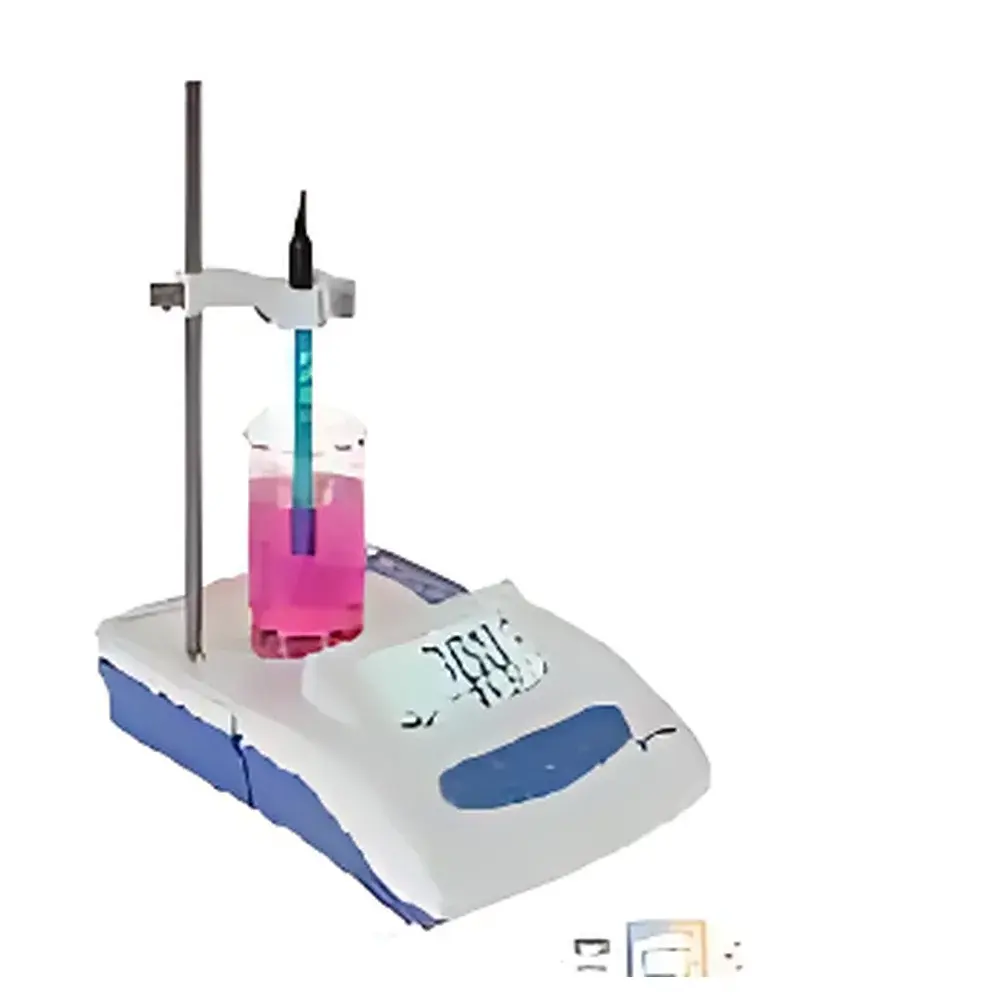
Leici PHS-3G Benchtop pH Meter
| Brand | Leici |
|---|---|
| Origin | Shanghai, China |
| Instrument Type | Benchtop |
| Parameter Type | Single-parameter (pH/mV) |
| Measurement Range | -2.00 to 19.99 pH |
| Resolution | 0.01 pH |
| Accuracy | ±0.01 pH |
| Temperature Compensation | Manual (0.0–60.0 °C) |
| Input Impedance | ≥1 × 10¹² Ω |
| Stability | ±0.01 pH ±1 digit / 3 h |
| Display | Segment LCD |
| Buffer Recognition | Auto-identification of 3 standard pH buffers (China-specific) |
| Calibration | 1–2 point calibration |
| Built-in Magnetic Stirrer | Yes |
| Power Supply | AC 220 V ±10 %, 50 Hz |
| Dimensions (W × D × H) | 210 × 320 × 90 mm |
| Weight | 2.0 kg |
Overview
The Leici PHS-3G is a benchtop electrochemical instrument engineered for precise, reliable pH and millivolt (mV) measurements in routine laboratory environments. Based on potentiometric measurement principles, the PHS-3G detects the electromotive force (EMF) generated across a pH-sensitive glass electrode and a reference electrode—typically an Ag/AgCl system—relative to a known buffer solution. This voltage difference, governed by the Nernst equation, is converted into a pH value with high linearity and repeatability. Designed to meet Class 0.01 accuracy requirements per Chinese national metrological standards (JJG 119–2018), the instrument supports extended-range pH measurement from –2.00 to +19.99, enabling applications beyond conventional aqueous solutions—including strongly alkaline industrial effluents, concentrated electrolyte systems, and certain non-aqueous media when paired with compatible electrodes. Its integrated magnetic stirrer ensures homogeneous sample mixing during measurement, minimizing diffusion layer effects and enhancing response time and reproducibility.
Key Features
- High-accuracy potentiometric measurement platform compliant with Class 0.01 specification (±0.01 pH ±1 digit)
- Segment-type LCD display with clear numeric readout and polarity indication for mV mode
- Automatic recognition of three standard Chinese pH buffer solutions (pH 4.01, 6.86, and 9.18 at 25 °C), reducing calibration errors and operator dependency
- Flexible 1-point or 2-point calibration protocol with manual slope adjustment capability
- Manual temperature compensation (0.0–60.0 °C) using integrated thermistor input, supporting correction per the Nernstian temperature coefficient (–0.198 mV/°C per pH unit)
- Built-in magnetic stirrer with variable speed control—eliminates need for external stirring apparatus and improves measurement consistency in viscous or heterogeneous samples
- Input impedance ≥1 × 10¹² Ω ensures minimal loading error with high-resistance pH electrodes, critical for stable readings in low-conductivity samples
- Robust industrial-grade housing (210 × 320 × 90 mm; 2.0 kg) optimized for long-term benchtop deployment in QC, teaching, and R&D labs
Sample Compatibility & Compliance
The PHS-3G is validated for use with standard double-junction or gel-filled composite pH electrodes (e.g., Leici E-201-C series). It accommodates aqueous, mildly organic, and buffered solutions typical in pharmaceutical QA, environmental testing, food processing, and academic instruction. While not certified to ISO/IEC 17025 or GLP out-of-the-box, its documented stability (±0.01 pH ±1 digit over 3 hours), traceable calibration routines, and defined operating parameters support internal method validation under GMP-aligned quality systems. The instrument complies with GB/T 11165–2005 (Chinese national standard for laboratory pH meters) and meets electromagnetic compatibility (EMC) requirements per GB/T 18268.1–2010. Note: For regulated environments requiring audit trails or electronic signatures, external data logging via RS-232 (not built-in on PHS-3G) or manual recording is required.
Software & Data Management
The PHS-3G operates as a standalone analog-digital hybrid instrument with no embedded microprocessor-based data storage or USB connectivity. All measurements are displayed in real time and must be manually recorded or transcribed. No proprietary software, drivers, or cloud integration is provided. However, its analog output stage and stable DC signal path allow compatibility with third-party analog-to-digital converters or chart recorders for basic trending applications. For laboratories requiring electronic records compliant with FDA 21 CFR Part 11, integration with validated LIMS or ELN platforms necessitates external hardware interfaces and procedural controls—not inherent to this model.
Applications
- Quality control of raw materials and finished products in chemical manufacturing (e.g., caustic soda, sodium silicate, phosphate buffers)
- Academic teaching labs for fundamental electrochemistry experiments and calibration methodology training
- Environmental monitoring of wastewater alkalinity and industrial discharge compliance (e.g., pH >14.0 reporting per EPA Method 150.1 adaptations)
- Food and beverage production—monitoring fermentation endpoints, cleaning-in-place (CIP) rinse efficacy, and brine formulation
- Routine calibration verification of field-portable pH meters using traceable lab reference standards
- Research involving non-standard pH regimes where extended range (>14.00) or sub-zero pH values are relevant (e.g., acid mine drainage, molten salt systems)
FAQ
Does the PHS-3G support automatic temperature compensation (ATC)?
No—the PHS-3G provides manual temperature compensation only, requiring the user to enter the measured sample temperature before reading. ATC requires a dedicated temperature probe input circuit, which is absent in this model.
Can the PHS-3G measure pH in non-aqueous solvents like ethanol or acetone?
It can provide a relative EMF reading, but pH values lack thermodynamic meaning outside aqueous systems. Users must apply solvent-specific calibration and interpret results with caution; electrode hydration and junction potential shifts significantly affect accuracy.
Is the built-in stirrer controllable independently of measurement mode?
Yes—the stirrer operates continuously once activated via front-panel switch, regardless of whether the instrument is in pH, mV, or standby mode.
What is the recommended recalibration frequency for routine use?
Per JJG 119–2018 guidelines, recalibration is advised before each analytical session or after every 2–4 hours of continuous operation, especially when measuring samples with large pH gradients or high ionic strength.
Does the PHS-3G comply with ASTM E70 or ISO 3696 for water purity testing?
No—it lacks the ultra-low drift specification (<0.002 pH/h), high-input-impedance validation, and specialized low-conductivity cell design required for ultrapure water analysis per those standards. For such applications, higher-tier models (e.g., PHSJ-4A) are recommended.
Related Products





