
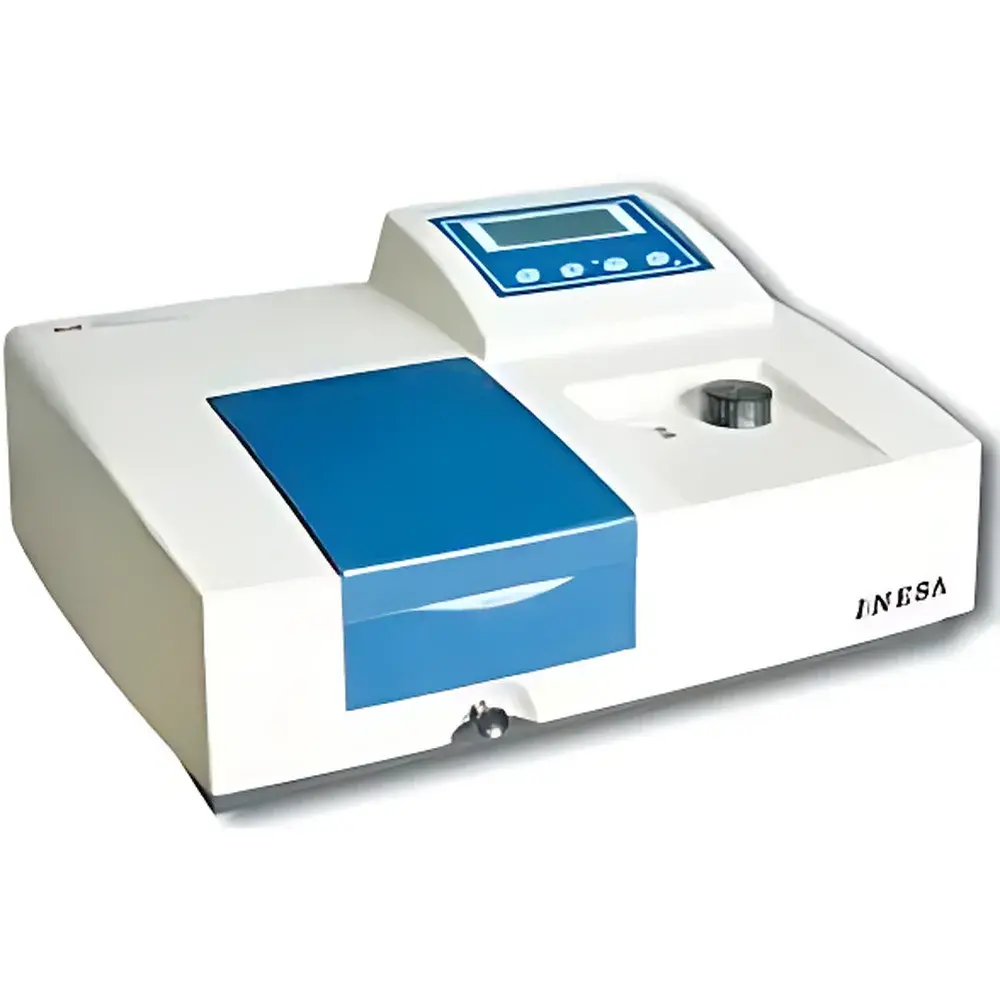
Shanghai INESA UV-Vis Spectrophotometer Model 752N
| Brand | INESA |
|---|---|
| Origin | Shanghai, China |
| Model | 752N |
| Optical System | Single-beam |
| Detector | Photodiode Array |
| Wavelength Range | 200–1000 nm |
| Wavelength Accuracy | ±2 nm |
| Wavelength Repeatability | ≤1 nm |
| Spectral Bandwidth | 4 nm |
| Stray Light | ≤0.1% T (at 220 nm, measured with NaI |
| Photometric Accuracy | ±0.5% T |
| Photometric Repeatability | ≤0.2% T |
| Noise | 0.3% T |
| Wavelength Setting | Manual via precision dial |
| Light Source Switching Point | 340 nm |
| Focal Length | 160 mm |
| Grating | Holographic blazed grating, 1200 lines/mm |
| Display | 7-inch color touchscreen interface |
| Data Storage | Internal memory for up to 30 calibration curves |
| Measurement Modes | Transmittance (%T), Absorbance (A), Concentration (C) with linear regression and coefficient-based calculation |
| Auto-zero & Auto-100%T functions | Yes |
Overview
The Shanghai INESA UV-Vis Spectrophotometer Model 752N is a manually operated, single-beam optical instrument engineered for routine quantitative and qualitative analysis in educational laboratories, quality control environments, and small-scale research settings. It operates on the fundamental principle of Beer–Lambert law-based absorption spectroscopy, measuring the attenuation of ultraviolet and visible light as it passes through a sample solution. The instrument employs a holographic blazed grating monochromator (1200 lines/mm, 160 mm focal length) to isolate discrete wavelengths across a broad spectral range of 200–1000 nm. Its fixed 4 nm spectral bandwidth ensures adequate resolution for standard applications such as concentration determination, kinetic assays, and basic spectral scanning—without the complexity or cost associated with double-beam or diode-array scanning architectures.
Key Features
- Holographic blazed grating monochromator delivering high wavelength accuracy (±2 nm) and excellent spectral purity, supported by low stray light performance (≤0.1% T at 220 nm and 360 nm).
- 7-inch full-color capacitive touchscreen interface enabling intuitive navigation, method selection, and real-time display of %T, Abs, and concentration values.
- Integrated microprocessor-controlled photometric system with automatic zero-adjustment (%0 T) and reference calibration (%100 T), minimizing operator-induced drift and improving measurement consistency.
- Dual-concentration calculation modes: linear regression fitting for multi-point calibration standards and coefficient-based direct reading for single-standard workflows.
- Onboard memory stores up to 30 independent calibration curves, each retaining slope, intercept, correlation coefficient (r²), and date/time stamp—supporting traceable recordkeeping in GLP-aligned environments.
- USB port for data export to external storage devices; compatible with standard spreadsheet formats for downstream statistical analysis and reporting.
Sample Compatibility & Compliance
The 752N accommodates standard 10 mm pathlength cuvettes (glass, quartz, or plastic), supporting liquid-phase measurements of aqueous, organic, and buffered solutions. Its wavelength coverage enables detection of common chromophores including nucleic acids (260 nm), proteins (280 nm), nitrate (220 nm), and transition metal complexes (400–800 nm). While not designed for regulated pharmaceutical QC under strict 21 CFR Part 11 requirements, its photometric repeatability (≤0.002 Abs in 0–0.5 A range) and documented calibration stability align with ISO/IEC 17025 competency criteria for non-accredited testing labs. Routine verification using NIST-traceable neutral density filters or potassium dichromate solutions (per ASTM E275 and USP ) is recommended for ongoing performance validation.
Software & Data Management
No proprietary PC software is required—the 752N performs all core operations autonomously via its embedded firmware. All calibration parameters, measurement logs, and curve metadata are retained internally with timestamped entries. Exported datasets include columnar %T/A/C values, wavelength points, and user-defined sample IDs. For integration into LIMS or enterprise QA systems, exported CSV files may be parsed programmatically or imported into validated third-party analysis platforms (e.g., OriginLab, JMP, or Python-based analytical pipelines). Audit trail functionality is limited to manual logbook entries; however, the device supports user-defined naming conventions for stored curves to facilitate procedural accountability.
Applications
- Educational instruction in analytical chemistry: demonstration of Beer’s law, spectral identification, and dilution series analysis.
- Water and wastewater testing: quantification of nitrate, phosphate, iron, and chlorine residual using standardized colorimetric methods (e.g., APHA 4500-NO₃⁻, 4500-P E).
- Food and beverage QA: determination of preservative concentrations (e.g., sulfites), colorant levels, and antioxidant capacity (via FRAP or DPPH assays).
- Pharmaceutical raw material screening: identity confirmation and assay of active ingredients with known extinction coefficients (e.g., paracetamol at 243 nm).
- Environmental field lab support: portable use with external power supply for on-site screening where benchtop instrumentation is impractical.
FAQ
Is the 752N compliant with ISO 9001 or GLP documentation requirements?
The instrument supports essential GLP practices—including calibration logging, sample ID assignment, and curve versioning—but lacks electronic signature capability or automated audit trails required for full 21 CFR Part 11 compliance.
Can quartz cuvettes be used below 220 nm?
Yes—standard fused silica cuvettes enable reliable transmission down to 190 nm; however, the 752N’s specified lower limit remains 200 nm due to lamp output constraints and detector sensitivity roll-off.
What maintenance is required for long-term wavelength accuracy?
Annual verification using holmium oxide or didymium glass filters (per ASTM E387) is recommended; optical alignment is factory-set and not user-serviceable.
Does the 752N support kinetic or time-scan measurements?
No—it is a fixed-wavelength or manually stepped instrument; continuous spectral scanning or time-resolved acquisition requires a dedicated scanning spectrophotometer.
How is photometric accuracy verified during routine operation?
Using certified reference materials such as potassium dichromate in 0.005 M H₂SO₄ (absorbance values traceable to NIST SRM 935a) at 235, 257, 313, and 350 nm.




