
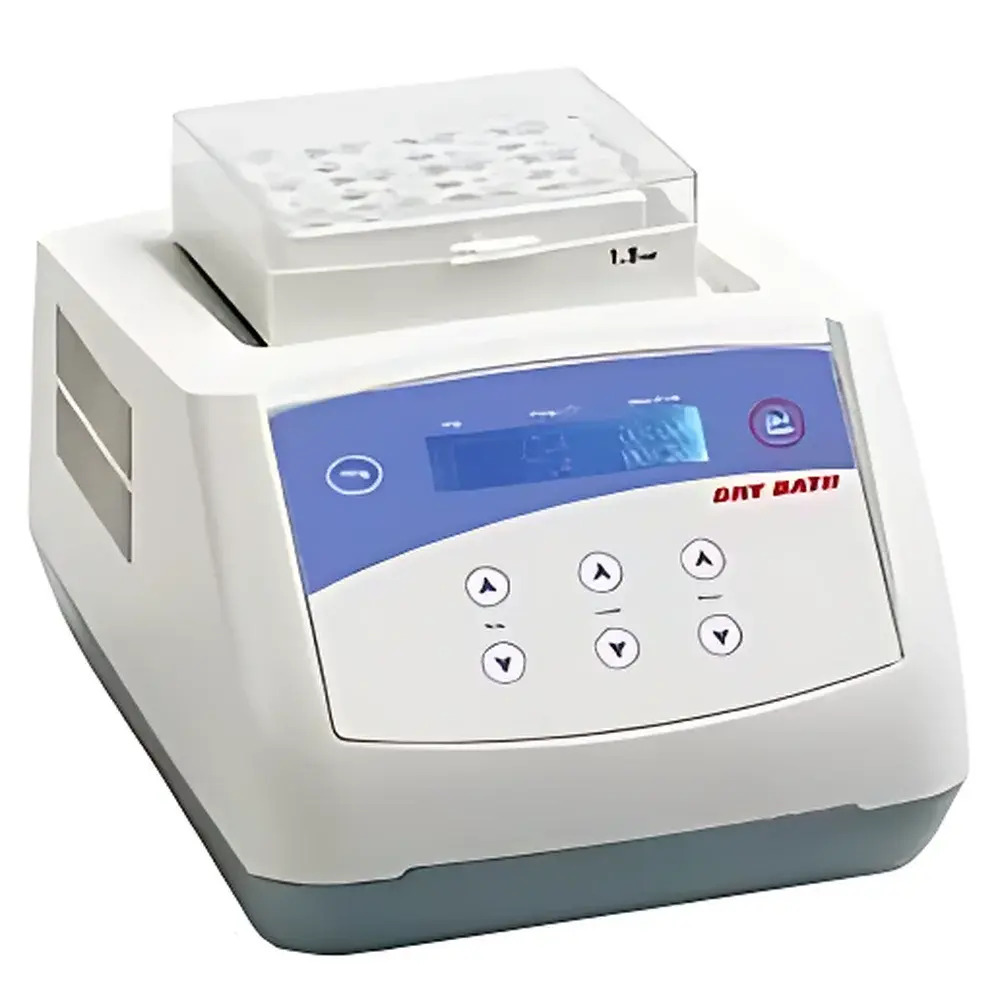
Yiheng TU-100C Semiconductor-Cooled Metal Block Thermostat
| Brand | Yiheng |
|---|---|
| Origin | Shanghai, China |
| Model | TU-100C (Semiconductor-Cooled) |
| Temperature Range | −10 °C to 100 °C |
| Temperature Accuracy | ±0.5 °C |
| Display Resolution | 0.1 °C |
| Temperature Uniformity (within block) | ≤±0.5 °C |
| Heating Time | ≤25 min (20 °C → 100 °C) |
| Cooling Time | ≤25 min (20 °C → 0 °C) |
| Power Consumption | 200 W |
| Timer Range | 0–99 h 59 min |
| Module Type | Interchangeable E-series aluminum block |
Overview
The Yiheng TU-100C Semiconductor-Cooled Metal Block Thermostat is a precision-engineered thermal management instrument designed for consistent, contamination-free sample conditioning in molecular biology, clinical diagnostics, and analytical laboratories. Unlike conventional water baths—prone to evaporation, microbial growth, and cross-contamination—the TU-100C employs solid-state Peltier cooling and resistive heating elements embedded directly into a high-thermal-conductivity aluminum block. This architecture enables bidirectional temperature control across a wide operational range (−10 °C to 100 °C), with real-time microprocessor regulation ensuring stable setpoint maintenance under variable ambient loads. Its closed-loop thermal design eliminates fluid handling, reducing maintenance overhead and supporting GLP-compliant workflows where traceability and environmental control are critical.
Key Features
- Microprocessor-based PID temperature controller with dual-display interface: simultaneous readout of current block temperature (0.1 °C resolution) and countdown timer (up to 99 h 59 min).
- Interchangeable E-series aluminum heating/cooling modules—designed for rapid thermal equilibration and compatible with standard tube formats (e.g., 0.2 mL, 0.5 mL, 1.5 mL, 2.0 mL PCR tubes, microcentrifuge tubes, and 0.2 mL strip tubes).
- Semiconductor (Peltier) cooling technology integrated with resistive heating—enabling both active cooling and precise heating without refrigerants or compressors.
- Integrated safety systems: over-temperature cutoff, self-diagnostic fault detection, audible alarm upon cycle completion or error condition, and automatic pause/resume capability.
- Optically transparent polycarbonate lid minimizes convective heat loss while allowing visual monitoring of samples—critical for time-sensitive protocols such as enzyme activation or denaturation steps.
- Passive convection cooling via internal fan-assisted airflow ensures rapid cooldown from 100 °C to room temperature and supports sustained sub-ambient operation down to −10 °C.
Sample Compatibility & Compliance
The TU-100C accommodates a broad spectrum of biological and chemical sample containers through its standardized E-module footprint. Modules are autoclavable and chemically resistant, supporting ISO 13485-aligned cleaning validation procedures. While the device itself does not carry CE marking for IVD use or FDA 510(k) clearance, its operational parameters align with common method requirements outlined in USP , CLSI EP23-A, and ISO/IEC 17025 for equipment used in temperature-critical sample preparation. The absence of liquid media eliminates risks associated with water-bath contamination (e.g., endotoxin leaching, biofilm formation), making it suitable for pre-analytical steps in qPCR setup, serum coagulation assays, and restriction digest incubation where sterility and repeatability are paramount.
Software & Data Management
The TU-100C operates as a standalone benchtop instrument with no external software dependency. All configuration—including target temperature, dwell time, and alarm thresholds—is managed via front-panel membrane keys and LCD feedback. Though it lacks USB or Ethernet connectivity, its deterministic thermal response and built-in audit trail (via timed alarm logs and manual recordkeeping) support basic 21 CFR Part 11 compliance when integrated into documented SOPs. For labs requiring electronic data capture, optional third-party environmental monitoring systems can interface with the unit’s analog output signal (if equipped with optional analog port variant) or log timestamps manually against batch records.
Applications
- DNA denaturation and annealing steps in PCR and RT-PCR workflows, particularly where rapid thermal cycling between 4 °C hold and 95 °C denaturation is required.
- Serum and plasma coagulation studies at precisely controlled temperatures (e.g., 37 °C clotting assays per CLSI H21-A5).
- Enzyme activity assays requiring strict thermal stability (e.g., ligase, phosphatase, or kinase reactions).
- Pre-electrophoresis sample heating for protein denaturation prior to SDS-PAGE.
- Storage and stabilization of thermolabile reagents—including antibodies, restriction enzymes, and lyophilized standards—at defined sub-ambient conditions (−10 °C to 4 °C).
- Calibration verification of thermocouples and digital thermometers using NIST-traceable reference blocks.
FAQ
Does the TU-100C support external data logging or computer control?
No—the TU-100C is a stand-alone instrument without digital communication interfaces. Data recording must be performed manually or via external environmental loggers.
What is the typical temperature uniformity across the E-module surface?
Measured uniformity is ≤±0.5 °C at steady state across the entire module surface when operating within the specified range (−10 °C to 100 °C).
Can the aluminum block be sterilized?
Yes—E-series modules are autoclavable at 121 °C for 20 minutes; however, repeated autoclaving may affect long-term thermal calibration and should be followed by verification using a calibrated reference thermometer.
Is the unit suitable for continuous operation at −10 °C?
Yes, provided ambient temperature remains ≤25 °C and relative humidity is below 60%. Prolonged sub-zero operation in warm/humid environments may reduce cooling efficiency and accelerate condensation-related wear.
How often should temperature calibration be verified?
Per ISO/IEC 17025 recommendations, calibration verification should occur before each critical assay series or at least daily when used in regulated environments; use a NIST-traceable probe inserted into a designated calibration well in the block.



