
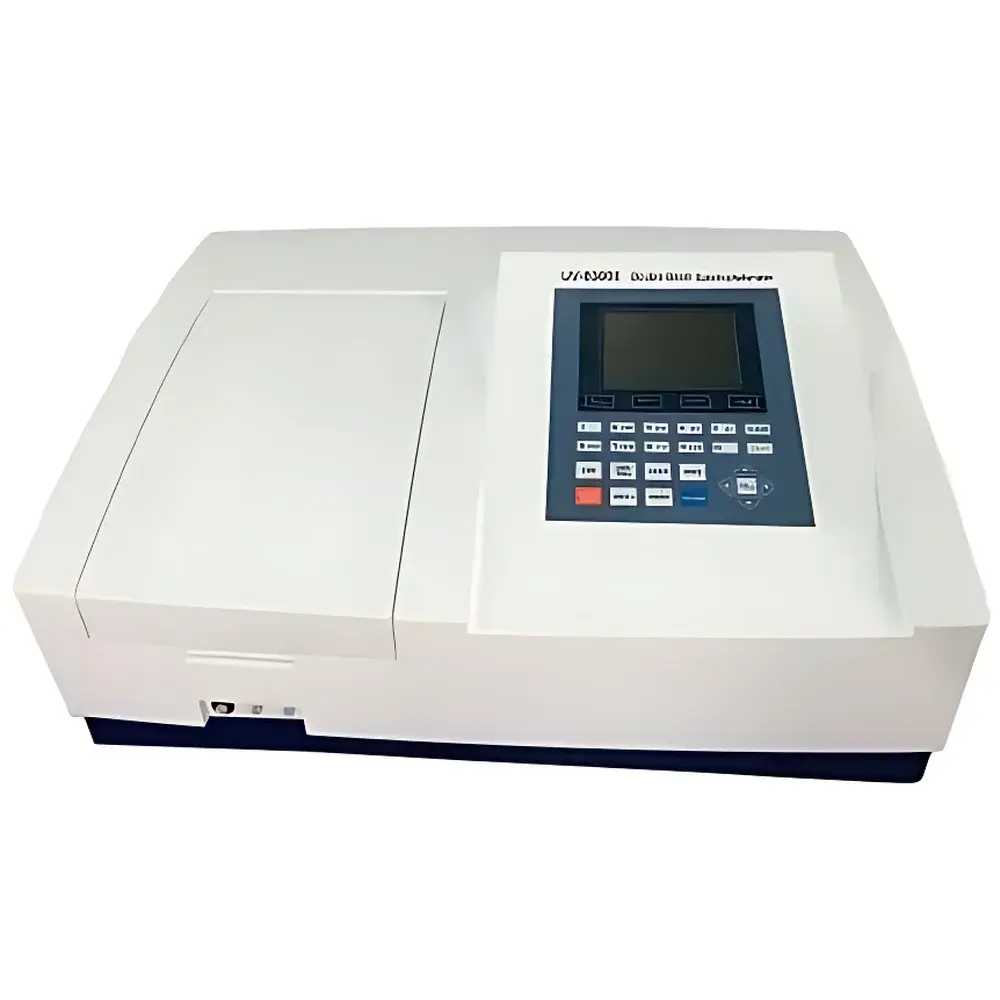
Mapada UV-6300B Dual-Beam Ultraviolet-Visible Spectrophotometer
| Brand | Mapada |
|---|---|
| Model | UV-6300B |
| Optical System | Dual-beam |
| Detector Type | Photodiode Array |
| Wavelength Range | 190–1100 nm |
| Spectral Bandwidth | 1 nm |
| Wavelength Accuracy | ±0.3 nm |
| Wavelength Repeatability | ≤0.1 nm |
| Photometric Accuracy | ±0.2%T (0–100%T), ±0.002 A (0–0.5 A), ±0.004 A (0.5–1 A) |
| Photometric Repeatability | ≤0.15%T (0–100%T), 0.001 A (0–0.5 A), 0.002 A (0.5–1 A) |
| Stray Light | ≤0.03%T at 220 nm and 360 nm |
| Baseline Flatness | ±0.001 A |
| Drift | ±0.0003 A/h at 500 nm |
| Noise | ±0.0003 A |
| Display | 320 × 240 pixel, 5-inch LCD |
| Scan Speed | High/Medium/Low (up to 3800 nm/min) |
| Data Interface | USB port |
| Print Interface | Parallel port |
| Power Supply | AC 220 V/50 Hz or AC 110 V/60 Hz |
| Dimensions | 590 × 420 × 260 mm |
| Weight | 26 kg |
Overview
The Mapada UV-6300B Dual-Beam Ultraviolet-Visible Spectrophotometer is an engineered solution for routine and research-grade quantitative and qualitative analysis across pharmaceutical, environmental, biochemical, and academic laboratories. Based on dual-beam optical architecture, the instrument continuously splits the light path into sample and reference beams—enabling real-time compensation for source intensity fluctuations, solvent absorption, and electronic drift. This design ensures high photometric stability and reproducibility without requiring manual baseline correction between measurements. The system employs a high-efficiency 1200 lines/mm holographic grating and precision-aligned optical train to deliver consistent spectral resolution across its full 190–1100 nm range. Coupled with imported long-life deuterium and tungsten-halogen lamps—and ozone-reducing deuterium lamp housing—the UV-6300B meets operational safety and sustainability expectations in modern analytical workflows.
Key Features
- Dual-beam optical configuration with real-time reference beam monitoring for enhanced photometric accuracy and long-term signal stability
- High-resolution 1200 lines/mm holographic grating ensuring nominal 1 nm spectral bandwidth and minimal peak broadening
- Imported photodiode array detector providing rapid spectral acquisition and low-noise signal transduction (±0.0003 A RMS noise)
- Ozone-minimized deuterium lamp assembly compliant with occupational health guidelines for laboratory environments
- Plug-and-play lamp module design—no optical alignment required after replacement of either deuterium or tungsten lamp
- Large 5-inch monochrome LCD (320 × 240 pixels) supporting direct visualization of absorbance/transmittance spectra, kinetic time courses, and calibration curves
- Integrated GLP self-validation function enabling on-demand verification of wavelength accuracy (±0.3 nm) and photometric linearity per ISO 6581 and ASTM E275
- Three selectable scan speeds (up to 3800 nm/min) optimized for rapid screening or high-resolution spectral profiling
- Robust mechanical construction (26 kg mass, rigid aluminum alloy chassis) minimizing vibration-induced artifacts during extended acquisitions
Sample Compatibility & Compliance
The UV-6300B accommodates standard cuvettes from 5 mm to 100 mm pathlength—including rectangular quartz, fused silica, and UV-grade glass cells—supporting both dilute aqueous solutions and highly absorbing organic solvents. Its wide dynamic range (–4.0 to +4.0 A; 0–200% T) enables precise quantification across concentration extremes without manual range switching. The instrument conforms to core international performance standards including ISO 9001 quality management protocols, and supports audit-ready documentation via timestamped data logging. While not pre-certified for 21 CFR Part 11, its software architecture allows integration with validated third-party LIMS platforms that enforce electronic signature, change control, and audit trail requirements under GxP-regulated environments.
Software & Data Management
The UV-6300B operates natively with Mapada’s professional scanning software (v3.0+), delivered as a Windows-compatible application via USB interface. The software provides full remote instrument control—including wavelength programming, kinetic method setup, multi-point calibration, and derivative spectroscopy. All acquired spectra and measurement logs are stored in vendor-neutral ASCII formats (.csv, .txt), facilitating import into MATLAB, OriginLab, or Python-based chemometric pipelines. Internal memory retains up to 500 spectra and 200 quantitative methods; external storage expansion is supported via USB flash drives. Print output via parallel port delivers publication-ready reports with embedded metadata (date/time, operator ID, lamp hours, calibration status).
Applications
- Pharmaceutical QC: Assay validation of active pharmaceutical ingredients (APIs) per USP and EP 2.2.25
- Environmental testing: Nitrate, phosphate, and COD analysis in wastewater per APHA Standard Methods
- Biochemistry: Protein quantification (Bradford, Lowry, BCA), enzyme kinetics (NADH/NADPH monitoring at 340 nm), and DNA/RNA purity assessment (A260/A280 ratios)
- Materials science: Bandgap estimation of semiconductor nanoparticles via Tauc plot analysis
- Food & beverage: Colorimetric determination of antioxidants (e.g., anthocyanins at 520 nm) and preservative concentrations
- Academic teaching: Hands-on instruction in Beer-Lambert law fundamentals, spectral deconvolution, and multicomponent analysis
FAQ
What is the maximum scan speed of the UV-6300B, and how does it affect spectral resolution?
The instrument supports up to 3800 nm/min in high-speed mode; however, optimal spectral fidelity (especially for narrow absorption features) is achieved at medium or low scan rates, where dwell time per data point increases and signal averaging improves S/N ratio.
Does the UV-6300B support compliance with FDA 21 CFR Part 11?
The base firmware does not include electronic signature, role-based access, or immutable audit trails. However, when integrated with validated enterprise LIMS or ELN systems, full Part 11 compliance can be achieved through external workflow governance.
Can the instrument perform quantitative analysis without PC connectivity?
Yes—standalone operation supports fixed-wavelength absorbance, %T, and concentration measurements using preloaded calibration curves directly on the LCD interface.
How often should wavelength accuracy be verified per GLP best practices?
We recommend quarterly verification using NIST-traceable holmium oxide or didymium filters, especially prior to critical batch release testing or regulatory submissions.
Is the photodiode array detector cooled?
No—the detector operates at ambient temperature. Thermal stabilization is achieved through internal temperature-compensated analog circuitry and dark-current subtraction algorithms embedded in the acquisition firmware.
Related Products




